
ezee.ai partners with the global credit union community as a Platinum Sponsor at WCUC 2026

Read the announcement

Beyond Credit Union Consolidation: A Strategic Roadmap to Independence

No time to read?
Let AI give you a quick summary of this article.

Credit union system is transforming due to the constant pressure of credit union consolidation, escalating technology expenses, and heightened competition by banks and fintech’s. As of Q4 2025, the federally insured credit unions in the United States had reduced to 4,287, compared to 4,455 the previous year, as the assets of the system totaled about 2.43 trillion dollars and the membership had increased to 144.7 million. The volume of mergers is very high: the National Credit Union Administration (NCUA) sanctioned 157 mergers in 2025, which is only slightly lesser than 162 in 2024 and much higher than 145 in 2023. Meanwhile, the typical size of the credit union has grown by approximately 186 percent over the last ten years- between approximately 188.2 million and 538.2 million dollars- indicating a definite move toward fewer and larger institutions and an amplified impact of every wave of credit union consolidation.

Being acquired is no longer the major strategic threat; it is becoming competitively irrelevant in a market where members are increasingly moving toward institutions that integrate digital speed with human trust by developing targeted credit union digital transformation programs. Fintechs and digital-first providers are establishing a standard of real-time decision-making, mobile experiences, and personalized services, and most smaller credit unions cannot afford modernization, handle regulatory burden, and remain at the digital arms race. Mobile and online channels demonstrate a long-term growth in usage, whereas branch traffic tends to level off, which indicates that digital experience has become a core of the member experience, credit union growth strategies, and long-term relevance.

It is against this backdrop that executives have a question that stands out; grow, merge, or modernize. This paper offers a model of how to react to credit union consolidation and competition and remain independent. It draws attention to the difference in high-performing credit unions, why the origin of loans has become a strategic control point of loan origination system modernization, and what capabilities are needed to modernize without damaging the trust of the members or the stability of the operations. The answer is obvious: independence will be more and more guarded not by historical relationships and legacy strength, but the capacity of an institution to implement current, information-driven, data-enabled policies in lending and in member experience.

Credit union consolidation is reshaping the market
Credit union Consolidation is Reshaping the Market

Decrease in the number of institutions.

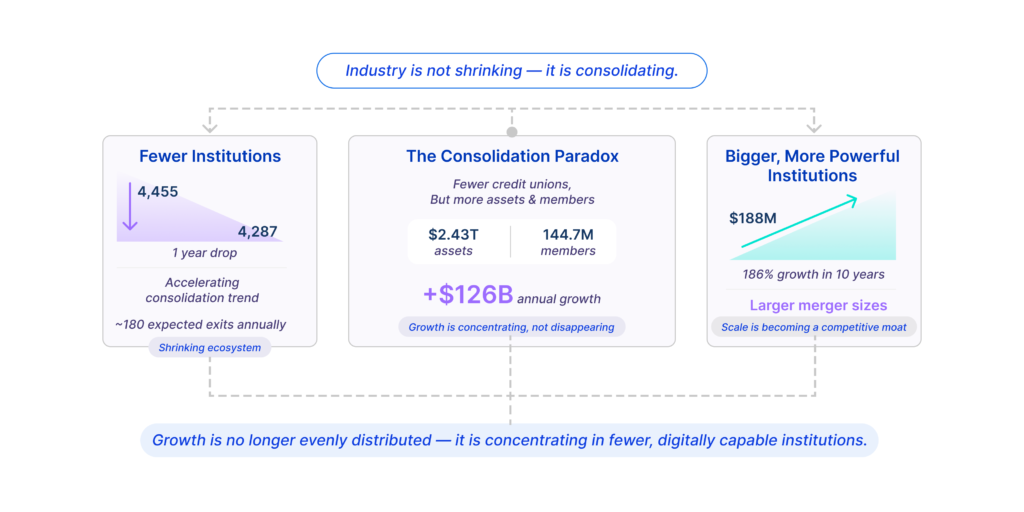
Industry consolidation is not a short‑term anomaly; it is a structural, long‑running trend in credit union consolidation. The federally insured credit union figures given by NCUA system performance show that the total number of federally insured credit unions has decreased by 168 institutions in one year, a drop in the total number of federally insured credit unions to 4,287 in Q4 2025. Earlier trend work includes the TruStage Credit Union Trends Report which forecasted a loss of about 180 credit unions in 2025, one of the quickest rates of credit union consolidation since the post-financial crisis period. The number of total institutions decreased over the last ten years and the total assets and membership increased, but the power was concentrated in fewer institutions that can sustain credit union digital transformation.

Simultaneously, the new NCUA succession planning rule directly aims to address one of the systemic causes of unplanned mergers, by mandating that all federally insured credit unions implement written succession plans to key leadership positions, and aims to mitigate unforced mergers and safeguard the credit union system. This regulation emphasizes that governance, continuity of leadership and strategic planning are now perceived as part of reducing the risks of unregulated credit union consolidation.

Increasing average asset size and scale of mergers.

With the shrinking of the number of institutions, the average credit union is becoming significantly larger. Analysis from CreditUnions.com reports that the average credit union’s asset size increased about 186 percent over ten years from roughly 188.2 million dollars to 538.2 million dollars as cooperatives have pursued the efficiencies and bargaining power that come with scale as part of their credit union growth strategies. Even merger transactions are increasing in scale: the average size of assets in a merger credit union was 66.3 million dollars by mid-2025, 44 percent larger than the previous year, and a large portion of historic mergers involved less than 20 million dollars in assets.

The data on NCUA mergers has revealed that in 2025 the regulator has approved 157 mergers as compared to 162 in 2024 and 145 in 2023, which seems to indicate that the exact number of mergers is changing year to year, yet the pressure on credit unions consolidation is high. Analysis of Third quarter 2025 shows that despite a relatively steady number of mergers, the combined assets of merging credit unions went up sharply to 34 billion dollars in that quarter alone, compared with 5.6 billion in Q2 and 2.4 billion in Q1, and due to a number of very large mergers-of-equals. This alters the calculus of credit union growth strategies to many executives: size can no longer be discussed in terms of scale in the context of asset size, but also in the context of operating model sophistication.

Market reshaping and bank acquisitions.

There is also a growing trend of credit union acquiring banks, and it represents a wider redefinition of the community financial services, beyond the classic credit union consolidation. Some of the credit union-bank acquisitions deals occurred in 2025 and the total assets of banks acquired by credit unions in Q3 alone totalled about 1.9 billion dollars. Although such deals are not consistently as numerous as in other years, their existence supports the idea that the consolidation narrative is not only intra-sector, but also cross-sector restructuring between tax-exempt cooperatives and tax-paying banks and increases the pressure to continue credit union growth strategies in local markets.

Consolidation with continued growth

The system overall is expanding even after consolidation. According to NCUA data, total assets in federally insured credit unions have grown by approximately 126 billion dollars (5.4 percent) during the year ending in Q4 2025 and reached 2.43 trillion dollars; the 2025 net income grew to 18.8 billion dollars, an increase of 31.5 percent compared to 2024. Membership also increased, 2.4 million new members were added within the year and total members topped approximately 144.7 million. The paradox of fewer institutions and more assets and members highlights the main problem of credit union consolidation: growth is being concentrated around a few credit unions that are able to maintain scale, execution capacity, and significant credit union digital transformation.

The real threat is not just mergers; it is competitive irrelevance

Competition by fintech and big banks redefining the bar.

There has been a consistent increase in what consumers expect of financial institutions, particularly in the areas of speed, convenience, personalization, and the current outcomes of credit union digital transformation results by both fintechs and large banks. The industry commentary on 2026 focuses on the fact that alternative and fintech lenders are more and more using artificial intelligence, alternative data, and AI-driven risk analytics to deliver faster, more flexible offers, which is effectively compelling credit unions to partner, develop similar capabilities, or risk being disintermediated. Competition in the fintech sector has pushed credit unions into the digital arms race in which stagnant or disjointed technology adoption and efforts to loan origination system mordernization directly lead to a loss of relevancy.

Thought leadership targeting credit unions in 2026 states that credit unions have been asked by members to provide features like mobile account opening, instant payments, AI-driven insights, and frictionless digital lending, benchmarking their credit union experience against national banks and major fintech apps instead of local ones. The pressure of increased per-unit technology expenses, regulatory burden, and internal technology staffing shortages are felt most by smaller institutions which is creating a digital divide between large, well-resourced credit unions and small cooperatives which have not yet fully adopted credit union digital transformation.

Change in behavior by the members and moving to digital channels.

The patterns of engagement among the members support this competitive change. Consumer channel usage analysis indicates that the mobile and online banking channels have had a significantly greater growth in the last few years compared to the branches or ATM. The review of the access trends says that the mobile banking usage also increased by approximately 15 percent within a period of four years whereas online banking increased 9 percent and branch growth was merely about 2 percent during the same period. Further survey research of the wider banking industry reveals that Americans are now doing transactions through mobile applications more frequently than any other process indicating that mobile is no longer a second-order but is the primary point of interaction and that credit union digital transformation has become a daily driver of interactions.

In the case of credit unions, this implies that to credit unions the front door of the institution is increasingly being represented by digital interfaces, either in the form of mobile applications or web portals and embedded experiences. When the experiences are slow, discontinuous or uneven, members tend to migrate share of wallet to competing providers capable of satisfying their expectations of immediacy and ease of use which negatively impacts long-term credit union growth strategies.

Digital transformation as non-negotiable strategic priority.

Credit union-focused industry analyses emphasize that credit union digital transformation is no longer a strategic priority, but an obligatory project. A review of 2026 suggests that it is time to stop going digital, and this is the mission of digital certainty, which is speed and smartness of fintech and trust and safety that members are used to. According to the same source, digitally mature institutions tend to gain up to twice the revenue growth per year as their less tech-savvy counterparts, and that budgets on digital transformation have grown significantly, with an annual growth of about 220,000 dollars per billion of assets in 2021, and 780,000 dollars per billion of assets in 2023.

Simultaneously, technology-trend reports 2026 note that data is no longer a back-office by-product, but the lifeblood of growth with generative AI already implemented by approximately half of banks and almost 60 percent of credit unions in certain surveys. To support this, modern platforms increasingly adopt an API-first architecture and plan for phased core banking migration, allowing credit unions to orchestrate data, integrate new capabilities, and preserve co-operative values even as they modernize. With AI and data-driven capabilities becoming the new standard, the institutions that will not be able to integrate and manage the data properly will be left behind, despite their traditional relationships with its members.

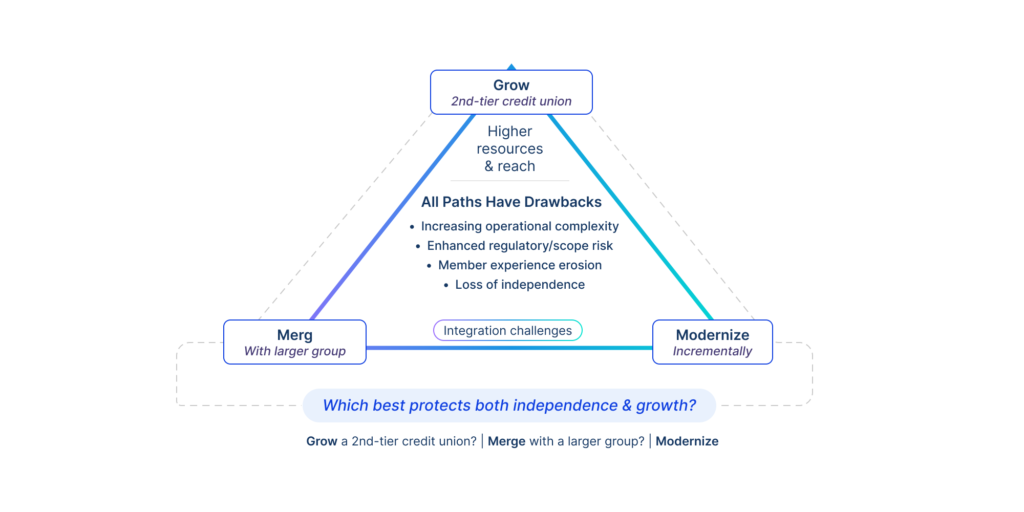
The actual executive dilemma: grow, merge or modernize?

Wait and see strategy limitations.

With such dynamics of credit union consolidation, there is a trend of boards and executive teams ceasing to adopt passive strategies. The speed at which institutions are wilting, alongside the growing average institutional size and the growing pace of digital demands, makes a wait and see strategy riskier. Such predictions as those made by the TruStage Credit Union Trends Report, that predicts a faster loss of approximately 180 credit unions in 2025, are reminiscent of the trends that occurred following the global financial crisis, in which there was a momentary reduction in mergers, followed by a number of years of increased consolidation.

What it means is that waiting until the market conditions stabilize is hardly likely to bring back the previous landscape. Rather, credit unions have to take the initiative to choose whether they wish to expand, find merger partners as a defensive strategy, or modernize aggressively in order to stay independently competitive and open new avenues of credit union growth strategies. This requirement of active leadership decisions is further supported by the NCUA succession planning rule, which requires boards to record how key positions will be occupied in the long term, making the governance specifically linked to the long-term viability of the institution.

Trade-offs between the three directions.

trade-offs between the three directions grow, merg, modrenize, in credit union consolidation

There are different trade-offs associated with every strategic direction:

  • Grow: Organic and inorganic growth means capital and advanced risk management, as well as scalability in operations. This avenue is feasible to most mid-sized and larger credit unions, provided with vigorous modernization of technology- especially lending and member interaction- and well-defined credit union growth strategies.
  • Merge: In smaller or financially restricted institutions, mergers may provide an opportunity to access bigger balance sheets, more products, and common technology platforms. Nevertheless, technology complexity, cultural and governance issues, and local loss of identity can also be compounded when technology integration is not managed properly, when it is introduced through a merger.
  • Modernize independently: Modernization will demand substantial investment, but enable credit unions to keep brand, governance, and ownership of members and modernize capabilities to compete in terms of speed and experience. Technology-trend analyses emphasize that collaboration, shared services, and strategic partnerships have the potential to reduce the cost and risk of modernization to smaller institutions.

To a lot of boards, the most attractive route is a blend; modernize the core competency to be competitive and selective, yet remain available to selective partnership or merging in the future on good terms.

Re-conceptualizing modernization as a strategic, but not technical choice.

More importantly, modernization must be viewed as a key strategic choice, but not as a sequence of detached IT projects. Credit union priority reports on credit union investments in AI-based lending platforms, data orchestration, and digital experience are currently being budgeted as critical facilitators of long-term sustainability, and no longer as incremental feature upgrades. With that said, the fundamental executive query is as follows:

How do we modernize this institution to maintain independence and generate sustainable growth, considering its size, market, and member base, as well as, its exposure to continued credit union consolidation?

Scale is no longer just about size.

Scale between operational and balance sheet.

Historically, scale within credit unions was frequently equated with size of balance sheet (greater volume of assets in order to do better in terms of asset diversification, absorption of fixed costs, and pricing power). The present circumstances, however, indicate that size of a balance sheet is not a sufficient condition to be competitive. Despite the dramatic increase in the average assets, large institutions continue to experience slow product launches, sluggish lending processes, and fragmented experiences of members across channels because of legacy systems and data silos.

Thought leadership regarding 2026 trends emphasizes that the more appropriate concept is operational scale- the capability to serve more members, process more loans and handle more complexity without proportionally raising headcount or friction. Workflow automation, data integration, configurable systems, loan origination system modernization, and AI-enhanced decisioning drive operational scale, rather than merely asset growth. To most institutions, this necessitates re-platforming some important elements based on an API-first architecture and anticipating a gradual core banking migration instead of making a high-risk, single-time replacement.

Integration risk of mergers.

The 2025 merger analysis shows that bigger mergers have a way of increasing the complexities of operations as well. In only the third quarter of 2025, the number of mergers increased slightly compared with the previous quarters, yet the assets involved in mergers increased dramatically, mainly through mergers of equals between multi-billion dollar institutions. In these dealings, there is a tendency to inherit several core systems, conflicting loan origination platforms, and overlapping vendor relations by the merged entity.

Unless the merged institution rationalizes this technology stack, it can end up with more scale on paper but less agility in practice. The integration risk may take the form of more time to develop products, inconsistency of member experiences and higher operational risk that erode the purported advantages of scaling up via credit union consolidation.

Speed, agility, and member experience as the new scale metrics

According to the modern analyses of financial-institution performance, speed to market, responsiveness in modifying policies and products, and member experience indicators (e.g., digital adoption and satisfaction) gain more and more popularity. The attainment of these results in the case of credit unions relies on the adaptability of under-lying systems and data designs, as well as on rigorous credit union growth strategies that focus on modernizing where it counts the most.

Institutions that are scaled operationally are able to respond to economic changes promptly by adjusting credit policies, roll out new lending products across channels within weeks of development without months of tailoring, and use data to make fine-tuning pricing and risk decisions. Here, the smaller yet technologically advanced credit union, with the help of specific loan origination system modernization and intelligent credit union digital transformation, will be able to compete with larger organizations that are still limited by the old infrastructure.

What high‑performing credit unions are doing differently

High-Performing Credit Unions Trade Secrets

Laying bets on digital transformation.

Successful credit unions are more likely to think of credit union digital transformation as an enterprise-wide initiative with a specific set of goals and objectives as opposed to a set of haphazard purchases. Digital maturity analyses reveal that those institutions that strategize and implement consistent digital strategies, including the experience of members, back-office automation, and data capabilities, can attain significantly greater revenue growth than those that treat technology modernization as an opportunity.

These institutions frequently allocate budgets to digital transformation on an ongoing basis, some surveys show that a solid majority of those who are described as digital leaders, are planning to increase such amounts of budgets until 2026, which represents the realization that technology is core to growth, not merely efficiency. They also prioritize change management, talent, so that the new capabilities are actually embraced by employees and incorporated into daily operations as holistic credit union growth strategies.

Developing data and AI governance.

The other differentiating feature of the leading institutions is their attitude to data and AI. Technology-trend projections in 2026 point out that data has become the basis of predictive, prescriptive, and defensive AI applications in banking, such as credit decisioning, fraud detection, and personalized offers. According to surveys, about 50 percent of banks and almost 60 percent of credit unions are already implementing generative AI and other technology, which are no longer pilot projects but operational systems.

Excellent credit unions deploy data orchestration and quality-management approaches that unify information across various systems, allowing AI and analytics to process trusted and controlled information. They additionally invest in model governance, fair-lending controls and transparent communication to make sure that AI-enhanced decisioning promotes inclusion and regulatory compliance and does not undermine co-operative values.

Working together and exploiting common services.

In the case of smaller credit unions, it is not feasible to match the investments of large counterparts in technology on a stand-alone basis. The 2026 problems analyses highlight the idea that 2026 institutions are placing greater reliance on collaboration/credit union service organization (CUSO) and shared services to gain access to modern platforms and expertise. With the combined demand, they will be able to negotiate improved terms with vendors, share special resources like cybersecurity or high-level analytics teams, and reduce the time to deploy new solutions.

High-performing credit unions, in most instances, also want to partner with fintechs and develop co-branded or white-labeled offerings that enable them to provide competitive digital experiences without developing everything in-house. The similarity is that they are strategic in their partnerships and align them with the clear member-value propositions and clearly defined credit union growth strategies.

Loan origination has been turned into a control point.

Borrowing as the power and significance of growth.

Lending is the main source of revenue to most credit unions and also one of the most direct forms of member value where it is applied in auto loans, mortgages, small business financing, and personal credit. With the acceleration in fintech lenders and digital-first banks competing on speed and convenience, the quality of the lending experience at a credit union has shifted out of the back-office worry to the front-line competitive advantage, making loan origination system modernization is a strategic imperative rather than a technical upgrade.

Accordingly, the lending expectations of members have changed. Trends in loan-origination are analyzed with the focus that the members have come to require immediate or close to immediate responses, flawless online applications, and cross-channel responsiveness. When one of the members can have a decision within minutes with a fintech application and it still takes days in case of a manual check by a credit union, then the traditional trust advantage of the cooperative might not be as strong as to keep the relationship, whether it is with its co-operative values or not.

Growth engines: loan origination systems.

Loan origination systems (LOS) are increasingly characterized in the literature of modern industry as engines of growth rather than operational vehicles. Articles about 2026 highlight that LOS platforms have ceased to reside in the back office and have become key to creating growth, enhance efficiency and providing the digital experience members require. State-of-the-art LOS solutions can automate document accepted, orchestrate workflows, and combine information across various sources, cycle times and manual workload are reduced by means of automated underwriting, among other functions.

According to market surveys, the worldwide LOS market is estimated to reach 10 billion dollars in the next five years, considering the magnitude of institutional investment in this space and the idea that sophisticated lending technology and renewal of loan origination system modernization are no longer a niche but a mainstream expectation. Those credit unions that have not yet modernized their LOS are at a risk of competing with obsolete tools in a market where other rivals are starting to leverage AI-enabled platforms as a strategic resource.

Smart decision-making and integrative lending.

One of the distinguishing factors of contemporary LOS platforms is that the modern platforms are capable of supporting intelligent decisioning. Conventional underwriting usually uses a small number of credit characteristics and simple application information, creating extensive review areas of applications that must be manually reviewed and may slow down the decision making process. The current AI-driven engines are capable of processing wider data sets, like alternative and behavioral data, to further segment risk and discover creditworthy borrowers who would be missed otherwise.

This change is enabled by automated underwriting processes and embedded AI-driven risk analytics, which can both increase the lending to underserved groups and sustain or even enhance risk performance, so long as proper governance and fairness controls are established. In the case of credit unions, which, traditionally, focus on financial inclusion, these capabilities can be aligned with mission and competitiveness: they will allow them to make decisions faster and more regularly, which will allow building stronger relationships with members and promote credit union growth strategies.

Modernization without disruption: a smarter path forward

Credit union consolidation - Modernization without disrupting legacy core

Evading big-bang core replacement.

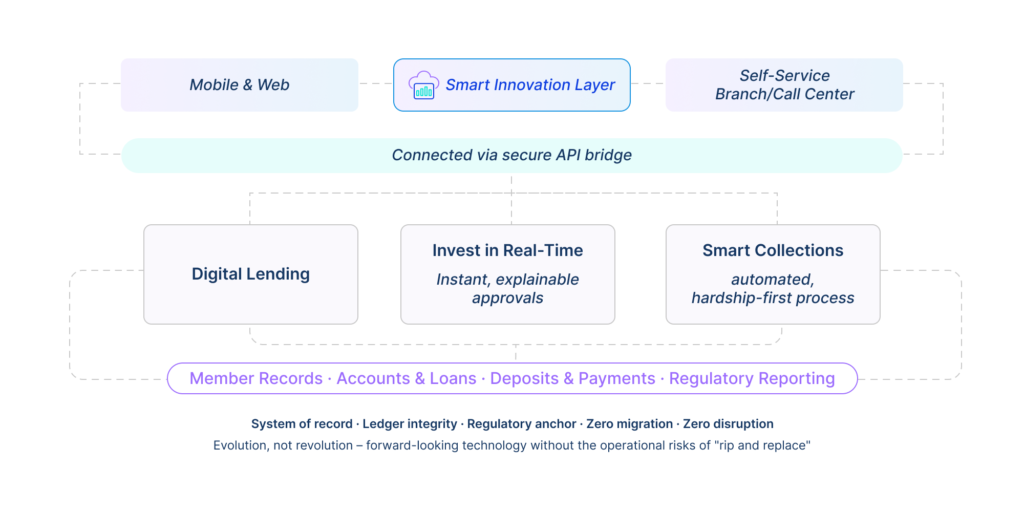
The belief that modernization entails disruptive, multi-year core replacement efforts is one of the factors that are causing some institutions to delay modernization. Credit union thought leadership cautions against this premise, noting that although it may ultimately be necessary to replace cores which are critically old-fashioned, many organizations can realise substantial benefits through focused modernization of the systems around it, especially via focused loan origination system modernization in lending, digital channels, and data integration.

Incremental modernization plans are aimed at creating an adaptive middle layer of APIs, integration centers, and customizable platforms that can communicate with the current cores and provide the opportunity to develop products more agilely and create digital experiences. This design capitalises on an API-first architecture and a scheduled core banking migration to lessen the risk of execution, enable staged value delivery, and maintain member trust by reducing service downtimes.

Focusing on high-impact areas including lending.

With limited budgets and capacity to change, executives are making more and more choices on areas where modernization can give them both quick wins and strategic benefit in the long term. Loan origination and loan origination are frequently on the top of this list as it influences the revenue, the experience of the members, and risk at the same time. Manual work reduction, decision-time reduction, and increased data capture by focusing on loan origination system modernization and workflows associated with it can help credit unions grow and become competitive.

These returns can in turn fund additional modernization investment which is a virtue cycle and not a single capital drain. Loan origination system modernization is frequently used in most transformation roadmaps as the demonstration of how credit union digital transformation is producing real value, not merely technology.

Handling transition and protecting trust of the members.

The modernization efforts should be followed by change management. Trust, local presence, and personal service have been the cornerstones of credit union brand equity; impersonal or bewildering changes in technology can destroy the edge. The best-practice guidance focuses on the aspect of effective communication with members, employee training, and gradual implementation that enable problems to be identified prior to the large-scale deployment.

Simultaneously, the institutions should uphold high standards of cybersecurity and data-protection since any incident or high-profile failure would disproportionately harm member trust and increase perceived regulatory burden. The smaller credit unions can reduce this risk by using vendor services, shared services, and external experience instead of trying to develop and establish everything on their own.

The capabilities credit unions need next.

The capabilities needed for credit union consolidation

Intelligent lending and decisioning.

In the next three-five years, AI-powered lending and decisioning will probably become a table stake of competitive credit unions. Technology-budget advice to 2026 It is suggested that credit unions set aside a significant portion of their technology budgets, typically ranging from 15 to 20 percent, to AI-powered lending solutions that have the potential to analyze alternative data, cut days to minutes to approve, and identify qualified borrowers with greater precision. These solutions tend to be a combination of automated underwriting, intelligent workflow routing, and embedded analytics as part of broader loan origination system modernization efforts.

These capabilities do not only enable quicker growth but may also enhance risk management, with models being fine-tuned to identify the imminent signs of stress and be proactive in modifying credit policies. Nonetheless, these advantages can only be enabled when institutions invest in quality data and model governance as well as open communications to the members to ensure trust and adherence to regulation.

Configurable, low‑code/no‑code workflows

The other essential ability is the speed of changing processes without necessarily developing them extensively. Modern LOS platform analyses note the importance of configuration instead of bespoke customization: systems enabling business users to modify workflows, rules and user interfaces using low-code or no-code tools can react faster to new regulations, competitive actions, or member demands.

This flexibility will lower reliance on limited technical resources and minimize the time interval between idea and implementation. It also facilitates experimentation, which allows credit unions to test new products or processes with a small amount of risk prior to scaling successful innovations as part of disciplined credit union growth strategies.

Analytics and orchestration of data.

Another underlying capability is data orchestration, which refers to the capability to collect data across various systems, clean it and make it accessible to analytics and AI. In commentary on technology-trend in 2026 to credit unions, it emphasizes the significance of permissioned data orchestration that is capable of stitching member data together with robust privacy control.

Those institutions that build strong data pipelines and analytics can understand member behavior better, as well as customize offers and track performance across products and segments. They are also in a better place to meet the changing regulatory requirements in the areas of fair lending, model risk management, and consumer protection as they can more readily produce the necessary evidence and reporting with AI-driven risk analytics tools and regulated data.

Digital experiences and embedded finance in the present day.

Lastly, competitive credit unions will be required to provide the experience of digital that would feel modern, cohesive, and more integrated into the overall financial life of members. Mobile-banking studies indicate that branch visits are still prevalent however, there has been a much greater movement towards mobile and online application and younger consumers in particular have a higher likelihood of using digital channels to a high degree.

Practically, this entails a smooth process of opening a digital account, a user-friendly mobile and web interface, cross-selling in context, and embedding into third-party ecosystems, including digital wallets or merchant platforms. Those institutions that are able to integrate lending and daily banking into such experiences and maintain co-operative values will be in a better place to attract and retain members.

How to scale without giving up independence

Reworking independence in a scaled world.

Dependency on credit union has long been associated with the local control, member ownership, and community orientation. With the credit union consolidation field and growing technology needs in the market, independence is becoming more and more dependent on whether one can provide competitive services without becoming a part of a bigger entity.

This does not imply working alone. Independence can be combined with in-depth cooperation in the form of CUSOs, joint venture, and vendor alliance, as long as the credit union is strategically in charge in terms of its member value propositions and governance. In this regard, the modernization, particularly, focused on loan origination system modernization as the part of a bigger picture of credit union digital transformation, becomes an effort to gain independence by making the institution capable of satisfying the expectations and regulatory requirements of scale.

Scaling independently framework.

The following can be part of an action plan that will allow scaling without losing independence:

  • Clarify strategic positioning: State the member segments, products and communities in which the credit union wants to be the leader, not trying to match everything that the bigger competitors have.
  • Lend modernization: Early modernization initiatives should center around loan origination and analytics, as they have a direct effect on growth, risk, and member experience.
  • Share infrastructure: Individually, use CUSOs, shared services, and prudently chosen fintech alliances to gain access to capabilities that would be prohibitively expensive to develop on your own.
  • Data and AI governance: Making data a strategic asset and establish governance structures that facilitate responsible and explainable AI-based lending and member interaction.
  • Invest in people and culture: Invest in the skills and mindset of the staff to work in a more digital, data-driven world, retaining the culture of service of the credit union and its co-operative values but changing the way that service is provided.

These combined can enable a credit union to increase its effective scale that is to serve more members of higher quality and less marginal cost, without losing its independent character in the face of further credit union consolidation.

The executive checklist: the questions that leaders need to ask today.

The executive checklist to accelerate credit union innovation

A set of structured questions in strategy, operations, technology, and risk will enable the executives to translate these themes into the boardroom discussion.

Strategy and positioning in the market.

  • Which are the areas of the product and member segments that the credit union plan to dominate within the next three to five years, and how this is in line with the trends of credit union consolidation in its area?
  • Does the existing growth trend, in terms of assets, loans, and membership, have enough to keep it relevant in the market with an average increase in institutions size?
  • In what circumstances would the leadership proactively pursue a merger or acquisition, and what is the influence of modernization on that space?

Member experience and involvement.

  • Does the institution have a better digital experience (mobile, web, embedded) relative to those in the top quartile, and not just local competitors?
  • What proportion of member interaction is done digitally and how is that trending among younger generations?
  • Do lending processes (applying to being funded) go as quick and smooth as the members can get elsewhere or are delays and paperwork making people turn away?

Lending and LOS capabilities.

  • What is the average time it takes to go through application to decision on major loan products and what does this compare to the fintech performance?
  • How automatized or manual are underwriting decisions and does the credit union have a plan to achieve automated underwriting and AI-sensitive decisioning that is both faster, more inclusive, and risk-controlled?
  • Is the current LOS flexible enough to support new products, channels, and partnerships without extensive custom development, or is a more comprehensive loan origination system modernization strategy required?

Technology, information, and coalition.

  • What share of the technology budget is spent on modernization projects that directly enhance the experience of members and lending performance, as compared to support of old systems?
  • Does the institution have a coherent data strategy, such as data orchestration, quality management, and analytics capabilities that facilitate AI use cases and AI-driven risk analytics?
  • Do we have a chance to use CUSOs, fintech relationships, or shared services to speed up modernization without compromising cost and risk management?

Risk, culture, and governance.

  • Does the board manage the risk of technology and AI, and do they get frequent reports on the progress and results of digital transformation, including the compliance with the NCUA succession planning rule?
  • Does the organization at all levels prepare and motivate employees to use new tools and workflows or does it have high levels of resistance that may hamper modernization attempts?
  • How is the trust of its members being preserved through technology changes, such as communication, data protection, service continuity?

How the victors will appear in three years time.

Digitally confident, operationally lean institutions.

It is expected that during the next three years, the winning credit unions will be the ones that integrate digital confidence with operational discipline. They will have automated the most important processes, including loan origination, merged the most important systems via APIs and data platforms, and implemented AI responsibly into decisioning and member interaction. Most of them will consider continuous credit union digital transformation and loan origination system modernization as strategic drivers and not one-off initiatives.

These institutions will be operationally capable of executing greater volumes of transactions and product sets with less headcount proportionate increases due to automation, configurable workflows, and intelligent credit union growth strategies. This will help it to have improved cost-to-income ratios and become more resilient in the event of economic instability.

Member-based, data-driven growth models.

Future-oriented credit unions will take the next step of making their own member-focused by using data to know what people need, how to customize products, and provide guidance when it is most needed. Having a strong data orchestration and analytics, they will be able to create more customized services, anticipatory risk management, and more well-rounded financial-wellness offerings, distinguishing themselves among the purely transactional providers.

These institutions will not consider digital channels as tools of efficiency, but as core relationship-building spaces, and they will build education, community programs, and advisory relationships into mobile and online experiences, without forgetting about co-operative values.

Critical application of size and partnership.

Scale will be strategically used by winning credit unions, whether by organic growth, mergers, or joint arrangements. Others will grow to be large regional or national with huge assets and technology platforms, others will be small to mid-sized yet highly focused, leveraging shared infrastructure and relationships to compete with much larger institutions.

Similar to these models will be a capability to act swiftly, create new products and alliances effectively, and uphold robust administration over more intricate technology settings, despite the ongoing credit union consolidation.

The path forward: choice is no longer merge or wait; it is merge or modernize.

The credit union industry is no longer at the inflection point. It is already in one. The process of credit union consolidation is shrinking the number of institutions and scale, capital strength and modern operating capability are becoming concentrated in the hands of credit unions that are progressing quicker than others. Simultaneously, digital-first experiences are resetting the expectations of the members, and mobile, online, and AI-enabled experiences are becoming the norm instead of a nice-to-have addition.

This changes the leadership mandate. Whether pressure is mounting is not the question. The question is whether a credit union is ready to act fast and clearly enough to be competitive. Waiting is not a strategy anymore. Stagnation is now synonymous with lagging behind those institutions already modernizing lending, decisioning, and member experience to claim growth and secure relevance.

That is why the actual strategic decision is neither merge nor wait. It is amalgamate or innovate. Merger will be the result to some institutions. However, in case of credit unions which are willing to remain independent, modernization is the only option which is plausible to remaining independent with a strong force. Not incremental digitization. Another layer of disconnected tools. Actual credit union digital transformation and focused loan origination system modernization that enhance the speed of operations, make it easier to execute, enhance the member experience, and provide leadership greater control over growth.

This is precisely what ezee.ai can bring, enabling credit unions to update the systems that are the most important to them, loan origination, decisioning, workflow automation, and operational execution without taking them through a slow, disruptive change process. It provides executives with a means of scaling performance without scaling complexity, accelerating without compromising governance, and competing more successfully without losing the identity and co-operative values that distinguish credit unions.

The new generation will no longer be dominated by credit unions that sit back and wait to see the sun shine. It will be driven by the ones that modernize purposely, act swiftly, and adopt services such as ezee.ai to transform independence into a sustainable competitive edge.


Frequently Asked Questions

1. What is credit union consolidation and why is it increasing in 2026?

Credit union consolidation is the reduction of independent credit unions through mergers, driven by scale demands, technology investment pressure, and competitive positioning. The NCUA approved 157 mergers in 2025, with 2026 projected to exceed 200 the highest in a decade as rising tech costs and succession gaps accelerate strategic combinations.

2. Why do some credit unions choose to merge instead of modernize?

Merging feels faster and cheaper than overhauling a decades-old core especially when leadership succession is thin. Yet 71% of recent mergers cited expanded services, not financial distress, as the primary driver, suggesting technology capability gaps not failure are increasingly pushing boards toward consolidation as the default resolution.

3. What is the difference between consolidation and modernization in credit unions?

Consolidation combines two credit unions into one institution to gain scale; modernization upgrades a single credit union’s systems, processes, and digital lending capabilities without changing ownership. One achieves efficiency through structure; the other achieves it through technology while preserving member ownership, community identity, and local governance.

4. How can credit unions stay independent without sacrificing efficiency?

Credit unions preserve independence by automating manual workflows—loan origination, KYC verification, credit bureau pulls, and underwriting replacing headcount-driven operations with scalable technology. McKinsey identifies AI and data analytics as the primary levers, enabling lean teams to process higher loan volumes and respond to member needs at fintech-level speed.

5. What are the biggest risks of delaying digital modernization in a credit union?

Delayed modernization drives member attrition, inflates operational costs, and weakens the independence case. IDC reports legacy technology cost financial institutions $36 billion in 2022, projected to hit $57 billion by 2028, while McKinsey finds operational costs for legacy-core institutions run 10x higher than modern-platform peers.

6. How does a loan origination system support credit union independence?

A loan origination system (LOS) automates application intake, KYC, credit bureau pulls, underwriting decisions, and disbursal so a lean team manages volumes that previously required a larger institution’s headcount. This directly removes the staffing-pressure argument for merging, letting a credit union grow lending capacity without growing overhead.

7. What should a credit union board evaluate before deciding to merge or modernize?

Boards should assess four factors: loan TAT vs. peer benchmarks, cost-per-loan, succession plan depth, and core system upgrade feasibility within a 12-month window. If the pain is operational slow decisioning, manual workflows, compliance gaps modernization typically delivers faster ROI than merger integration timelines. If the pain is structural, the merger logic strengthens.

8. What features should credit unions look for in a loan origination platform built for long-term independence?

Credit unions should look for a platform like ezee.ai that gives them control over underwriting, workflows, and integrations without forcing a core replacement. Key features include configurable rule-engine decisioning, bureau and identity API connectivity, automated KYC, and no-code changes so teams can adapt faster as products and policies continuously evolve

9. What capabilities should credit unions look for in a modernization platform that reduces core disruption?

Credit unions should prioritize a modernization platform like ezee.ai that sits above the core as a flexible lending layer, so origination, decisioning, and servicing improve without destabilizing existing infrastructure. API-led integration, modular deployment, and pre-built connectors help reduce disruption, shorten implementation timelines, and lower change-management risk during modernization programs

10. How can credit unions prepare for the NCUA succession planning rule?

The NCUA succession planning rule (effective January 1, 2026) requires federally insured credit unions to maintain a board-approved written plan covering key positions, reviewed at least every 24 months. Boards should document CEO, CFO, and lending leadership roles, identify internal successors, and align succession timelines with technology modernization roadmaps.

Stay Ahead of Digital Lending Innovation

Real insights, case studies, and best practices from across the lending ecosystem.

Email Opt-in Form

Related Posts

<a href="https://staging.ezee.ai/author/lalitha-a/" target="_self">Lalitha Arugula</a>

Lalitha Arugula

Fintech Content Strategist

Lalitha Arugula is a fintech content strategist with years of experience focused on how financial institutions make technology decisions at scale. She has authored analytically grounded blogs and case studies trusted by C suite and senior banking leadership teams to evaluate digital transformation, risk posture, and operating models. Known for her research depth, she translates AI driven decision engines, underwriting automation, and digital lending platforms into strategic clarity. Lalitha writes to influence long term decision posture, not surface level transformation narratives.

0 Comments

Submit a Comment

Your email address will not be published. Required fields are marked *

Lending Innovation, Explained Simply

Insights from the frontlines of digital lending transformation.

Learn how industry leaders achieved measurable efficiency and customer impact through AI-driven automation.