
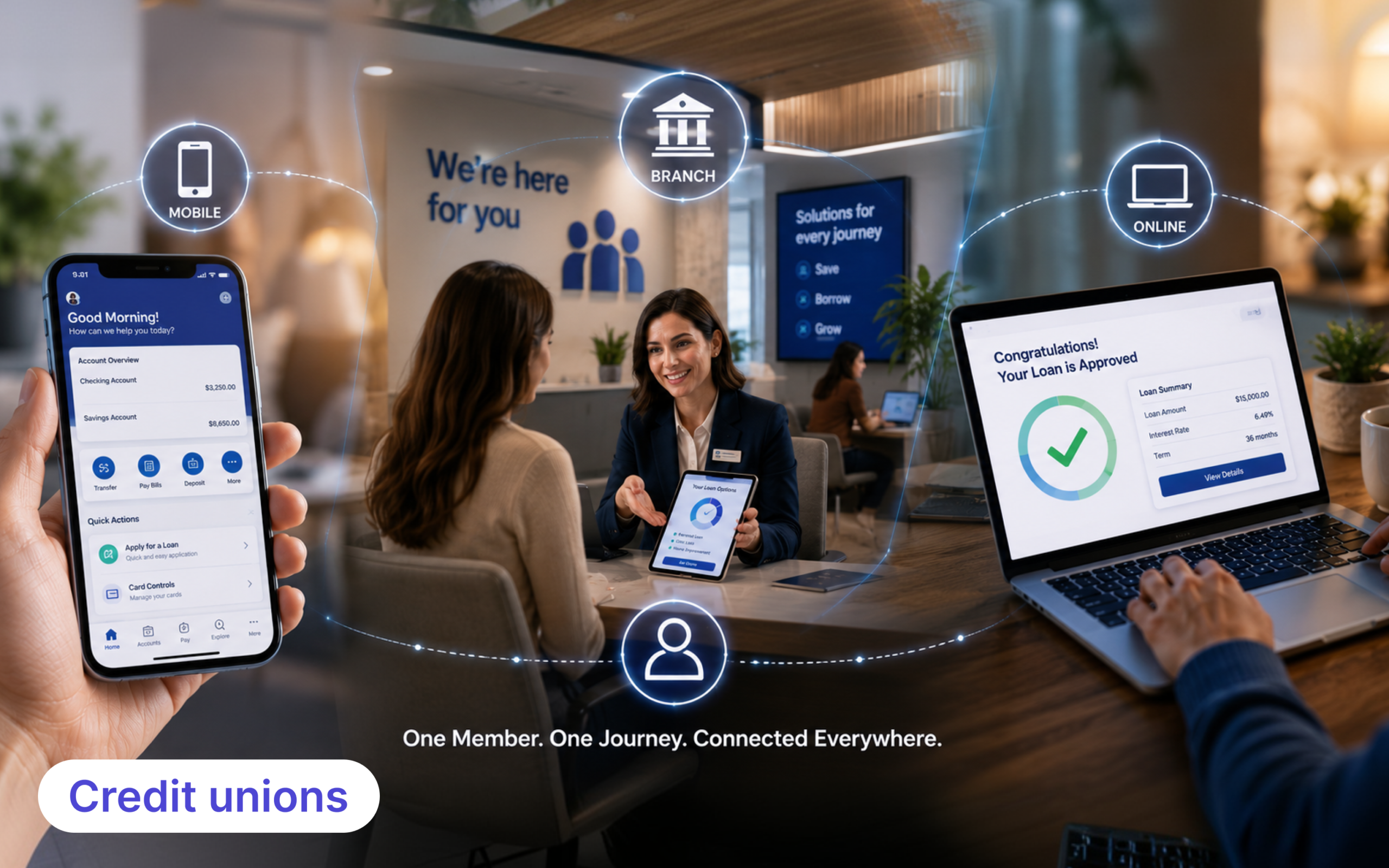
The modern member journey no longer follows a straight line.
A prospective borrower might discover a loan offer through a mobile app during their morning commute, compare options online later that day, visit a branch for advice over the weekend, and expect approval updates through digital channels the following week. To the member, this is a single experience. To many credit unions, however, it remains a collection of disconnected interactions spread across multiple systems and teams.
This growing gap between member expectations and institutional capabilities is reshaping the future of financial services. According to industry research, more than 70% of consumers now use multiple channels during a single banking journey, often switching between mobile apps, websites, branches, contact centers, and digital lending platforms before making a financial decision. As digital expectations continue to be influenced by fintech’s, ecommerce platforms, and consumer technology brands, members increasingly expect the same continuity from their credit union.
This shift has elevated the importance of the omnichannel credit union. What was once considered a digital transformation initiative has become a strategic growth imperative. The institutions best positioned for the future will be those capable of creating a seamless unified member journey across mobile, branch, and lending experiences.
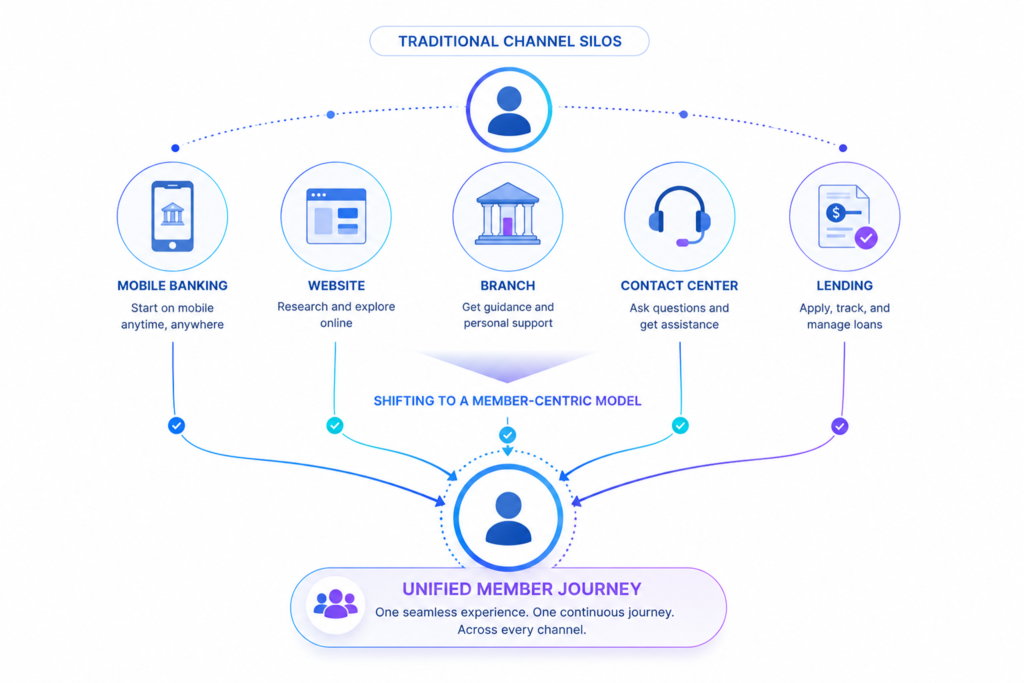
The New Reality: Members No Longer Think in Channels
For decades, financial institutions organised operations around channels. Branches handled service interactions. Contact centers addressed enquiries. Lending teams managed applications. Digital platforms existed as separate service layers.
Members no longer see those distinctions.
Today, members simply want to accomplish their financial goals with as little friction as possible. This aligns with priorities highlighted at the World Credit Union Conference 2024, where digital transformation and member experience modernization emerged as leading strategic themes for credit unions worldwide.
Several factors are driving this shift:
- Mobile banking has become the primary engagement channel for many members.
- Digital experiences across industries have raised expectations for convenience.
- Consumers increasingly expect personalised and contextual interactions.
- Financial decisions often begin digitally but conclude through human conversations.
This is why a mobile-first credit union strategy has become essential. Mobile is no longer just another channel. It is increasingly the starting point of the member relationship. Yet mobile alone cannot deliver a complete experience. The real challenge is connecting every interaction that follows.
The Hidden Cost of Fragmented Member Journeys
Many credit unions have invested heavily in digital capabilities. Mobile applications have improved. Online services have expanded. Self service options continue to grow.
However, members often encounter friction that originates beneath the surface.
Common challenges include:
Repeated Information Requests: Members provide information online only to repeat it during branch visits or lending conversations.
Disconnected Systems: Member records, lending data, servicing information, and workflow activities frequently reside in separate applications.
Limited Visibility: Employees often lack a complete view of previous member interactions.
Process Delays: Manual handoffs between departments create bottlenecks and extend turnaround times.
These issues contribute to what many institutions experience as digital account opening friction. While the interface may appear modern, the underlying process remains fragmented.
The consequences extend beyond member dissatisfaction. Accenture research shows that 73% of consumers expect organizations to understand their unique needs and expectations, making fragmented journeys increasingly incompatible with modern member expectations.
The Three Journeys That Matter Most for Modern Credit Unions
While omnichannel transformation impacts the entire organisation, three member journeys have become particularly important.
Mobile Journey
The mobile experience increasingly serves as the front door to the credit union.
Members expect to:
- Explore products
- Open accounts
- Apply for loans
- Upload documents
- Track application status
The success of any mobile-first credit union strategy depends on the ability to maintain continuity as members move beyond the mobile experience.
Branch Journey
Despite ongoing digital adoption, branches continue to play a critical role.
Members often seek personal guidance when making significant financial decisions. Mortgages, vehicle financing, business loans, and financial planning discussions still benefit from human interaction.
The role of the branch is evolving from transaction processing to relationship building.
Lending Journey
Among all member interactions, lending remains one of the most influential.
Borrowing decisions involve multiple steps, stakeholders, and compliance requirements. Any disconnect within the process becomes highly visible to the member.
This makes the omnichannel lending journey one of the most important indicators of a credit union’s overall maturity.
What True Omnichannel Banking Looks Like in Practice
Many organisations claim to be omnichannel when they are actually operating in a multichannel environment.
The distinction is important.
A multichannel institution offers multiple ways for members to engage. An omnichannel credit union ensures those interactions remain connected.
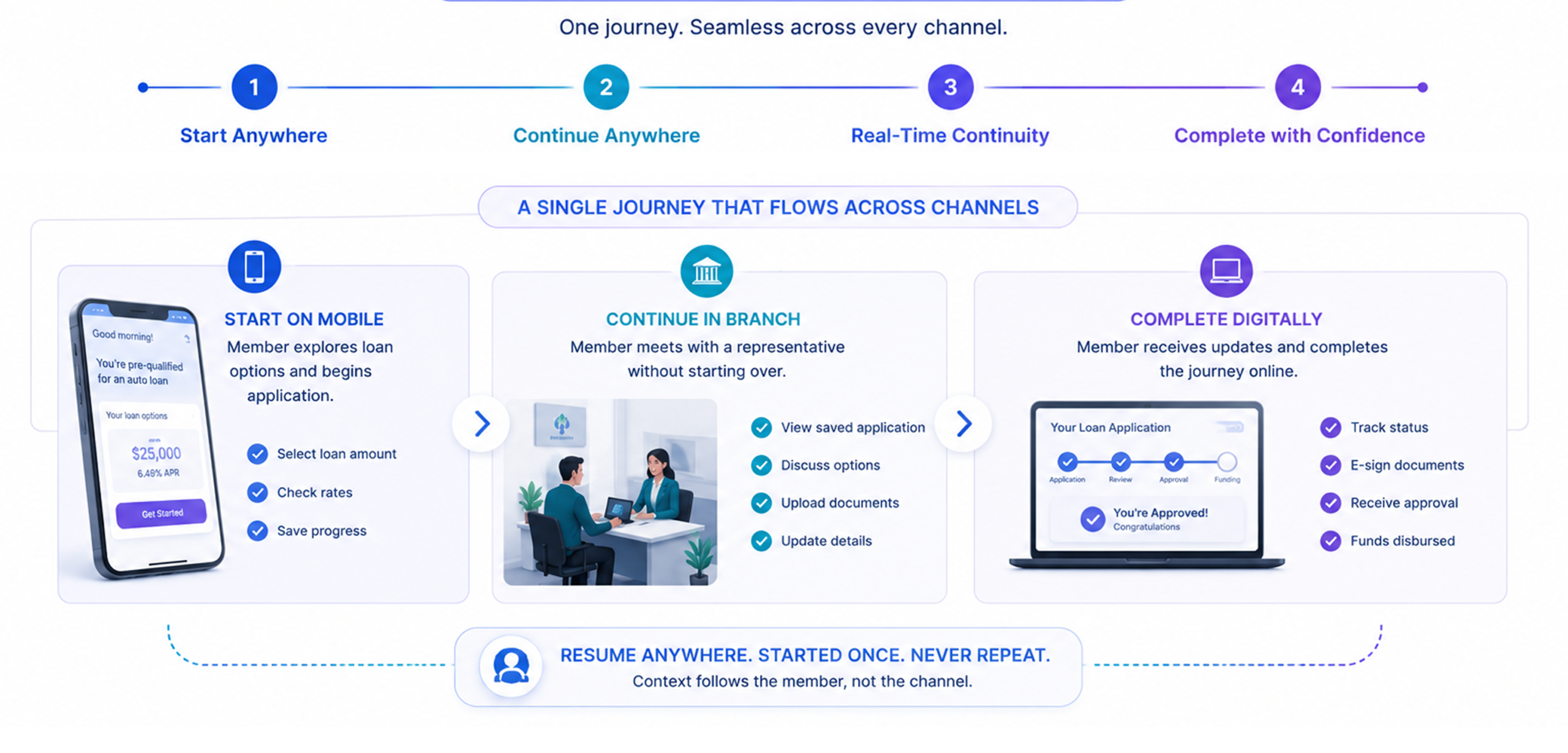
Consider a typical vehicle loan application.
A member receives a personalised offer through mobile banking and begins the application digitally. Supporting documents are uploaded from home. Before submitting the final application, the member schedules a branch appointment to discuss financing options.
In a fragmented environment, the advisor asks the member to restart portions of the process.
In a true omnichannel environment:
- The application is already available.
- Uploaded documents are immediately accessible.
- Previous interactions are visible.
- Conversations continue from where they left off.
- Decisions move forward without duplication.
This creates a genuine unified member journey where the member experiences continuity rather than channel switching.
The difference may appear operational, but from the member’s perspective it fundamentally changes the quality of the relationship.
The Technology Behind Omnichannel Execution
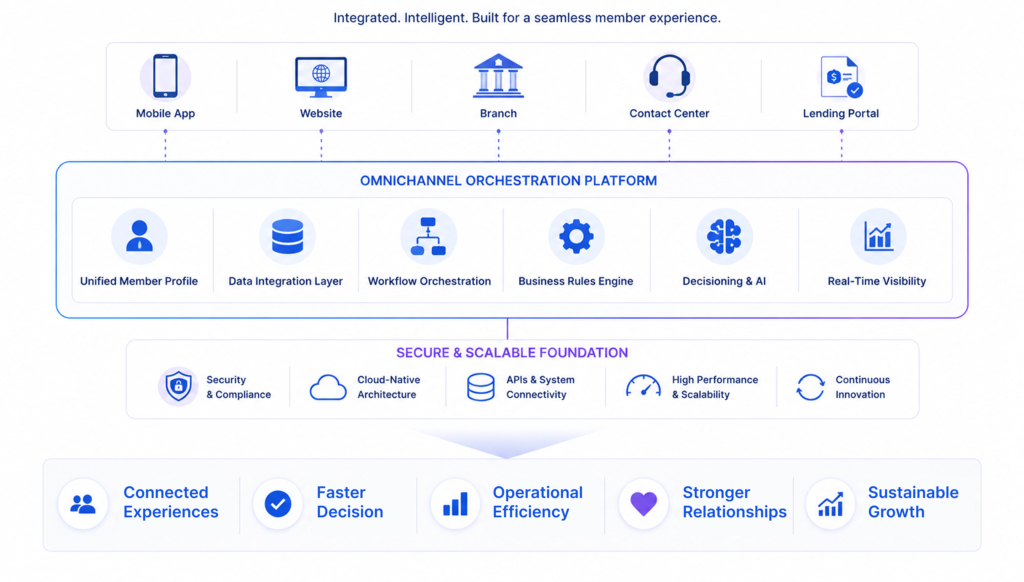
Creating a seamless experience requires more than modern interfaces. It requires a connected operational foundation.
Several capabilities have become essential.
Unified Member Data
Every interaction should contribute to a single view of the member. When data is shared across channels, employees gain complete visibility into member activity, eliminating repetitive information requests and enabling more personalised engagement.
Digital Loan Origination
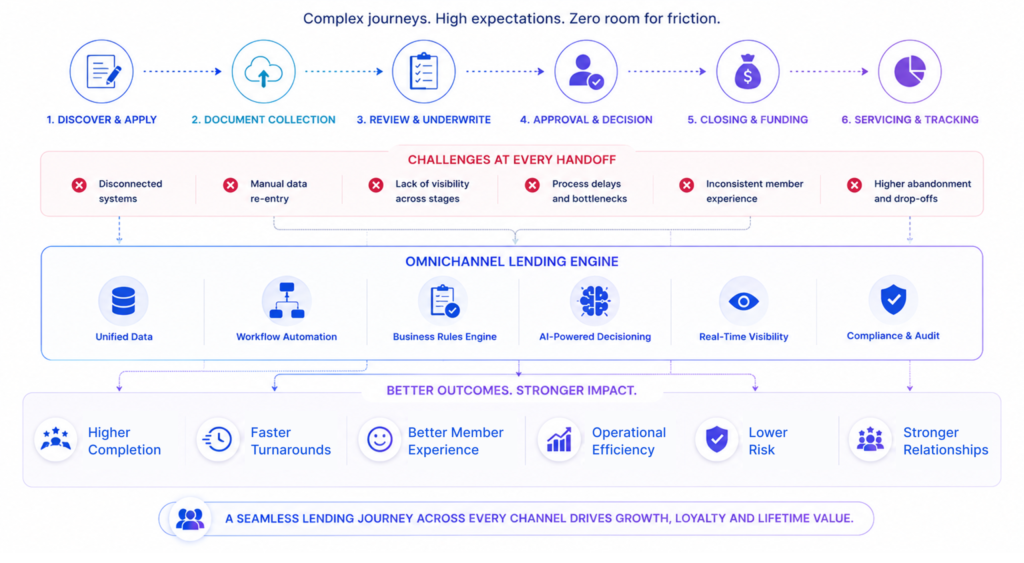
Lending journeys involve multiple stages, from application and document collection to underwriting and approval. A connected loan origination process ensures members can switch channels without restarting applications or repeating steps.
Workflow Orchestration
Many delays occur during internal handoffs. Workflow orchestration automates task routing across teams, helping applications move faster while reducing manual effort and operational bottlenecks.
Intelligent Decisioning
Consistent experiences require consistent decisions. By applying the same business rules and lending policies across channels, credit unions can accelerate approvals, improve compliance, and deliver more predictable outcomes.
Real Time Visibility
Members expect transparency throughout their journey. Real time visibility allows both members and employees to track application progress, outstanding requirements, and next steps without unnecessary follow ups.
Together, these capabilities create the infrastructure necessary to support a true unified member journey.
Why Lending Has Become the Ultimate Omnichannel Test
Many financial processes can tolerate some level of fragmentation.
Lending cannot.
A typical lending journey involves identity verification, document collection, credit evaluation, policy assessment, underwriting, compliance reviews, approvals, and fulfilment. Multiple teams participate throughout the process.
Every handoff introduces risk.
Every disconnected system introduces delay.
Every manual process creates friction.
This complexity is precisely why the omnichannel lending journey has become the ultimate measure of omnichannel maturity.
Credit unions that successfully transform lending often discover improvements across onboarding, servicing, and member engagement as well.
The 2026 Trends Reshaping Omnichannel Credit Unions
Several industry shifts are accelerating the evolution of the omnichannel credit union, pushing institutions to rethink how they engage, lend, and serve members across channels.
AI Guided Experiences
Personalisation is quickly becoming a competitive necessity rather than a differentiator. According to Accenture, 73% of consumers expect organisations to understand their unique needs and expectations. For credit unions, this means moving beyond generic product offers and using AI to deliver more relevant, contextual experiences.
By analysing member behaviour, transaction history, and engagement patterns, AI can help identify borrowing needs, recommend appropriate products, and support more personalised interactions. As member expectations continue to rise, AI guided experiences will play a critical role in creating a more connected and proactive unified member journey.
Embedded Lending
Lending is increasingly moving closer to the point of need. Rather than requiring members to navigate separate application processes, credit unions are embedding lending opportunities directly within digital banking experiences.
Whether it is a pre qualified auto loan offer displayed in a mobile app or a financing option presented during account activity, lending is becoming a natural extension of everyday banking. This shift helps reduce friction, improve engagement, and create a more seamless omnichannel lending journey that aligns with how members already interact with their financial institution.
Real Time Decisioning
Speed has become a defining factor in member experience. Members increasingly expect lending decisions and status updates in minutes rather than days.
To meet these expectations, credit unions are investing in automated decisioning, business rules management, and workflow automation. The goal is not simply faster approvals but greater transparency throughout the process. Members want visibility into application status, outstanding requirements, and next steps at every stage.
As lending competition intensifies, institutions that can deliver consistent, real time decisions across channels will be better positioned to improve satisfaction, reduce abandonment, and strengthen member relationships.
The common thread across these trends is clear: members expect experiences that are faster, more personalised, and seamlessly connected. Meeting those expectations will be central to the success of every omnichannel credit union in the years ahead.
The Future Omnichannel Credit Union Runs on Unified Decisioning
Many credit unions have successfully expanded their channels. Members can engage through mobile apps, websites, branches, and contact centers. Yet delivering a truly connected experience remains challenging when decisions, workflows, and data operate in silos.
The next phase of omnichannel transformation is not about adding more touchpoints. It is about creating a single decisioning foundation that connects every interaction. Whether a member starts a loan application on their phone or completes it in a branch, the experience should remain consistent, transparent, and uninterrupted.
This requires lending policies, business rules, workflows, and member data to work together seamlessly. When they do, credit unions can accelerate approvals, reduce manual effort, and create a more cohesive unified member journey.
To achieve this, many institutions are moving towards integrated platforms that combine onboarding, lending, workflow automation, and decisioning within a single ecosystem. Solutions such as ezee.ai support this approach by bringing together digital account opening, loan origination, workflow orchestration, business rules management, and AI powered decisioning, helping credit unions connect mobile, branch, and lending experiences without disrupting operations.
The future omnichannel credit union will not be defined by the number of channels it offers, but by how effectively those channels work together to deliver faster decisions, consistent experiences, and a truly connected member journey.
Frequently Asked Questions
Omnichannel banking connects mobile, branch, and lending via shared APIs and unified profiles that sync application data, KYC status, and credit responses in real time. A member uploading docs on mobile lets branch officers jump to underwriting using the same files. McKinsey notes nearly 50% onboarding friction cuts from this.
Member journeys break on digital-to-branch switches because siloed systems force re-entry of apps, KYC data, or docs, erasing progress. A borrower starting a loan online repeats identity checks in-branch, spiking frustration. Forrester reports up to 40% onboarding abandonment from these gaps.
Omnichannel delivers consistent service, faster loan decisions, and channel-switching freedom without restarting apps or losing KYC/underwriting data. Members start onboarding mobile and finish in-branch seamlessly across lending stages. McKinsey finds 20–30% higher digital adoption from integration.
“Resume anywhere” syncs application data, KYC checks, and credit pulls across mobile, branch, or call centers, eliminating re-entry. A borrower pausing a personal loan online resumes underwriting in-branch instantly. Accenture shows over 30% higher completion rates with continuity.
Prioritize workflow orchestration, API connectivity to cores, unified profiles, and real-time decisioning for KYC, credit APIs, and underwriting. Platforms must link branch tools without silos for high-volume lending. Gartner notes 30% faster digital rollouts.
Unified platforms use APIs and middleware to link mobile, branch, and lending over existing cores, syncing KYC-to-underwriting flows. Apps trigger shared services for credit calls without core changes. IDC highlights 40% shorter integration timelines.
Design with centralized workflow engines exposing mobile-captured data like KYC and apps to branch interfaces via APIs. Systems run credit checks and rule-based underwriting; staff add docs for STP disbursal. Gartner cites up to 50% TAT improvements.
Legacy silos, mismatched data models, and disconnected lending tools cause duplicate KYC and fragmented views across channels. Mobile apps ignore branch progress, slowing underwriting. McKinsey says nearly 60% cite legacy infrastructure as top barrier.