

Digital ambition is not the problem inside most credit unions.
Execution is.
Across North America and other mature banking markets, institutions have spent years discussing credit union digital transformation. Strategic plans highlight digital onboarding, faster lending, improved member experiences, and modern servicing. Yet despite strong intent, many organisations still struggle to convert those plans into live, measurable outcomes.
The issue is not a shortage of ideas. Recent McKinsey research similarly highlights that competitive advantage increasingly comes from an organization’s ability to operationalize initiatives efficiently rather than from strategic intent alone.
While large banks continue investing heavily in technology, successful digital transformation in credit unions is increasingly determined by execution speed, not spending power. Institutions that can launch, test, and improve digital journeys quickly are gaining an advantage regardless of size.
The Execution Gap in Credit Union Digital Transformation
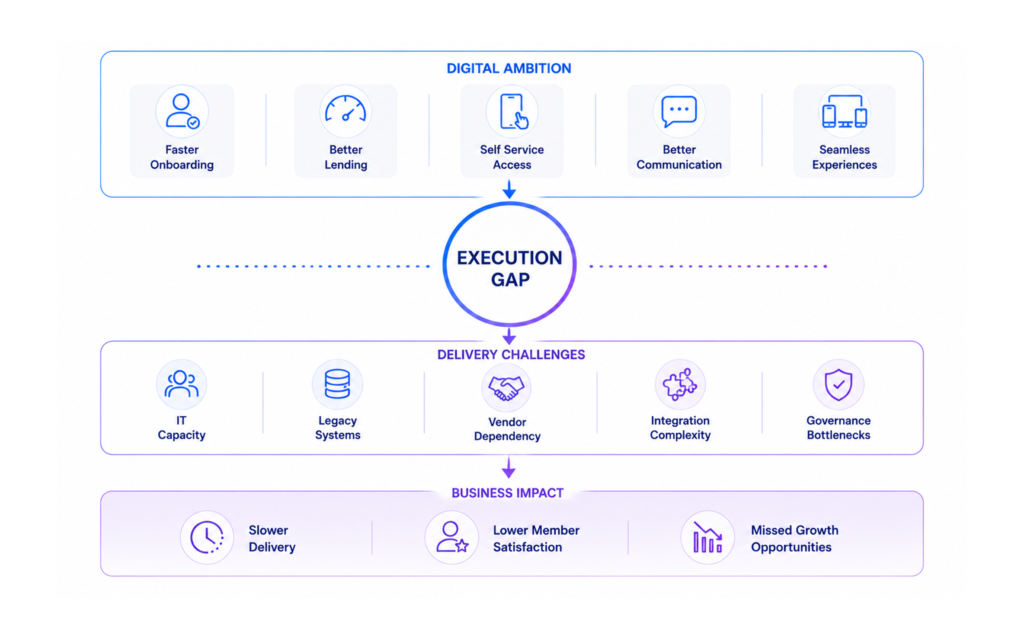
Most credit unions already understand what members want:
- Faster onboarding
- Digital self service
- Quicker lending decisions
- Better communication
- Seamless experiences across channels
The problem emerges after strategy approval.
Roadmaps receive executive support, budgets are allocated, and transformation programmes begin. Then progress slows as projects encounter operational realities.
Common barriers include:
- Limited IT bandwidth
- Legacy systems
- Vendor dependency
- Integration complexity
- Governance bottlenecks
Over time, the gap between ambition and delivery widens.
Members compare their experience against leading digital platforms, not against other local institutions. When expectations rise faster than execution, the consequences appear in acquisition, engagement, and retention metrics.
Why Transformation Efforts Stall
Most challenges associated with digital transformation in credit unions are operational rather than strategic.
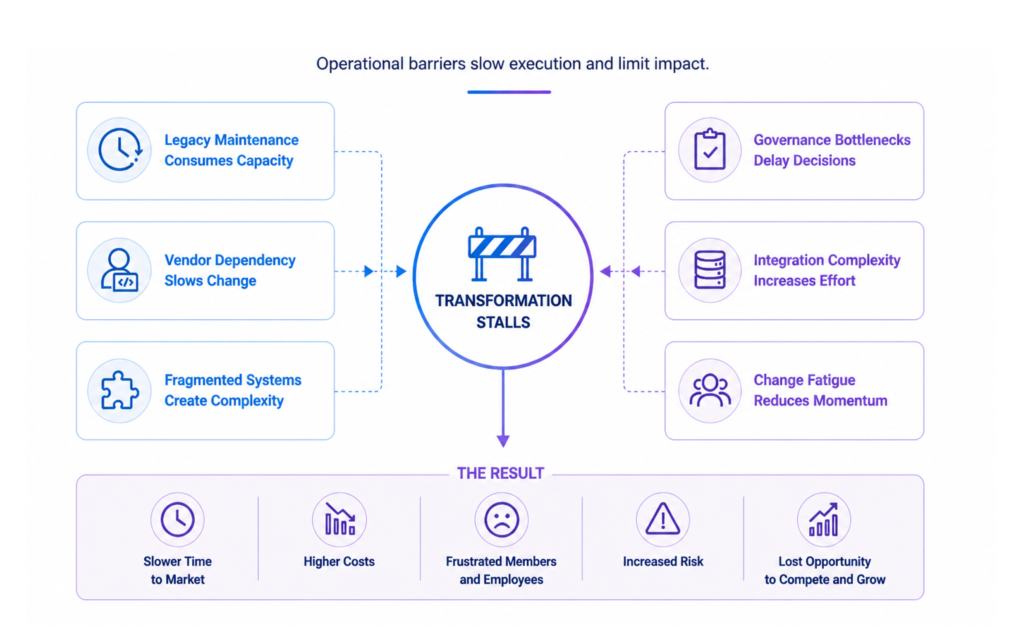
Legacy Maintenance Consumes Capacity
Technology teams spend much of their time maintaining existing environments.
Core systems, compliance updates, integrations, and security requirements consume resources that could otherwise support innovation.
As a result, every new initiative competes with critical operational priorities.
Vendor Dependency Slows Change
Many institutions remain dependent on vendors for even minor modifications.
Simple updates often require:
- Change requests
- Budget approvals
- Development queues
- Lengthy release schedules
This slows responsiveness and reduces organisational agility.
Fragmented Systems Create Complexity
Member journeys rarely exist within a single platform.
Data often sits across:
- Core banking systems
- Loan origination platforms
- CRM environments
- Document management systems
- Third party applications
Without effective orchestration, every improvement requires coordination across multiple technologies and teams.
This complexity remains one of the biggest obstacles to successful credit union digital transformation.
The Myth of the Big Transformation Program
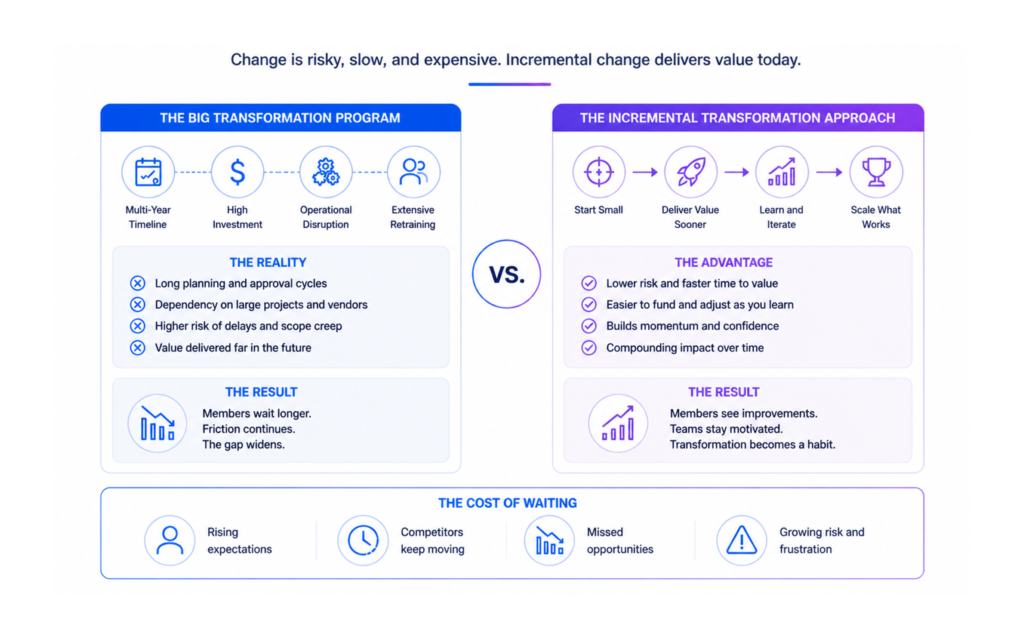
When execution challenges persist, many institutions assume the answer is a large scale transformation initiative.
In reality, this assumption often delays progress.
Why Core Replacement Appears Attractive
Large banks frequently promote modernisation stories built around new platforms and infrastructure.
This creates the impression that meaningful change requires a complete technology overhaul.
However, core replacement programmes often involve:
- Multi year timelines
- Significant investment
- Operational disruption
- Extensive retraining
For many institutions, the risk outweighs the immediate benefits.
The Cost of Waiting
Waiting for a future state architecture often means postponing improvements that could be delivered today.
Meanwhile:
- Members experience ongoing friction.
- Staff continue managing manual processes.
- Competitors keep improving.
The result is a widening gap between expectations and delivery.
Modern digital transformation in credit unions does not need to begin with replacing everything. It can begin by improving what matters most.
One Journey, One Product, One Segment
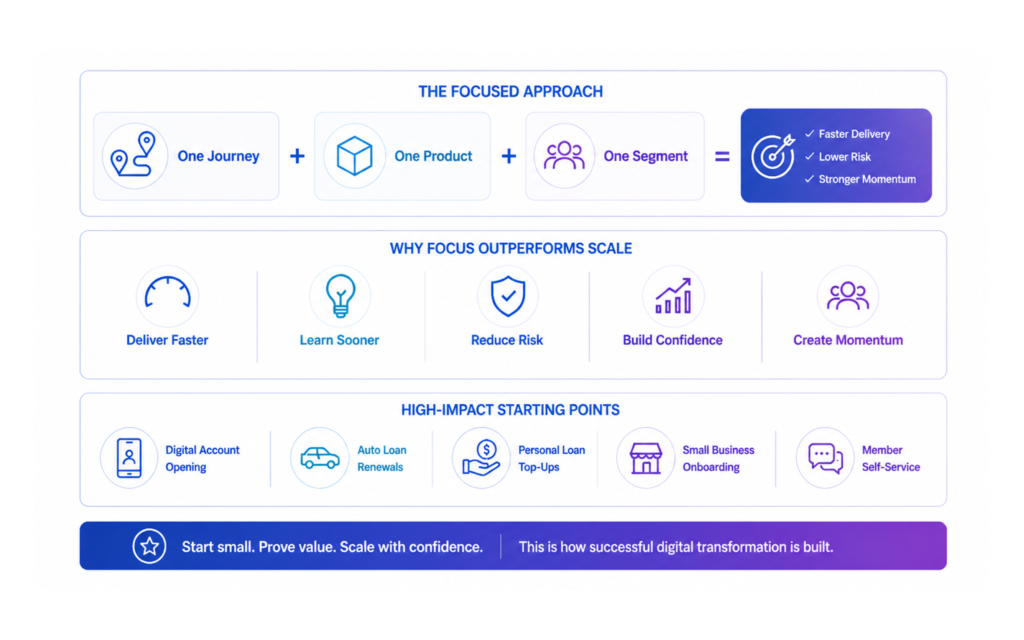
The most effective transformation initiatives share a common characteristic.
They start small.
Not because the vision is small, but because execution becomes manageable.
A focused approach centres on:
- One journey
- One product
- One member segment
This reduces complexity while creating measurable outcomes.
Why Focus Outperforms Scale
Attempting enterprise wide change often creates competing priorities and extended timelines.
By contrast, focused initiatives allow teams to:
- Deliver faster
- Learn sooner
- Reduce risk
- Build confidence
Incremental success creates momentum that larger programmes often struggle to generate.
High Impact Starting Points
Strong candidates include:
- Digital account opening
- Auto loan renewals
- Personal loan top ups
- Small business onboarding
These journeys typically combine high visibility, measurable value, and manageable implementation scope.
Many of the most successful low code digital transformation credit unions initiatives begin with exactly these types of use cases.
The Three Step Execution Model
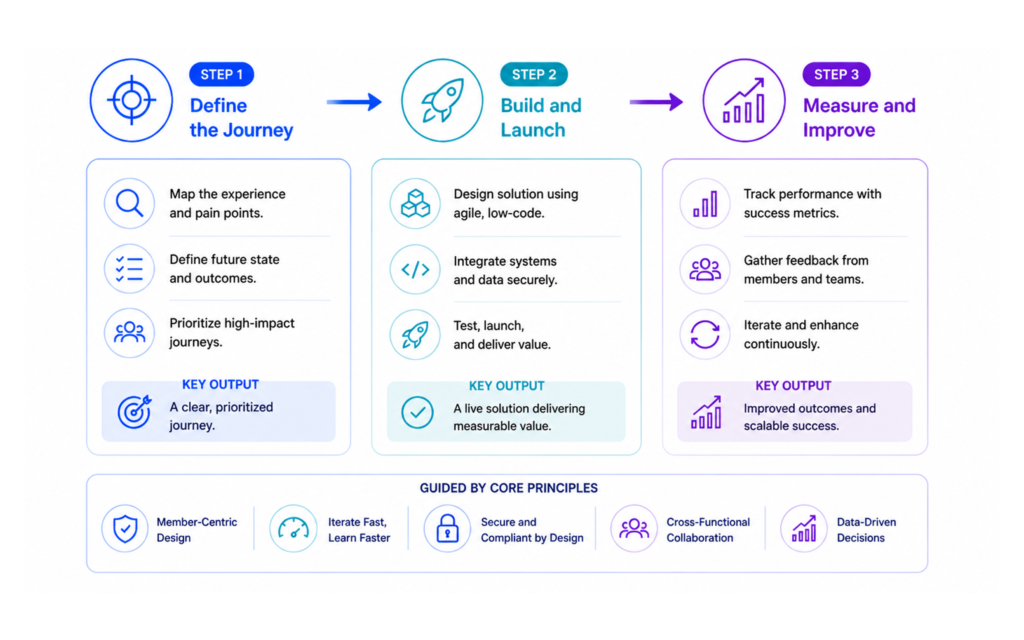
Step 1: Define the Journey
Start by mapping the current experience.
Identify:
- Manual steps
- Approval bottlenecks
- Member drop off points
- Turnaround delays
Then establish clear KPIs before making any changes.
Examples include:
- Application completion rates
- Approval times
- Funding speed
- Cost per application
A clearly defined baseline creates accountability and makes success measurable.
Step 2: Configure Through a No Code Layer
This is where modern credit union digital transformation features create practical value.
Rather than building every workflow through traditional development cycles, institutions can configure journeys through a no code execution layer. The International Finance Corporation’s Digital Lending Handbook similarly identifies workflow automation, digital identity verification, and process integration as key enablers of scalable digital financial services.
This enables teams to:
- Design workflows visually
- Configure business rules
- Manage communications
- Automate routing
Existing systems remain in place while new experiences are built around them.
This approach is increasingly becoming a foundation for low code digital transformation credit unions strategies because it accelerates delivery without increasing technical complexity.
Step 3: Launch as a Controlled Pilot
Successful transformation depends on testing rather than assumptions.
Launch the journey with:
- A defined member segment
- Clear success metrics
- Existing processes running in parallel
Track performance continuously and make adjustments based on real behaviour.
The objective is not perfection.
The objective is creating a repeatable execution model.
Rethinking IT and Vendor Dependency
One of the biggest shifts in modern credit union digital transformation is redefining the role of technology teams.
From Builder to Governor
Traditionally, every digital initiative depended on IT execution.
Today, IT delivers greater value when it focuses on:
- Architecture
- Security
- Integration standards
- Governance
Business teams become owners of the journey while IT maintains control of the platform.
This balance improves speed without sacrificing compliance.
Breaking the Vendor Bottleneck
A no code orchestration approach also reduces dependence on vendor release cycles.
Many changes can be managed internally, including:
- Workflow updates
- Rule modifications
- Routing adjustments
- Communication changes
This improves organisational responsiveness while reducing ongoing customisation costs.
The result is greater agility without replacing the existing core environment.
Building a Culture of Continuous Digital Delivery
Technology is only part of the equation.
Sustainable transformation requires organisational change.
Empowering Business Teams
When product, lending, and operations teams actively participate in designing journeys, accountability improves.
Digital initiatives become business outcomes rather than technology projects.
Shortening Idea to Launch Cycles
Faster execution encourages experimentation.
Teams become more willing to test new ideas because implementation no longer requires months of planning.
This shift from perfection to continuous improvement is essential for long term success.
Strengthening Cross Functional Collaboration
Successful digital journeys require input from:
- Operations
- Lending
- Risk
- Compliance
- IT
- Member experience teams
A shared execution framework improves alignment and reduces rework.
Measuring Success and Scaling What Works
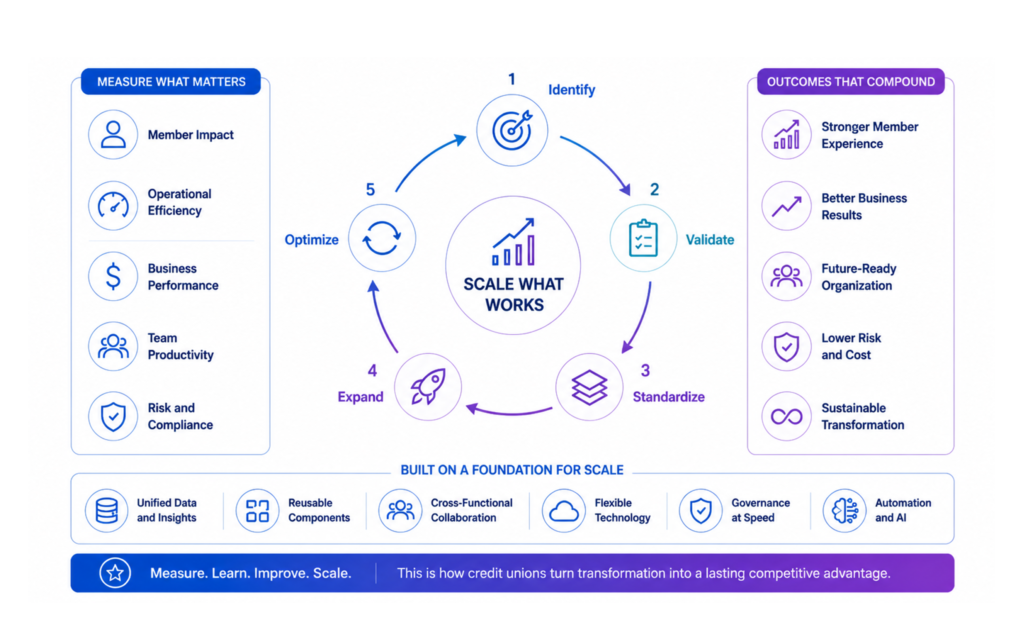
The first 90 days should focus on proving the model rather than transforming the institution.
Key metrics include:
Member Experience Metrics
- Application completion rates
- Abandonment rates
- Time to approval
- Time to funding
Financial Metrics
- Conversion rates
- Loan growth
- Account growth
- Cost per completed journey
Operational Metrics
- Manual touch reductions
- Error rates
- Processing times
- Staff productivity
Once measurable improvements are achieved, the same execution framework can be extended to additional products and journeys.
This creates a scalable model for digital transformation in credit unions.
The Future of Credit Union Digital Transformation
Credit unions will never match the technology budgets of the largest financial institutions.
They do not need to.
Success increasingly depends on how effectively organisations turn strategy into execution.
Institutions that embrace focused delivery models, adopt modern credit union digital transformation features, and leverage low code digital transformation credit unions approaches can compete successfully without undertaking massive transformation programmes.
This is where ezee.ai fits naturally into the modernisation journey.
Rather than forcing institutions into disruptive core replacement projects, ezee.ai enables credit unions to modernise through AI powered automation, workflow orchestration, intelligent decisioning, loan origination, credit decisioning and debt collection capabilities. Business teams can design and launch digital journeys faster while IT retains governance and control.
The future of credit union digital transformation belongs to institutions that stop waiting for perfect conditions and start delivering measurable improvements one journey at a time.
The organisations that master execution will not simply keep pace with change. They will define the next generation of member experiences.
Frequently Asked Questions
A “one journey at a time” approach means modernising a single high impact member journey, such as digital auto loan origination, without attempting full core replacement. It delivers visible results quickly while containing risk. For example, digitising application intake, bureau pull, underwriting rules, and eSign for one product can reduce turnaround time by up to 30 percent per McKinsey, proving value before scaling.
Digital transformation in credit unions typically slows due to core system constraints, limited IT bandwidth, and multi vendor integration complexity. When IT is tied to legacy maintenance, new workflows such as online loan origination or automated KYC checks stall. McKinsey notes that 70 percent of large transformation programs underperform, often due to execution gaps rather than strategy. As one industry study observed, “execution discipline matters more than ambition.”
Large, multi year programs fail because they delay member facing improvements while focusing on infrastructure overhaul. Value is pushed to year two or three, so frontline teams see no early wins. When digital account opening or instant credit decisioning is postponed behind core upgrades, momentum drops. McKinsey reports nearly 70 percent of transformations fall short of expectations, largely due to slow value realisation.
Credit unions should measure first 90 day success through operational metrics such as reduced loan turnaround time, higher straight through processing rates, and lower manual touchpoints. For example, automating bureau pulls and rule based underwriting for personal loans can lift STP by 20 to 40 percent per industry benchmarks. Early movement in TAT and approval consistency signals that execution is working.
If the core is not being rebuilt, IT should act as architecture steward and integration enabler rather than primary developer. Their focus shifts to API governance, security reviews, and data flow integrity across LOS, credit bureau, and KYC systems. Gartner notes that organisations using modular architectures reduce time to market by up to 25 percent, reinforcing IT’s role in orchestration and oversight.
Credit unions can modernise digital journeys by layering orchestration and workflow automation on top of the core through APIs, without altering the ledger. Application capture, credit bureau checks, rule engine underwriting, and eSign can run externally while posting final transactions back to the core. Gartner highlights that composable architectures improve agility by 30 percent, making phased modernisation viable.
Credit unions reduce vendor dependency by separating decision logic and workflows from hard coded vendor systems into configurable layers. For example, underwriting rules, eligibility criteria, and KYC flows can be managed internally instead of embedded in vendor code. Industry research shows organisations adopting modular platforms improve change velocity by over 25 percent per Gartner, lowering long term lock in risk.
Scaling requires shifting from project based teams to a product operating model with shared governance over data, rules, and workflows. Credit, risk, and operations must co own rule engines and decision policies rather than routing every change through IT. McKinsey reports agile product models can improve delivery speed by 30 percent, enabling multiple loan and onboarding journeys to run in parallel.
Credit unions should look for configurable workflows, integrated rule engines, API connectivity to bureaus and KYC systems, full audit trails, and role based access controls. The platform must support straight through processing for loan origination and exceptions for manual underwriting. Gartner notes that organisations using low code automation improve deployment speed by up to 50 percent, supporting faster member journey launches.
A no code orchestration layer enables business teams to configure workflows, eligibility rules, and decision paths without altering core banking logic. For example, launching a new unsecured loan product can involve configuring application forms, CIBIL API checks, risk score thresholds, and disbursal triggers externally. Low code and no code adoption can reduce development time by 40 to 60 percent per industry estimates, accelerating product rollout while preserving core stability.