ezee.ai partners with the global credit union community as a Platinum Sponsor at WCUC 2026

Read the announcement

The Omnichannel Credit Union: Connecting Mobile, Branch, and Lending Journeys

by | Mar 12, 2026 | Credit Unions | 0 comments

No time to read?
Let AI give you a quick summary of this article.

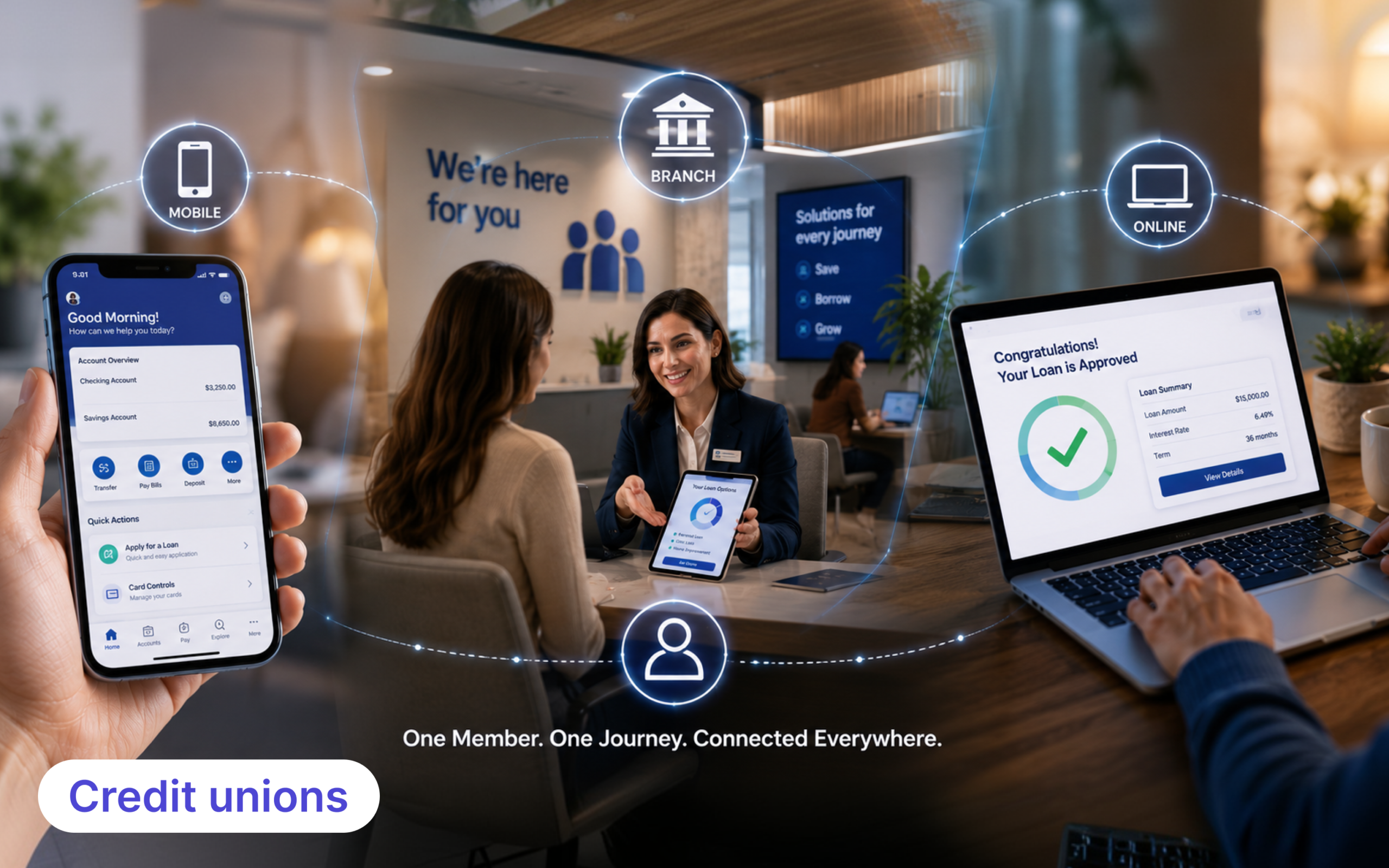
For modern credit unions, omnichannel is no longer about offering multiple access points; it is about orchestrating one coherent experience across mobile, branch, web, and lending so members feel known and supported at every step. As digital interactions become the dominant mode for everyday banking, the differentiator is the ability to connect those interactions with human support in moments that matter, particularly around borrowing and life events.

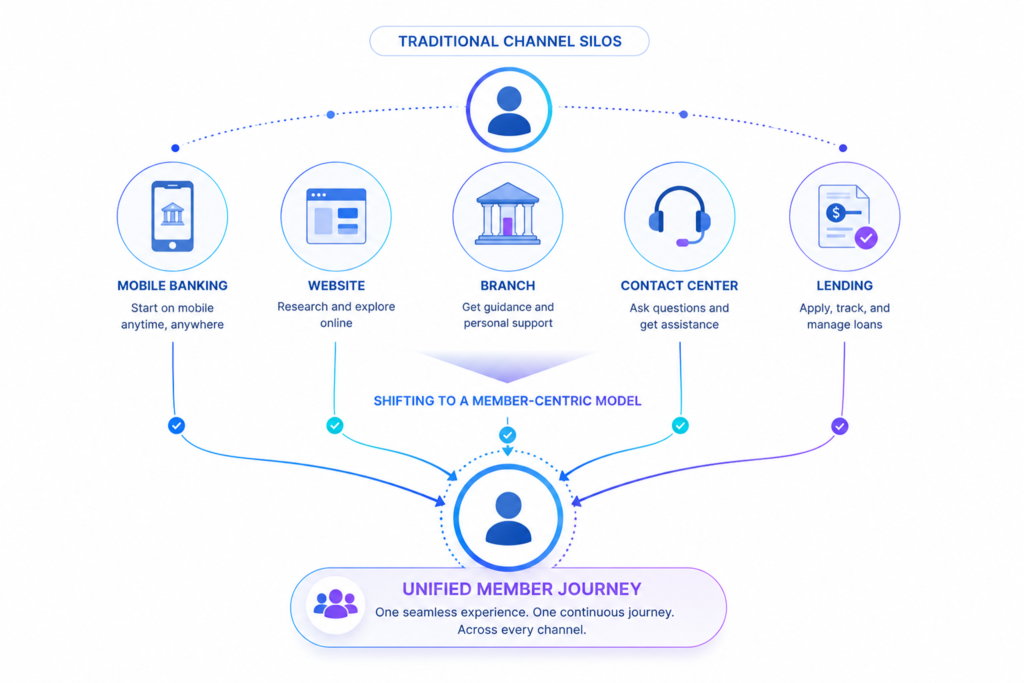
An omnichannel credit union treats channels as delivery mechanisms for a single relationship, not separate silos with their own processes, data, and rules. When a member moves from mobile to branch, or from call center to lending portal, context should follow them, staff should see the same picture, and workflows should adapt without requiring the member to start again.

The Shift Toward Mobile First Banking in Credit Unions

Mobile has shifted from a convenience feature to the primary way members interact with their financial institution across age groups, including older demographics. Surveys show that a large share of consumers log into their mobile banking app or website daily, with digital channels becoming the “front door” to the institution.

For credit unions, this shift creates both an opportunity and an existential challenge: members increasingly judge the institution by the quality of its mobile experience, not by its physical footprint. A mobile-first credit union strategy positions the mobile app as the main orchestrator of everyday money management, service requests, and lending interactions, while ensuring that branch and call center teams are tightly integrated into the same journeys.

Key Digital Trends Credit Union Leaders Must Consider in 2026

Several macro trends in 2026 are reshaping the competitive landscape for credit unions.

  • Younger generations are far more willing to switch providers, with research indicating that around one-third of Gen Z and Millennials expect to change their primary bank within months, often to digital-first platforms.
  • Consumers expect personalized, data-driven experiences, with roughly three-quarters saying they want more personalization and a majority comfortable with their bank using data to improve it.
  • Digital channels have become the dominant interaction point for members under 60, and are now the top strategic priority for many credit union leadership teams.

These shifts demand not just better apps, but a re-architecture of member experiences into unified, end-to-end journeys that can run across products, channels, and lines of business.

The strategic implications of changing member behaviour

Members now behave as “free agents” who can move funds and relationships rapidly using digital wallets, payment apps, and neobanks, reducing the natural inertia that once protected traditional institutions. They compare their credit union experience not only to banks but to technology brands like Amazon or Netflix, expecting instant responses, one-click tasks, and proactive recommendations.

For credit union executives, this means growth strategies must shift from branch-centric acquisition to deepening relationships through digital engagement and advice-led interactions. A robust Mobile-first credit union strategy and a connected, Unified member journey across channels become central to maintaining primary financial institution status and share of wallet.

Mobile expectations among younger member segments

Gen Z and Millennials have grown up with smartphone-native services; they expect real-time notifications, frictionless authentication, and end-to-end digital fulfillment for routine financial tasks. They are also more likely to experiment with fintech apps for payments, budgeting, and investing, fragmenting their financial lives across ecosystems.

For these segments, a credit union that cannot deliver quick account opening, pre-approved offers, and near-instant lending decisions through mobile will struggle to be their first choice. Removing Digital account opening friction and enabling a seamless Omnichannel lending journey are therefore essential for capturing younger members at key life moments, from their first car loan to their first mortgage.

Competitive pressure from digital first financial institutions

Digital-first banks and fintech’s excel at narrow but highly optimized journeys such as buy-now-pay-later, instant savings accounts, or streamlined small-dollar loans and they often set the benchmark for user experience. They leverage agile technology stacks, data science, and design-led processes to reduce both real and perceived friction.

Credit unions retain powerful advantages in trust, mission, and community presence, but those advantages erode if digital experiences feel outdated or fragmented. To compete effectively, an Omnichannel credit union must pair its relational strengths with a technology and process foundation that supports fast, personalized, and transparent experiences at scale.

Why digital maturity is becoming a leadership priority

Surveys of credit union executives show digital experience and channel optimization rising to the top of strategic priority lists, alongside growth and operational efficiency. Leaders increasingly recognize that digital experience is not an IT project but a board-level concern that directly affects growth, cost-to-serve, and risk.

Higher digital maturity enables better data integration, more sophisticated analytics, and automation across origination, servicing, and collections. It also underpins the ability to design a Unified member journey where every interaction digital or human contributes to a coherent picture of the relationship and next best actions.

The Evolving Role of Branches in Modern Credit Unions

Contrary to early predictions, branches have not disappeared in the era of mobile banking. Industry research consistently shows that members still value physical locations for complex decisions, high-value lending, and situations where advice matters more than speed. What has changed is the nature of branch work. Routine transactions such as cash deposits or balance enquiries have largely shifted to digital channels, while in-person visits increasingly focus on life events, problem resolution, and tailored financial guidance.

This rebalancing is good news for credit unions. It reinforces their traditional strengths in relationship-based service while allowing digital channels to handle repetitive, low-value tasks. A mobile-first credit union strategy can therefore position branches as advisory hubs that pick up where mobile leaves off, adding context and empathy to the data gathered online. When the digital record of a loan application, card dispute, or savings goal flows directly into the branch workstation, staff can move immediately to coaching and decision-making instead of reconstructing the story from scratch.

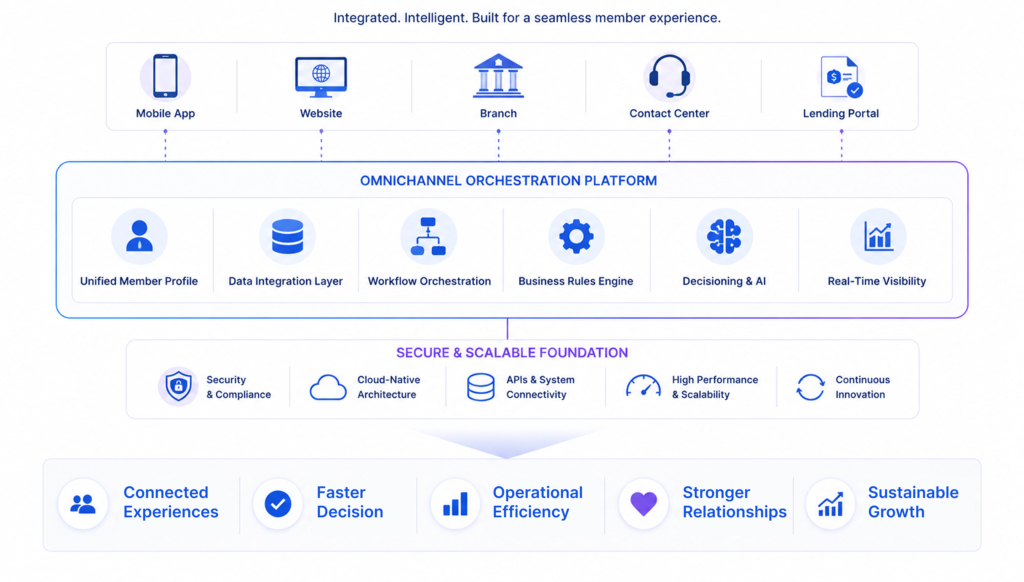
This is where a unified member journey becomes critical. By linking mobile, web, contact centre, and branch tools into a single orchestration layer, credit unions can give branch teams real-time visibility into the history and intent behind each visit, rather than treating every walk-in as a completely new interaction.

Where Member Journeys Break Across Banking Channels

Most member journeys today already cross channels research online, start on mobile, ask questions via chat, finalize in branch or via e-signature but underlying systems and processes were often built channel-by-channel. This creates gaps where context is lost, data is duplicated, and rules differ between front ends.

Typical breakpoints include:

  • Moving from marketing campaigns into account opening or loan origination portals.
  • Switching from self-service to assisted channels like branch or call center.
  • Re-engaging with an in-progress application after a delay or on a new device.

These breaks are where Digital account opening friction and lending abandonment rates escalate.

Understanding the friction caused by disconnected systems

Disconnected core systems, LOS platforms, CRM tools, and digital banking front ends often maintain separate member records, interaction histories, and process rules. When these are not synchronized in real time, staff may lack visibility into activity that started online, and members may receive conflicting instructions or duplicate requests.

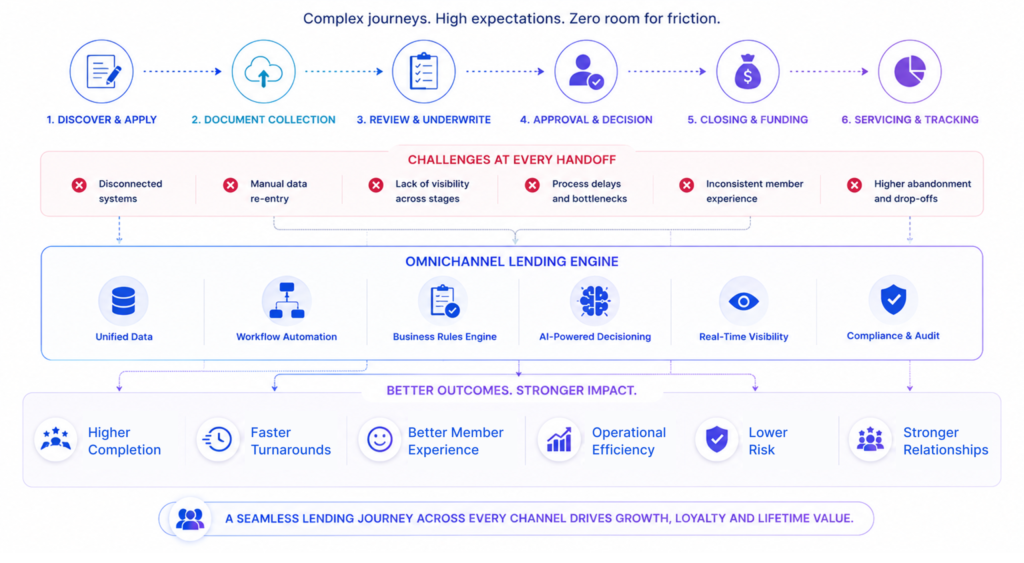
This fragmentation directly undermines the promise of a unified member journey, leading to longer cycle times, higher dropout rates, and operational workarounds. It also makes it harder to design and monitor a consistent omnichannel lending journey that spans pre-qualification, decisioning, documentation, funding, and onboarding.

Starting applications online and restarting in branch

A common pattern is a member who begins an application for a loan or account online, only to be told at some later point to “visit the branch” to continue. Often, the branch systems cannot see partial applications, or the eligibility and documentation rules differ from those applied in the digital channel.

In the worst case, members are required to re-key information, re-submit identity documents, or re-answer KYC questions essentially starting from scratch. This not only increases Digital account opening friction but also sends a signal that the institution is not truly integrated or member-centric in its processes.

Repeating document submission and verification steps

Redundant document collection is another major pain point. Members may upload pay stubs, ID proofs, or business documents on a portal, only to be asked later by branch staff or underwriters to provide the same files again via email or in person.

This usually stems from siloed content repositories, manual handoffs, or lack of workflow integration between digital channels and back-office systems. The result is perceived incompetence, avoidable delays, and frustration that erodes trust, especially among digital-native members accustomed to one-time verification and ongoing reuse of verified data.

The operational impact of channel switching

From an operations perspective, broken journeys and channel switching create significant hidden costs. Staff time is spent on rework, data correction, and member handholding that could have been avoided with better design. Manual reconciliation between systems also increases error rates and compliance risk.

GapConversion LossTAT HitStaff Drag
No mobile sync-15%+3 days40% screen time
Doc re-entry-27% NPSx2Manual typing
Status blackoutsTrust loss+60% callsFirefighting

When members abandon applications halfway due to friction, acquisition costs rise while conversion falls, hitting both sides of the growth equation. In contrast, a streamlined omnichannel lending journey with minimal handoffs, clear status visibility, and consistent rules can improve throughput and reduce cost-to-serve simultaneously.

Operational Challenges Faced by Branch Teams

Members expect one institution and one smooth experience. In reality, branch teams often work across multiple systems, disconnected workflows, and incomplete information, making it difficult to deliver a truly Unified member journey.

Too many systems, too little visibility

A typical branch employee may need to move across several tools just to complete one request, including:

  • Core banking screens for balances and account details
  • CRM systems for member history
  • Loan origination tools for credit products
  • Document and compliance systems for verification
  • Email, spreadsheets, or internal trackers for follow-up

Individually, these systems may work well. Together, they create complexity, slow down service, and make it harder for staff to stay focused on the member conversation.

Manual work creates delays and inconsistency

When systems are not well connected, branch staff often have to re-enter the same information across multiple platforms. This leads to:

  • Longer service times
  • Higher risk of errors
  • Inconsistent processes across employees and branches
  • Greater dependence on workarounds and tribal knowledge

Over time, this weakens service quality and makes even simple requests feel more complicated than they should.

What branch teams actually need

A strong Mobile-first credit union strategy should not only improve digital self-service but also make branch work easier and more connected. To support an Omnichannel credit union, branch teams need:

  • One view of the member and their current journey
  • Clear workflow-driven steps for what happens next
  • Fewer logins and less duplicate data entry
  • Real-time visibility into work started in mobile or web channels

When these foundations are in place, branch teams can spend less time navigating systems and more time advising members, solving problems, and strengthening relationships.

The Need for a Unified View of the Member Journey

Why visibility matters

Members do not think in channels; they think in outcomes. They may start on mobile, ask a question through the contact centre, and walk into a branch expecting the conversation to continue without repetition. When staff cannot see what happened earlier, the experience becomes fragmented and frustrating, which is why a Unified member journey is now essential for an Omnichannel credit union.

What a unified view should enable

A unified view should do more than show account details. It should give branch and service teams real-time visibility into recent digital activity, in-progress applications, uploaded documents, and the next step in the process, so they can respond with context instead of restarting the interaction. This is especially important in onboarding and lending, where disconnected systems increase Digital account opening friction and slow down decisions.

For leadership, the implication is clear: a Mobile-first credit union strategy only works when digital and physical channels share the same context. When that happens, staff spend less time searching across systems and more time guiding members, resolving issues, and moving journeys forward confidently.

Mobile First Banking and Its Impact on Service Delivery

Mobile as the starting point

For many members, mobile is now the primary entry point into the credit union relationship, shaping first impressions, daily engagement, and expectations for speed and convenience. That makes a Mobile-first credit union strategy more than a channel decision; it becomes a service model in which routine actions begin digitally and move to human support only when needed.

How service delivery changes

When mobile works well, it reduces avoidable branch traffic for simple requests and frees staff to focus on higher-value conversations such as lending guidance, problem resolution, and financial advice. It also allows members to begin tasks like onboarding or borrowing on their own time, while giving the institution a chance to continue that interaction across channels as one Unified member journey.

Why continuity matters

The real value of mobile-first banking appears when work started on a phone can continue seamlessly in the branch or contact centre without restarting the process. That continuity reduces Digital account opening friction, lowers abandonment risk, and creates a smoother omnichannel lending journey for members who need both convenience and advice.

Designing Seamless Omnichannel Lending Journeys

omnichannel credit union orchestration layer

A strong Omnichannel lending journey allows members to move between mobile, branch, and assisted channels without losing progress or repeating the same steps. For credit unions, this matters because lending is one of the clearest moments where disconnected systems create friction, delay decisions, and weaken the overall member experience.

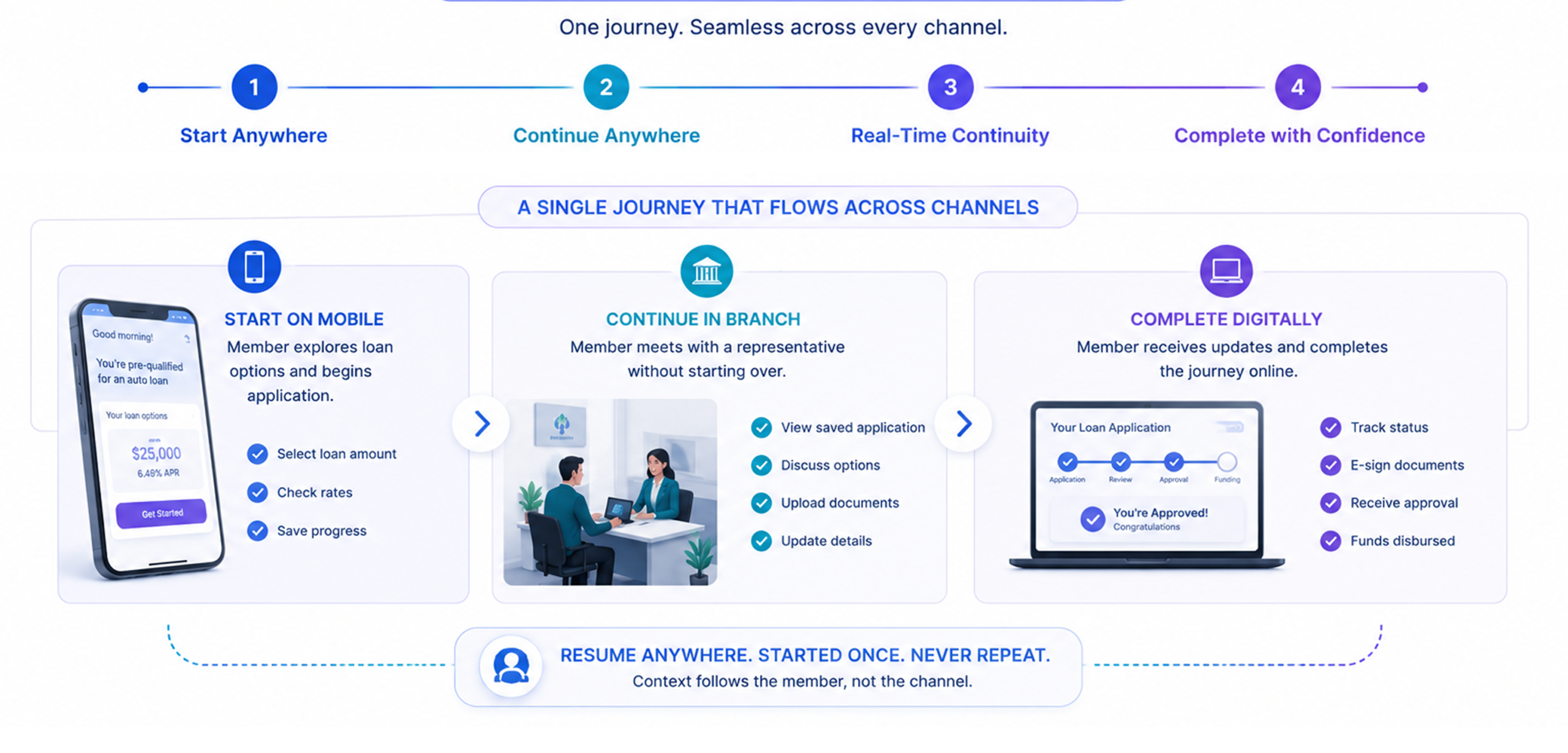
Starting applications on mobile platforms

For many members, mobile is the most convenient place to begin a borrowing journey, whether they are checking rates, comparing products, or starting an application. A Mobile-first credit union strategy should make it easy to capture intent early and save progress so the member can return later or switch channels without starting over.

Continuing processes in branch environments

Branches still play an important role when members need reassurance, explanation, or help with more complex lending decisions. The key is continuity: branch staff should be able to see the application history, documents, and next steps in real time so the interaction feels like part of one Unified member journey, not a restart.

Reducing duplication in lending workflows

The biggest source of frustration is duplication, such as re-entering data, re-uploading documents, or repeating verification steps across channels. Reducing that duplication lowers Digital account opening friction, improves completion rates, and helps staff spend more time advising members instead of managing process gaps

Applying the Resume Anywhere Experience to Banking

Digital leaders in other industries have trained consumers to expect “resume anywhere” capabilities: start a task on one device, continue on another, and finish later without losing context. Applying this paradigm to banking means members can begin a loan application on mobile, continue from a laptop, get help from a contact center, and finalize in a branch without rework.

Delivering this requires journey-aware orchestration that tracks each step, saves partial progress, and exposes it consistently to all channels and staff roles. It is also central to reducing Digital account opening friction and demonstrating that the institution truly operates as an Omnichannel credit union rather than a collection of point solutions.

Technology Barriers to Omnichannel Banking

Delivering a seamless experience across mobile, branch, and lending sounds straightforward in strategy discussions, but it is often much harder in practice because most credit unions are still operating on technology stacks built channel by channel over time. That means the vision of an Omnichannel credit union is often constrained not by intent, but by fragmented systems, siloed data, and rigid process design.

10.1 Channel specific applications and data silos

In many institutions, each channel has evolved with its own applications, workflows, and records. Mobile banking, online account opening, branch systems, contact centre tools, and lending platforms may all hold different pieces of the same member relationship, making it difficult to create a true Unified member journey.

The result is familiar: members repeat information, staff cannot see prior activity, and progress made in one channel does not automatically carry into the next. What appears to the member as one institution is often supported by several disconnected systems behind the scenes.

Limited flexibility in traditional loan origination systems

Traditional loan origination systems were often designed around internal processing efficiency rather than fluid, cross-channel member journeys. They may support application intake and underwriting well, but offer limited flexibility when a member starts on mobile, pauses midway, and later resumes with branch assistance.

This rigidity becomes a major weakness when credit unions try to support a modern omnichannel lending journey. Instead of enabling continuity, older platforms can force handoffs, duplicate data entry, and additional verification steps that increase Digital account opening friction.

Integration challenges across banking platforms

Even when institutions invest in modern front-end experiences, value is lost if those experiences are not deeply integrated with core systems, document platforms, compliance tools, and decisioning engines. Point-to-point integrations may work for a while, but they are often brittle, difficult to scale, and hard to adapt when new products or channels are introduced.

That is why many omnichannel initiatives stall after early wins. The experience may improve at the surface level, but without stronger orchestration underneath, the credit union still struggles to deliver consistent service across every step of the journey.

Workflow Driven Architecture for Mobile First Credit Unions

If legacy systems create the problem, workflow-driven architecture is increasingly becoming the answer. For a Mobile-first credit union strategy to succeed, the institution needs more than attractive digital interfaces; it needs shared processes that connect digital activity, branch actions, and back-office work into one coordinated flow.

Single workflows across digital and branch channels

A workflow-driven model allows the same underlying process to operate across mobile, web, branch, and contact centre touchpoints. Instead of building separate journeys for each channel, credit unions can manage one process that adapts to where the member starts and how they choose to continue.

This is essential for a Unified member journey. When a member begins online and finishes in the branch, staff should be stepping into the same workflow, not restarting a different one.

Checklist driven processes for operational consistency

One of the most practical benefits of workflow-led design is consistency. Clear, checklist-driven processes help staff understand what has been completed, what is missing, and what should happen next, reducing reliance on memory, workarounds, or branch-specific habits.

That matters operationally because process inconsistency is one of the main reasons service quality varies across people and locations. It also matters strategically because a more consistent operating model makes the omnichannel credit union easier to scale, measure, and improve over time.

Adaptive requirements that reduce errors

Modern workflows can also be adaptive rather than static. Instead of asking every member for the same information in the same order, the process can adjust based on product type, risk profile, existing relationship data, or where the member is in the journey.

This reduces unnecessary steps, lowers error rates, and helps remove Digital account opening friction from both onboarding and borrowing experiences. In practice, it means members face fewer repetitive requests while staff gain clearer guidance, which strengthens both efficiency and confidence across the omnichannel lending journey.

The Future Role of the Credit Union Branch

Branches are not disappearing, but their role is clearly changing. As routine transactions continue to shift into digital channels, the branch is becoming a more focused environment for advice, reassurance, and complex service interactions.

Advisory focused branch environments

The branch of the future is less about processing basic transactions and more about supporting important financial decisions. Members are still likely to seek in-person guidance for high-value lending, financial planning, problem resolution, and moments where trust matters more than speed.

This evolution plays directly to credit unions’ traditional strengths. In a mature omnichannel credit union, the branch becomes the place where digital intent is turned into confident action, with staff building on the context already captured online.

Assisted digital service models

The future branch will also support more assisted digital experiences. Rather than replacing mobile, branch staff will help members continue work started elsewhere, whether that means completing an application, resolving a stalled step, or guiding someone through unfamiliar digital tasks.

This is especially important for the Omnichannel lending journey, where members may begin independently but still want human reassurance before they commit. The strongest Mobile-first credit union strategy does not sideline the branch; it gives the branch a clearer role in helping members move forward without friction.

Technology enabled employee workstations

For branches to play this role well, employees need better tools than the fragmented desktops many still use today. A modern workstation should give staff a single view of the member, visibility into digital activity, access to documents and status updates, and workflow prompts that show what needs to happen next.

When that foundation is in place, branch teams can spend less time navigating systems and more time advising members. That is what makes the branch relevant in a digital era: not as a separate channel, but as a high-value part of the Unified member journey.

Strategic Benefits of Mobile First Omnichannel Banking

Credit unions that successfully execute a Mobile-first credit union strategy and deliver a connected, channel-agnostic experience can realize multiple strategic benefits.

  • Improved growth through higher product-per-member ratios and better cross-sell at key moments.
  • Reduced cost-to-serve through automation, straight-through processing, and fewer errors.
  • Stronger loyalty and advocacy driven by consistent, low-effort experiences.When combined with a strong brand and community presence, these capabilities position an Omnichannel credit union as the natural primary financial institution for members’ daily banking and borrowing needs.

How integrated journeys improve operational performance

Integrated, workflow-driven journeys reduce manual handoffs, data re-entry, and side-channel work (such as email threads and spreadsheets), freeing staff capacity for higher-value tasks. They also enable better measurement of end-to-end cycle times, bottlenecks, and outcomes, providing the basis for continuous improvement.

A well-orchestrated unified member journey gives operations leaders clear levers for optimization: which steps can be automated, where additional guidance reduces drop-off, and how different segments respond to nudges or proactive offers. Platforms like ezee.ai can embed this intelligence into configurable workflows, making it easier to design for both efficiency and member satisfaction.

Increased lending conversion rates

Reducing Digital account opening friction, simplifying document workflows, and providing real-time status updates all contribute to higher completion rates for applications initiated in any channel. When members can move fluidly between self-service and assisted channels without losing progress, they are far less likely to abandon the process.

Data from institutions that have modernized origination platforms and integrated digital and branch processes consistently shows improved funded-loan ratios and faster pull-through, particularly for consumer and small business lending. A configurable platform such as ezee.ai can accelerate these gains by enabling rapid experimentation with different Omnichannel lending journey designs.

Faster application processing times

End-to-end workflow integration allows credit unions to automate routine checks, trigger parallel tasks (such as credit checks and document collection), and route more complex cases to specialists only when needed. This reduces overall processing times and shortens the window between application and funding.

Faster decisions are not just an operational benefit; they are a competitive differentiator in markets where members can easily compare and apply with multiple providers online. When combined with transparent communication and a clear Unified member journey, speed reinforces trust and encourages members to bring more of their borrowing needs to the institution.

Higher member engagement and satisfaction

When journeys feel intuitive, consistent, and respectful of members’ time, engagement naturally deepens. Members log in more frequently, explore more features, and are more receptive to relevant offers and educational content. They are also more inclined to seek guidance from their credit union for major financial decisions.

An Omnichannel credit union that unifies data and workflows across touchpoints can deliver timely, personalized insights and offers wherever members are in the app, on the website, or in the branch lobby. Platforms like ezee.ai help operationalize this by embedding decisioning and personalization into the underlying workflows that support the Unified member journey.

Moving from Channel Based Banking to Journey Based Banking

For many credit unions, the core challenge is no longer adding more channels, but making those channels work together as one connected experience. Members do not think in terms of mobile, branch, or contact centre; they simply expect to complete tasks, resolve issues, and move through borrowing or service interactions without unnecessary effort or repetition. That is why the shift from channel-based delivery to journey-led design is becoming central to the modern omnichannel credit union.

How integrated journeys improve operational performance

Quantified transformation across five axes:

MetricFragmentedOrchestratedLift
Loan conversion52%67%+15 pts
App-to-fund TAT5 days1.5 days-70%
Digital adoption42%68%+26 pts
Servicing cost/customerBaseline-35%
NPS (complex journeys)6884+16 pts

In a channel-based model, each touchpoint is often optimized separately, but the member still feels the break when moving between them. Journey-based banking changes that by carrying context, progress, and intent across every touchpoint, creating a true Unified member journey instead of a series of disconnected interactions. This is especially important in onboarding and borrowing, where reducing Digital account opening friction and designing a smoother omnichannel lending journey can improve completion, speed, and overall confidence in the experience. A strong Mobile-first credit union strategy supports this shift by making digital the starting point for routine actions while enabling branch and service teams to step in with context, advice, and continuity when needed.

Building a scalable foundation for digital lending

Credit unions that successfully implement journey driven service models gain a strong foundation for long term growth.

They can launch new digital lending products more quickly, adapt workflows to regulatory requirements, and scale operations without increasing manual workloads.

Most importantly, they can deliver the type of seamless experience members increasingly expect.

In a financial landscape where digital convenience and human trust must coexist, institutions that connect mobile and branch experiences into a unified journey will be best positioned to strengthen relationships and grow their lending portfolios.

For leadership teams, this move is not just about experience design; it is about aligning technology, workflows, and service models around outcomes rather than internal silos. Credit unions that make this transition well are better positioned to deliver consistent service, improve operational efficiency, and strengthen long-term member trust across channels. And toward that goal, platforms like ezee.ai can play an important enabling role by helping unify workflows across digital, lending, and branch environments, making journey-based banking more practical to execute at scale.


Frequently Asked Questions

1. What does an omnichannel strategy mean for modern credit unions?

An omnichannel strategy lets members move seamlessly between mobile apps, branches, call centers, and lending portals while continuing the same transaction without restarts. It eliminates channel silos so staff and members share identical data views like KYC status or loan progressfor consistent underwriting. A loan started on mobile resumes in-branch instantly. Nearly 70% of members expect this, per Deloitte.

2. How does omnichannel banking connect mobile apps, branches, and lending journeys?

Omnichannel banking connects mobile, branch, and lending via shared APIs and unified profiles that sync application data, KYC status, and credit responses in real time. A member uploading docs on mobile lets branch officers jump to underwriting using the same files. McKinsey notes nearly 50% onboarding friction cuts from this.

3. Why do member journeys often break when switching between digital and branch channels?

Member journeys break on digital-to-branch switches because siloed systems force re-entry of apps, KYC data, or docs, erasing progress. A borrower starting a loan online repeats identity checks in-branch, spiking frustration. Forrester reports up to 40% onboarding abandonment from these gaps.

4. What are the key benefits of an omnichannel experience for credit union members?

Omnichannel delivers consistent service, faster loan decisions, and channel-switching freedom without restarting apps or losing KYC/underwriting data. Members start onboarding mobile and finish in-branch seamlessly across lending stages. McKinsey finds 20–30% higher digital adoption from integration.


“Resume anywhere” syncs application data, KYC checks, and credit pulls across mobile, branch, or call centers, eliminating re-entry. A borrower pausing a personal loan online resumes underwriting in-branch instantly. Accenture shows over 30% higher completion rates with continuity.

6. Why is a unified view of the member journey important for branch staff and service teams?

A unified view gives staff instant access to application status, docs, credit checks, and interactions for faster lending decisions. Branch officers continue online-started underwriting without repeats, cutting errors. Gartner reports 20–25% service efficiency gains.

7. What capabilities should credit unions evaluate when choosing an omnichannel platform for member journeys?

Prioritize workflow orchestration, API connectivity to cores, unified profiles, and real-time decisioning for KYC, credit APIs, and underwriting. Platforms must link branch tools without silos for high-volume lending. Gartner notes 30% faster digital rollouts.

8. How can a unified credit union omnichannel platform connect mobile, branch, and lending workflows without replacing core systems?

Unified platforms use APIs and middleware to link mobile, branch, and lending over existing cores, syncing KYC-to-underwriting flows. Apps trigger shared services for credit calls without core changes. IDC highlights 40% shorter integration timelines.

9. How can credit unions design lending journeys that start on mobile and continue in branch?

Design with centralized workflow engines exposing mobile-captured data like KYC and apps to branch interfaces via APIs. Systems run credit checks and rule-based underwriting; staff add docs for STP disbursal. Gartner cites up to 50% TAT improvements.

10. What are the main challenges credit unions face when implementing omnichannel banking?

Legacy silos, mismatched data models, and disconnected lending tools cause duplicate KYC and fragmented views across channels. Mobile apps ignore branch progress, slowing underwriting. McKinsey says nearly 60% cite legacy infrastructure as top barrier.

Stay Ahead of Digital Lending Innovation

Real insights, case studies, and best practices from across the lending ecosystem.

Email Opt-in Form

Related Posts

<a href="https://staging.ezee.ai/author/lalitha-a/" target="_self">Lalitha Arugula</a>

Lalitha Arugula

Fintech Content Strategist

Lalitha Arugula is a fintech content strategist with years of experience focused on how financial institutions make technology decisions at scale. She has authored analytically grounded blogs and case studies trusted by C suite and senior banking leadership teams to evaluate digital transformation, risk posture, and operating models. Known for her research depth, she translates AI driven decision engines, underwriting automation, and digital lending platforms into strategic clarity. Lalitha writes to influence long term decision posture, not surface level transformation narratives.

0 Comments

Submit a Comment

Your email address will not be published. Required fields are marked *

Lending Innovation, Explained Simply

Insights from the frontlines of digital lending transformation.

Learn how industry leaders achieved measurable efficiency and customer impact through AI-driven automation.