
Why Traditional Collections Models Are Falling Behind
For most banks and NBFCs, collections remain one of the largest opportunities for improving profitability and operational efficiency.
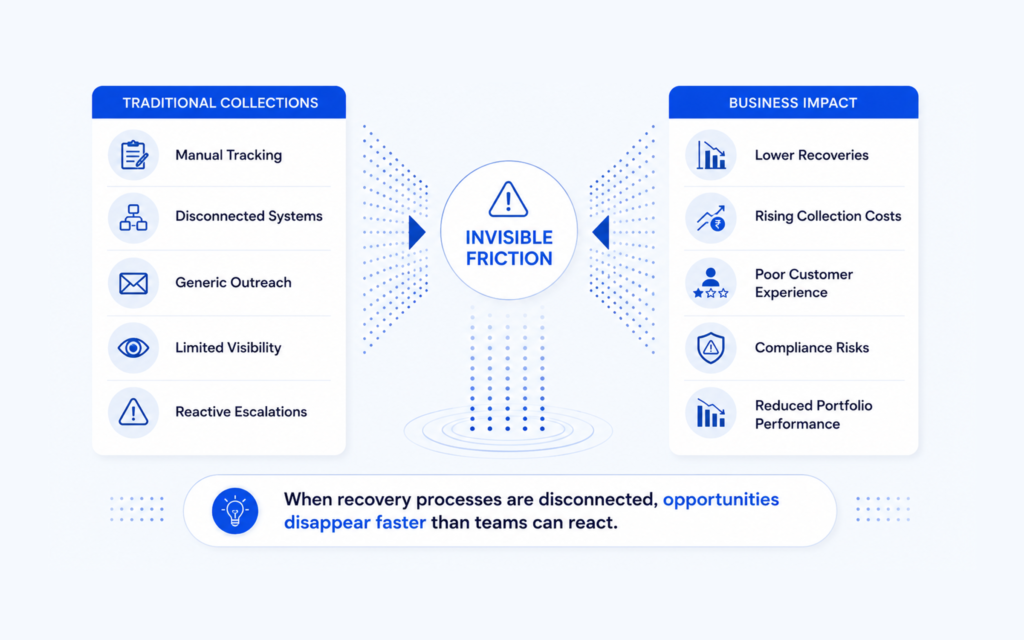
The challenge is not simply rising delinquency. It is the speed at which recovery opportunities disappear. Once an account moves beyond early-stage delinquency, recovery can become more difficult while collection costs rise. The impact extends beyond revenue to compliance, customer relationships, and operational efficiency.
Yet many institutions continue to operate collections through disconnected systems, manual tracking, fragmented borrower data, and generic communication strategies.
The result is friction across the collection process.
Agents work harder but recover less. Managers struggle to identify bottlenecks. CXOs lack visibility into channel performance and borrower behaviour. Meanwhile, customers may receive the same reminders regardless of risk profile, payment history, or intent.
This is where debt collection technology becomes a strategic capability. Modern debt collection technology connects data, decisioning, workflows, engagement, payments, and analytics, allowing lenders to move beyond isolated collection activities toward a more coordinated and responsive recovery process.
The Shift from Collection Activities to Collection Orchestration
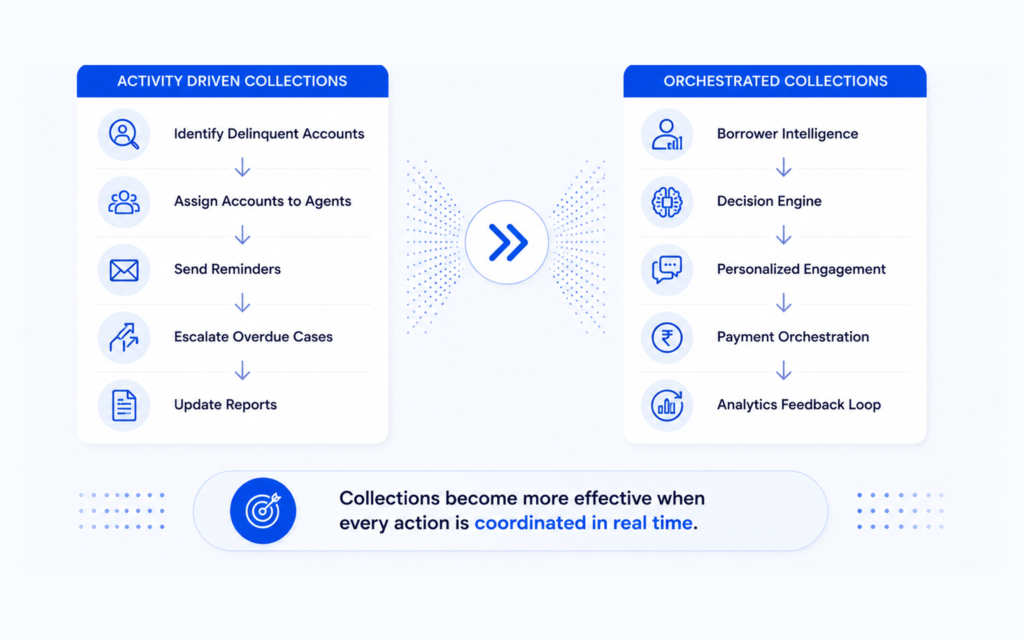
Many lenders still approach collections as a sequence of tasks:
- Identify delinquent borrowers
- Assign accounts to agents
- Send reminders
- Escalate overdue cases
- Update reports
Individually, these activities appear logical. Collectively, they can create a fragmented borrower journey when the systems and decisions behind them operate independently.
A more effective approach is to treat collections as an orchestrated system where data, decisioning, engagement, payments, analytics, and automated debt collection technology work together across the recovery process.
This shift matters because collections sits at the intersection of behavioural science, risk management, operational efficiency, compliance, and customer experience.
A borrower facing a temporary cash flow challenge may require a different treatment strategy from a chronic defaulter. Similarly, channel preferences can vary by borrower, making a single communication approach less effective across different segments.
Without intelligent orchestration, lenders risk creating communication noise instead of targeted recovery actions.
This is where a modern digital debt collection platform creates value. It provides a unified environment where borrower intelligence, workflow automation, communication channels, payments, and analytics can operate as a connected ecosystem.
The Five Layers of a Modern Collection Stack
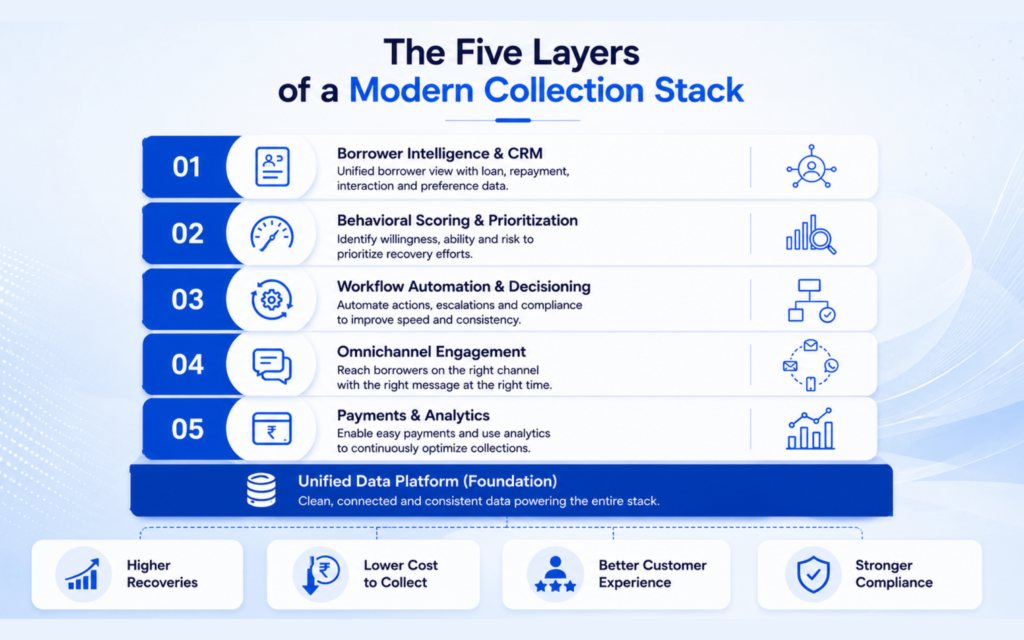
A successful debt collection software solution is not a single application.
Modern debt collection technology works as a connected collection stack built around five interconnected layers. Together, these layers bring borrower intelligence, prioritisation, workflow automation, engagement, payments, and analytics into a coordinated recovery process, connecting the debt collection technology tools used across the collection lifecycle.
Borrower Intelligence and CRM
Collections begins with visibility.
A unified borrower profile can bring together loan information, repayment history, delinquency status, interaction history, and communication preferences.
This context enables collection teams to make more relevant decisions. A generic reminder asking for payment creates little engagement. A personalised interaction informed by payment history, loan type, and repayment behaviour can make the communication more relevant to the borrower.
A connected borrower view also gives agents and managers a consistent source of information across the collection process.
Behavioural Scoring and Prioritisation
Not every delinquent borrower should receive the same treatment.
Behavioural scoring helps lenders distinguish between:
- Borrowers willing but temporarily unable to pay
- Borrowers capable but unwilling to pay
- Accounts with low recovery probability
- High-priority recovery opportunities
By combining relevant behavioural and repayment signals, lenders can prioritise accounts according to recovery potential and apply more appropriate treatment strategies. This allows collection teams to focus human intervention where it is most likely to add value.
Workflow Automation and Decisioning
As portfolios grow, manual escalation becomes difficult to manage consistently.
This is where automated debt collection technology can streamline collection workflows. Rule-based decisioning can trigger reminders, assign cases, escalate delinquent accounts, initiate defined legal workflows, and support compliance requirements based on configured conditions.
Workflow automation also reduces reliance on manual intervention for repetitive collection activities. Teams can apply consistent treatment strategies, maintain clearer accountability, and create an auditable record across the collection lifecycle.
The result is a more structured workflow in which collection actions can respond to account status and predefined business rules rather than relying entirely on manual follow-up.
Omnichannel Engagement
Today’s borrowers move across channels throughout the day.
They may ignore an email, respond to a WhatsApp message, and complete a payment through a mobile application. A modern digital debt collection approach allows lenders to coordinate these interactions rather than treating each channel as a separate activity.
An effective collections software platform can support multiple channels, including:
- SMS
- Voice
- Mobile notifications
- Self-service options
The objective is not simply to increase the number of messages sent. It is to use the appropriate channel, timing, and communication approach for different borrower segments and stages of delinquency.
Digital engagement can also make the transition from communication to repayment more direct when collection journeys are connected to payment options. This helps reduce friction between a borrower’s decision to pay and the completion of the payment.
Payments and Analytics
The collection journey does not end when the borrower decides to pay.
Payment friction can create unnecessary drop-offs between a payment decision and successful repayment. Lenders can reduce this friction by embedding payment options directly within communication journeys through pre-filled payment links and simplified settlement experiences.
At the same time, debt collection data analytics provides visibility into recovery performance, channel effectiveness, agent productivity, bucket movement, and portfolio trends.
These insights help collection teams identify patterns, measure the effectiveness of different strategies, and refine treatment approaches over time.
Without reliable measurement, continuous optimisation of collection performance becomes difficult.
Why Integration Is the Real Competitive Advantage
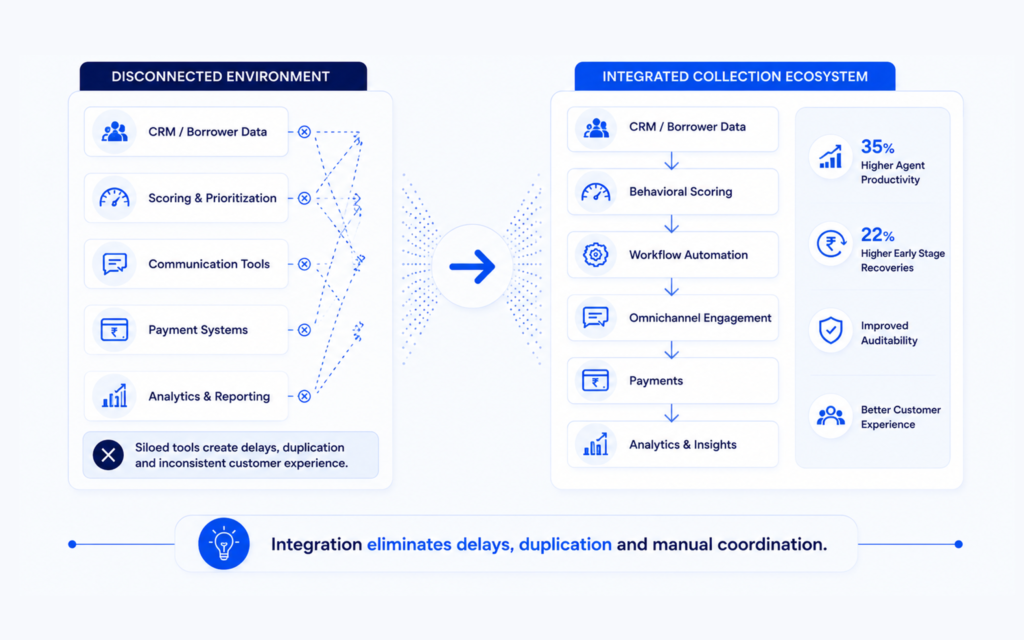
Many institutions have already invested in collection tools.
The problem is that those tools may not communicate effectively with one another. A CRM can operate independently from communication systems, scoring models can function separately from workflow engines, and payment data can arrive too late to inform the next collection action.
The result is fragmented execution.
An integrated collection ecosystem connects these debt collection technology capabilities so that information and actions can move across the recovery process. When borrower behaviour changes, communication strategies can adapt. When payments are received, account status can be updated. When outreach through one channel is unsuccessful, another channel can be activated based on the configured collection strategy.
This is where integration turns individual debt collection technology tools into a connected recovery environment.
Integration also strengthens governance. When communication, payment, escalation, and borrower interaction data are connected, lenders can maintain a more complete and traceable record of collection activity.
For lenders managing complex portfolios, this connectivity supports greater visibility, consistency, and auditability across the collection lifecycle.
Choosing the Right Debt Collection Software Solution
Selecting a debt collection software solution is about more than comparing features. The technology should support collection teams in managing workflows, engaging borrowers, monitoring performance, maintaining compliance, and scaling operations as portfolios grow.
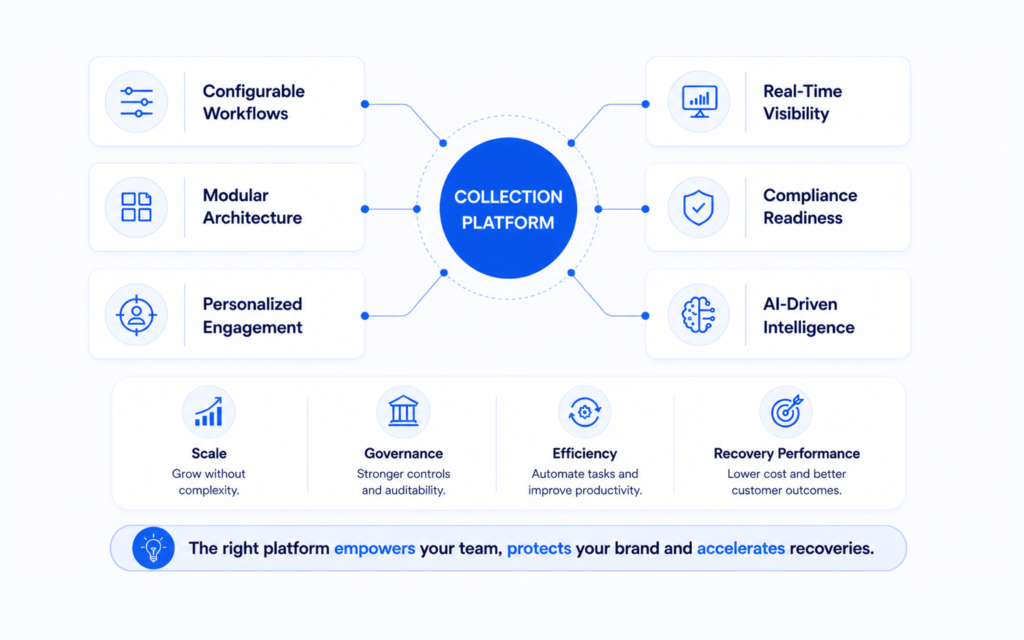
When evaluating options, focus on six capabilities:
- Configurable workflows that allow collection teams to modify rules, treatments, and borrower journeys as collection strategies evolve.
- Modular architecture that integrates with core banking, loan management, CRM, and payment systems.
- Personalised engagement that adapts communication by borrower profile, language, channel preference, and delinquency stage.
- Real-time visibility through role-based dashboards covering recovery rates, bucket movement, agent productivity, and channel performance.
- Compliance readiness with audit trails covering interactions, payments, and escalations.
- AI-driven intelligence that supports behavioural scoring, prioritisation, and automated collection strategies.
The strongest debt collection technology environments connect borrower data, workflows, engagement, payments, analytics, and decisioning rather than treating each capability as a separate tool. This connected approach can give lenders greater consistency and visibility across the collection lifecycle.
The Future of Collections Is Intelligent, Connected, and Predictive
Collections is entering a new phase. The next generation of debt collection technology is expected to move beyond basic reminders and escalations toward predictive risk identification, behavioural intelligence, AI-driven segmentation, and real-time decisioning.
Instead of responding only after missed payments occur, lenders can increasingly use data and predictive models to identify potential delinquency risks earlier. Engagement strategies can also become more adaptive, taking into account repayment behaviour, channel preferences, and recovery potential.
This evolution can transform automated debt collection technology from a largely operational function into a more connected capability spanning risk, customer engagement, payments, compliance, and portfolio management.
Platforms such as Collect.ezee by ezee.ai reflect this broader direction by bringing borrower intelligence, recovery automation, behavioural segmentation, omnichannel engagement, payment orchestration, dashboards, and compliance controls into a connected environment.
As lending portfolios grow and borrower expectations continue to evolve, the long-term direction is toward collection operations that are more connected, data-driven, and responsive. Collections can increasingly become an integrated part of how lenders manage portfolio performance and borrower relationships.
Frequently Asked Questions
Modern debt collection technology for banks and NBFCs includes borrower intelligence, behavioural scoring, workflow automation, multichannel engagement, payment integration, and collection analytics. These capabilities can work together to identify priority accounts, automate routine actions, tailor borrower communication, and connect outreach directly to repayment options.
Lenders can automate debt collection using rule-based workflows that trigger SMS, WhatsApp, IVR, or other collection actions based on payment due dates, delinquency status, borrower segments, and configured business rules. This reduces manual intervention for repetitive activities while allowing higher-priority accounts to be routed for appropriate follow-up.
Digital debt collection can support recovery by personalising outreach through preferred channels such as app notifications, SMS, WhatsApp, email, or voice. When communication is connected to payment options, borrowers can move from a collection reminder to repayment with fewer process steps, potentially reducing friction and payment drop-offs.
Predictive analytics can help lenders prioritise accounts by analysing relevant repayment history, behavioural signals, delinquency patterns, and other available data. Collection teams can use these insights to focus intervention on accounts with different recovery characteristics while identifying potential risks earlier in the delinquency lifecycle.
AI can support borrower segmentation and prioritisation by analysing repayment history, behavioural patterns, channel preferences, and other relevant data. Lenders can then assign different treatment strategies to borrower segments, combining automated engagement for appropriate accounts with targeted human intervention where additional attention is required.
Cloud-based debt collection platforms can give lenders centralised access to collection workflows, borrower information, dashboards, and reporting across distributed teams. They can also support scalable infrastructure and easier access to collection applications for field and operations teams, depending on the platform architecture and deployment model.
Lenders should evaluate debt collection software for appropriate security and compliance controls, including encryption, role-based access, authentication, audit trails, data protection controls, and mechanisms for monitoring collection activity. The specific requirements will depend on the lender’s regulatory obligations, data environment, and collection processes.
When choosing a debt collection software solution, lenders should evaluate workflow configurability, integration capabilities, borrower engagement options, analytics, security and compliance controls, scalability, and ease of administration. The platform should fit the lender’s existing technology environment while supporting the collection strategies and portfolio requirements that may evolve over time.
Lenders can integrate payment gateways with collection workflows through APIs that connect payment options to SMS, WhatsApp messages, borrower portals, or other communication channels. When borrowers receive a collection reminder, a connected payment journey can reduce the number of steps required to move from payment intent to completed repayment.
An integrated collection stack connects borrower data, scoring, workflow automation, communication channels, payments, and analytics across the recovery process. This allows changes in borrower status or behaviour to inform subsequent collection actions, while payment updates can flow back into the collection workflow. The result is a more connected borrower journey with greater visibility and consistency across collection operations.
References
- RBI – Guidelines on Digital Lending
- RBI – Outsourcing of Financial Services: Responsibilities of Regulated Entities Employing Recovery Agents
- RBI – Master Circular: Fair Practices Code for NBFCs
- RBI – Guidelines on Recovery Agents Engaged by Banks
- Deloitte – Automation with Intelligence: 2022 Survey Results