Why Co-Lending Success Now Depends on Unified Borrower Architecture
Co lending was designed to solve one of the lending industry’s biggest challenges: expanding credit access without forcing a single institution to bear the entire burden of origination, underwriting, servicing, and risk management.
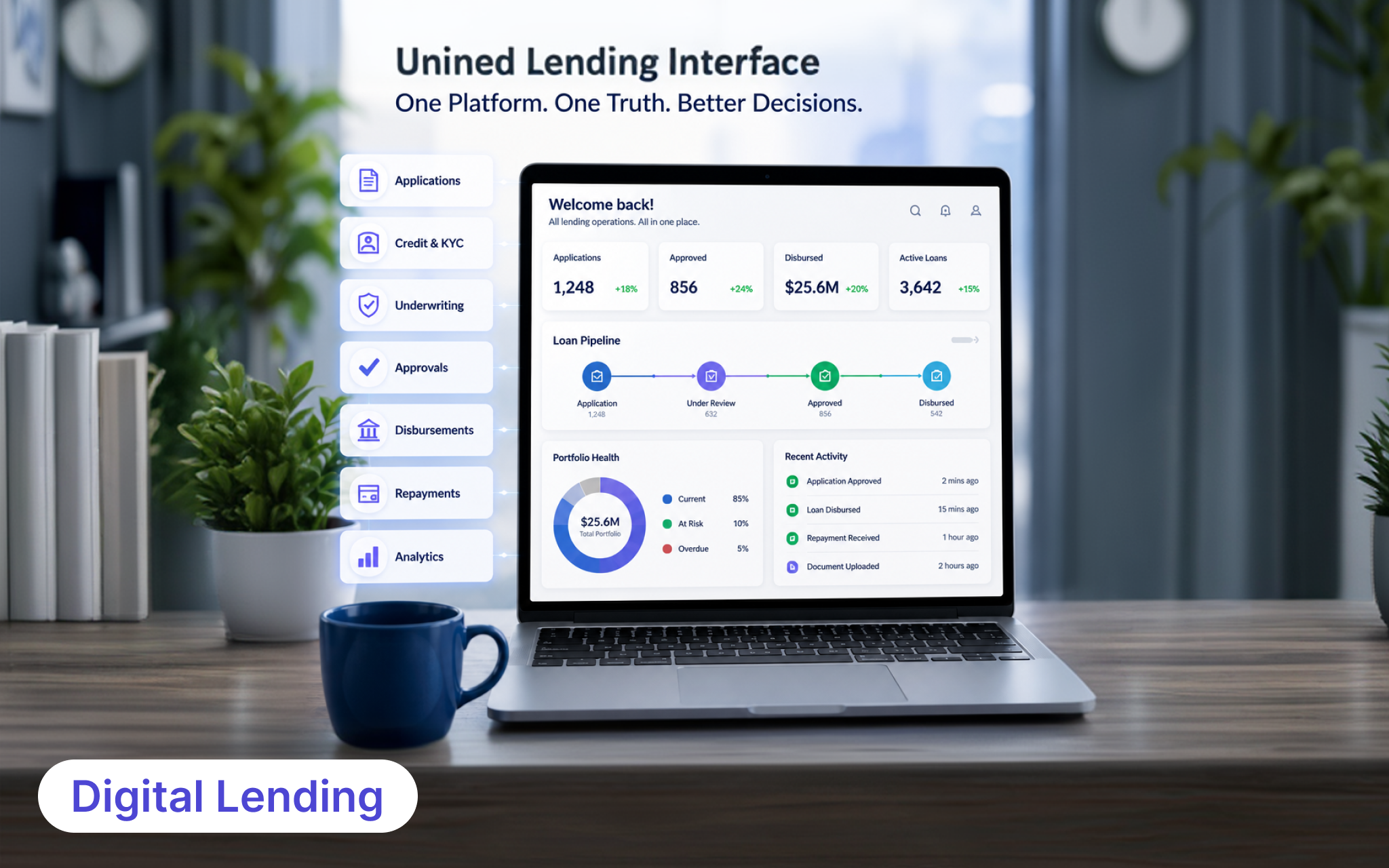
At the center of that vision is a unified lending interface that enables banks and NBFCs to operate with greater coordination, visibility, and control.
The proposition was simple. Banks brought capital strength, regulatory discipline, and balance sheet capacity. NBFCs brought market reach, customer proximity, and agility. Together, they could accelerate financial inclusion while unlocking new growth opportunities.
Yet despite the promise, many co lending partnerships struggle to scale efficiently.
The problem is rarely a lack of demand or inadequate credit appetite.
The real challenge lies beneath the surface.
Most lenders are attempting to operate a collaborative lending model on technology foundations that were never designed for collaboration. Borrower information sits across multiple systems. Risk assessments vary between institutions. Servicing records become fragmented. Compliance activities require continuous reconciliation.
What appears to be a lending challenge is increasingly becoming an architecture challenge.
As RBI’s latest Co Lending Directions push the industry toward greater synchronization, transparency, and accountability, lenders are realizing that future success depends on something far more fundamental than process improvement. Industry research has consistently shown that fragmented data and disconnected lending workflows increase operational friction, making unified borrower visibility a strategic requirement rather than a technology preference.
The Hidden Architecture Problem Behind Co Lending
The biggest misconception about co lending is that lenders fail to collaborate because of differing risk appetites.
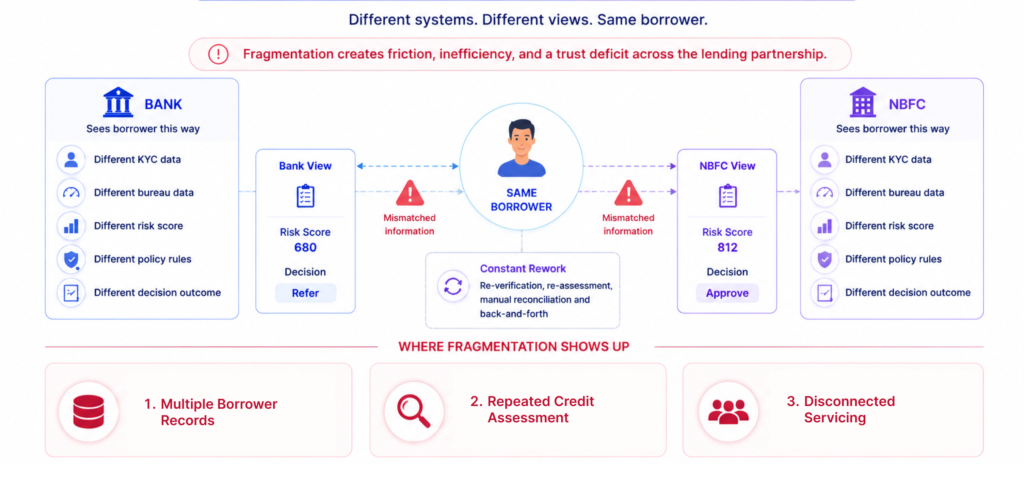
In reality, many partnerships struggle because participating institutions cannot see the same borrower in the same way.
An NBFC may approve a borrower based on its underwriting framework, data sources, and risk models. When the proposal reaches a banking partner, the same borrower is evaluated through a different lens. Different bureau data, different verification standards, and different policy frameworks often lead to conflicting conclusions.
The result is operational friction disguised as credit risk.
Instead of building upon each other’s assessments, lenders frequently restart the evaluation process. What should be a collaborative model becomes a cycle of validation, clarification, and reconciliation.
Where Fragmentation Shows Up
Multiple borrower records
Borrowers often exist in separate systems with varying KYC information, risk assessments, and servicing histories. Small inconsistencies create large operational delays.
Repeated credit assessment
Partner institutions frequently re evaluate applications because they lack confidence in the data and decision logic used by other participants.
Disconnected servicing
Collections teams, servicing departments, and risk functions often operate using different borrower information, resulting in inconsistent actions and communication.
Over time, these inefficiencies create more than operational delays. They create a trust deficit.
When lenders cannot establish a common view of the borrower, every process becomes slower, more expensive, and more difficult to govern. The IFC’s Digital Lending Handbook similarly identifies fragmented borrower data and disconnected operational systems as major barriers to efficient and scalable lending ecosystems.
What RBI’s Co Lending Directions Really Mean for Lenders
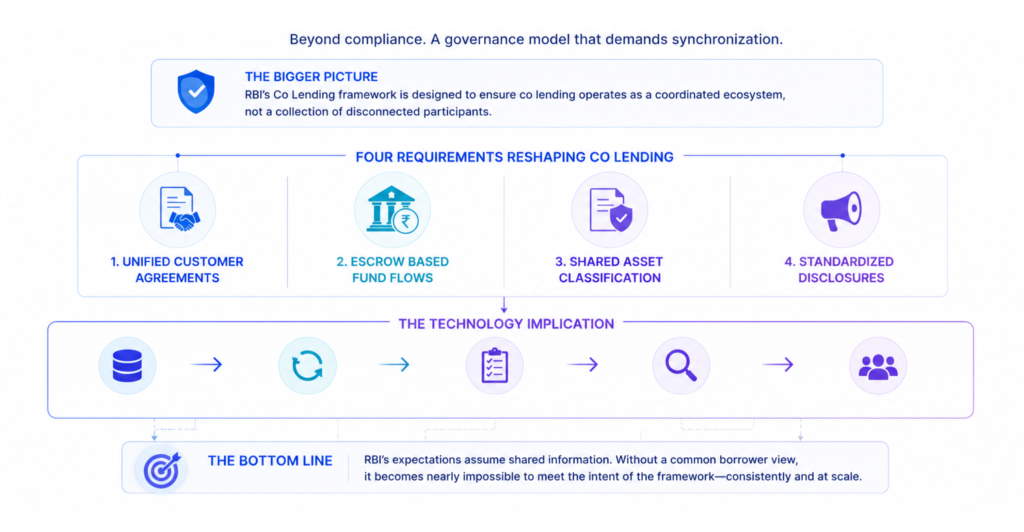
Much of the industry discussion around RBI’s Co Lending Directions focuses on compliance obligations.
However, the framework represents something much larger. RBI’s Co Lending framework requires participating institutions to establish clearly defined mechanisms for customer interface, loan monitoring, servicing, recovery, and grievance management, reinforcing the need for coordinated operational models rather than isolated lender workflows.
It is a governance model designed to ensure that co lending operates as a coordinated ecosystem rather than a collection of disconnected participants.
The challenge is that many of the framework’s expectations assume a level of synchronization that traditional lending environments struggle to deliver.
Four Requirements Reshaping Co Lending
Unified customer agreements
Borrowers must clearly understand the responsibilities, obligations, and roles of every lending participant involved in the relationship.
Escrow based fund flows
Funds must move through transparent structures that provide clear auditability and accountability.
Shared Asset Classification
All participating lenders must maintain a consistent understanding of borrower risk status. Effective Shared Asset Classification ensures that borrower classifications remain synchronized across institutions.
Standardized disclosures
Borrowers should receive clear, consistent information throughout the lending lifecycle, regardless of how many lenders participate in the arrangement.
These requirements may appear procedural.
In reality, they assume lenders are operating from shared information.
Without a common borrower view, maintaining Shared Asset Classification, ensuring timely updates, and supporting coordinated decision making becomes significantly more difficult.
This is where the gap between regulatory expectations and operational reality becomes visible.
Why Legacy Lending Platforms Are Struggling
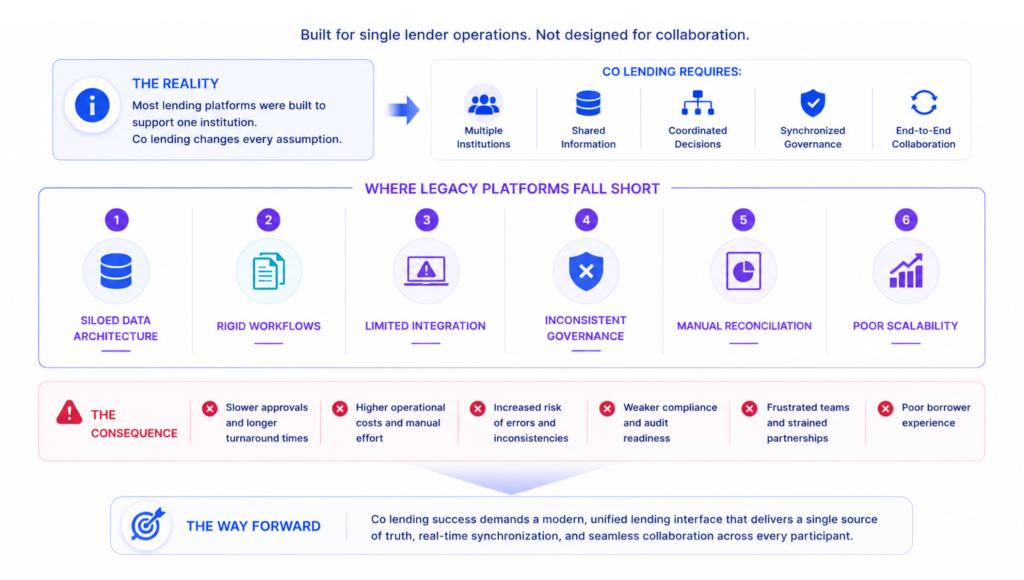
Most lending platforms were built to support a single institution’s operations.
Their underlying architecture assumes one lender, one underwriting process, one servicing model, and one governance framework.
Co lending changes those assumptions completely.
Multiple institutions must now collaborate, share information, coordinate decisions, and maintain synchronized records throughout the borrower lifecycle.
The Three Structural Limitations
Built for single lender operations
Traditional systems were never designed to orchestrate multiple lenders simultaneously. As partnerships grow, complexity increases exponentially.
Synchronization remains difficult
Many institutions continue to rely on periodic updates, manual reviews, spreadsheets, and reconciliation cycles to maintain consistency across systems.
Compliance becomes reactive
Instead of enforcing governance through system design, teams spend valuable time identifying discrepancies and correcting issues after they occur.
The challenge is not the absence of functionality.
The challenge is architectural misalignment.
No amount of incremental upgrades can fully solve a problem rooted in the design assumptions of legacy platforms.
The Five Pillars of Unified Borrower Architecture
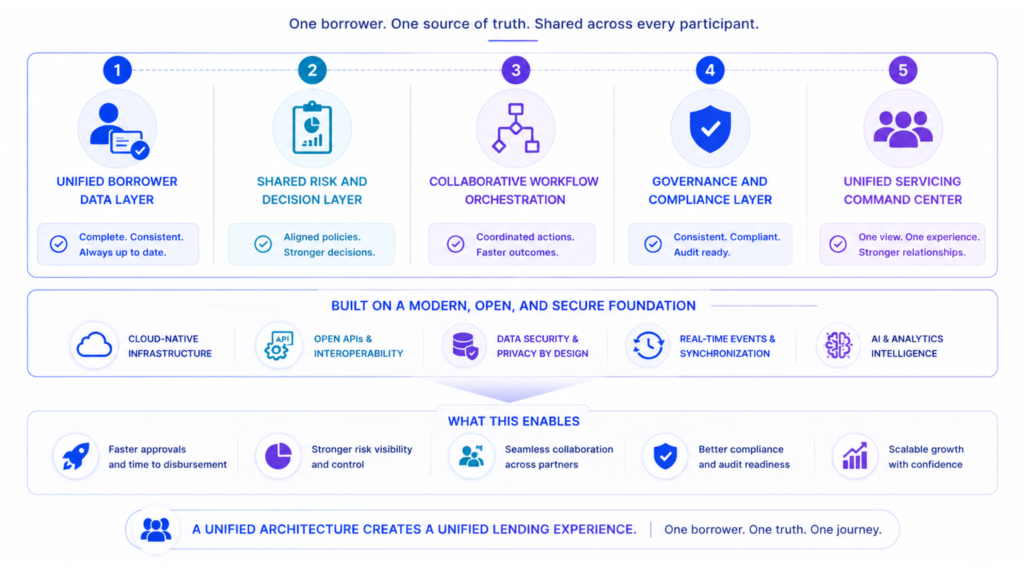
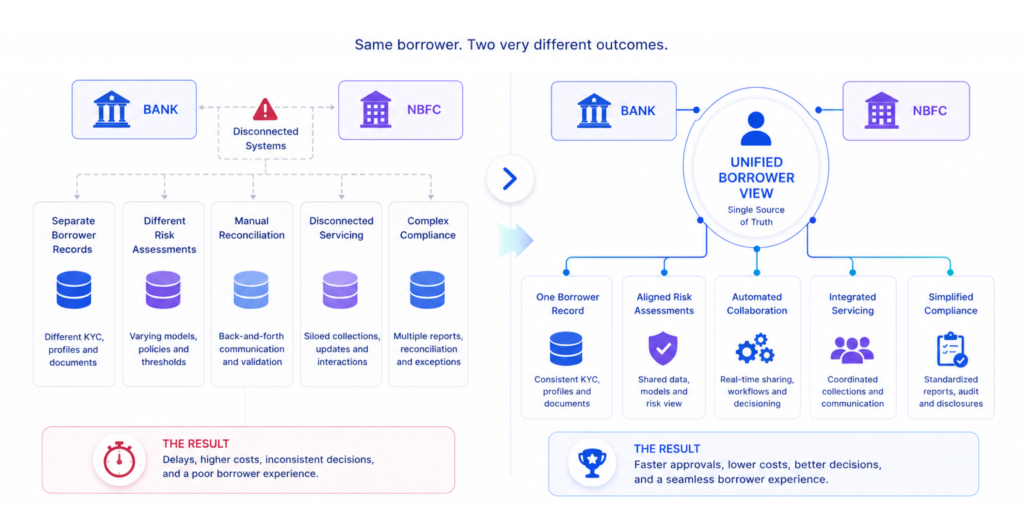
A successful Unified Borrower Architecture creates an operating model where all participants work from a synchronized borrower record while maintaining appropriate governance controls.
Rather than treating coordination as an afterthought, the architecture embeds it directly into the lending lifecycle.
1. Single Borrower Identity
Every borrower should exist once within the ecosystem.
Identity records, bureau information, consent history, servicing activity, and risk assessments should be maintained through a single authoritative profile.
This eliminates duplication, reduces onboarding friction, and creates consistency across participating lenders.
2. Shared Asset Classification
One of the most critical requirements of modern co lending is maintaining synchronized risk visibility.
Effective Shared Asset Classification ensures that delinquency events, restructuring actions, and NPA designations are reflected consistently across all participating institutions.
This reduces confusion, strengthens governance, and supports regulatory alignment.
3. Automated Reconciliation
Manual reconciliation remains one of the largest operational burdens in co lending environments.
Loan balances, borrower updates, transaction records, and reporting activities often require significant human intervention.
Automated Reconciliation enables continuous synchronization across participating systems while reducing errors and operational effort.
As co lending volumes grow, Automated Reconciliation becomes a prerequisite for scalability rather than an efficiency enhancement.
4. Escrow and Transaction Orchestration
Every transaction should be transparent, traceable, and auditable.
A unified architecture enables controlled fund movement, complete transaction visibility, and stronger governance across lending participants.
This improves accountability while simplifying audit readiness.
5. Consent Driven Data Governance
Borrower trust depends on responsible data usage.
Modern lending ecosystems must ensure that information is shared only through authorized, auditable channels supported by explicit consent controls.
Strong governance protects borrowers while supporting regulatory requirements and institutional accountability.
Together, these five capabilities transform fragmented operations into a coordinated lending ecosystem built around a shared borrower reality.
Why a Unified Lending Interface Creates Competitive Advantage
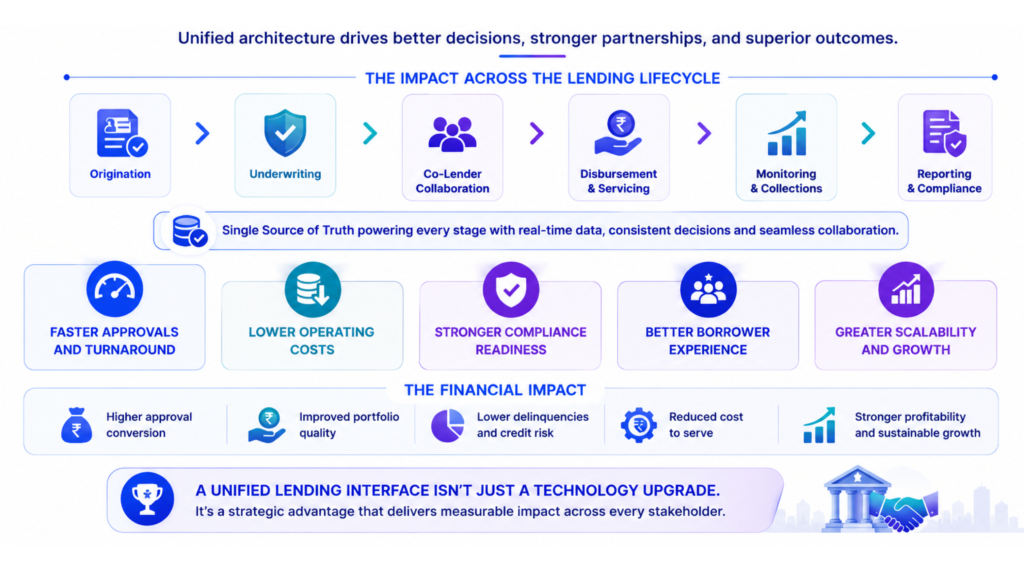
Many lenders initially pursue transformation to satisfy regulatory expectations.
The larger opportunity lies in business performance.
A modern unified lending interface creates operational advantages that extend far beyond compliance.
Business Outcomes That Matter
Faster approvals: Shared borrower information reduces duplication, accelerates verification, and shortens approval cycles.
Lower operating costs: Automation minimizes manual effort and reduces the resources required to manage complex partnerships.
Stronger compliance readiness: Consistent records, audit trails, and synchronized processes simplify governance obligations.
Better borrower experience: A cohesive unified lending interface eliminates confusion and provides borrowers with a more seamless journey across participating lenders.
Greater scalability: Institutions can expand partnerships without creating proportional increases in operational complexity.
The financial impact can be substantial.
Reduced operational overhead, improved approval efficiency, stronger risk visibility, and better servicing outcomes contribute directly to profitability and sustainable growth.
The Future of Co Lending Will Be Defined by Architecture
The next phase of co lending growth will not be determined by who originates the most loans. It will be determined by who coordinates information most effectively.
As the Co Lending Directions push the industry toward synchronized governance, lenders will need more than incremental system upgrades. They will need connected ecosystems that unify origination, decisioning, servicing, and compliance around a shared borrower view.
This is where architecture becomes a competitive advantage. A robust unified borrower architecture enables shared asset classification, supports automated reconciliation, and allows lending partners to operate from the same borrower context throughout the lifecycle. Compliance becomes easier because it is embedded into the operating model rather than managed as a separate activity.
This shift is driving lenders toward integrated platforms that can orchestrate the entire lending journey rather than relying on disconnected systems.
ezee.ai is built for this reality. lend.ezee helps streamline co lending origination, borrower onboarding, workflow orchestration, and partner collaboration from a single environment. decision.ezee enables consistent credit decisioning and policy execution across participating institutions, reducing friction caused by fragmented underwriting processes. collect.ezee extends this visibility into delinquency management and recovery operations, ensuring lenders continue to operate with the same borrower intelligence after disbursement.
Together, these capabilities create a unified lending interface that helps banks and NBFCs move from fragmented coordination to real time collaboration while building the foundation for scalable and compliant co lending.
The future of co lending belongs to institutions that can operate from a single source of truth. A strong unified borrower architecture is becoming the foundation for sustainable growth, stronger governance, and better borrower experiences.
Frequently Asked Questions
Mismatched borrower records delay co-lending by breaking STP across KYC, credit bureau pulls, and underwriting, forcing manual reconciliation before disbursal. This increases TAT and operational risk. For example, CKYC ID mismatches or name variations across CIBIL APIs trigger exception queues. Industry benchmarks show up to 30 percent TAT impact in multi lender flows (industry studies). As RBI noted, consistency of borrower data underpins co-lending efficiency.
A unified borrower profile helps lenders meet RBI’s 2025 co-lending rules by enforcing a single source of truth across KYC, bureau data, and loan exposure. It simplifies audits and reduces partner disputes. For example, both lenders view identical CKYC, repayment history, and underwriting inputs. Banks adopting shared profiles report materially faster compliance validation cycles (industry reports). As RBI observed, aligned data improves supervisory clarity.
Escrow based fund flow improves co-lending transparency by clearly separating principal, interest, and fee movements for each partner in real time. This reduces reconciliation of friction and audit queries. For example, rule engines allocate repayments automatically before collections posting. Industry analyses show reconciliation effort drops by over 40 percent with escrow led flows (industry research). As regulators emphasize, traceable fund movement strengthens trust.
Automated blending locks a single weighted-average rate from underwriting, preventing markup arguments over the loan lifecycle. It recalculates EMIs dynamically if partner costs shift, ensuring KFS consistency. “Blended rates lower borrower costs effectively,” per ICRA analysts.
Microservices split loan processing into independent modules like KYC validation, credit checks, and disbursal.
Distributed data stores handle parallel queries across nodes, enabling horizontal scaling via Kubernetes for peak volumes without downtime.
Lenders processing 1M+ apps deploy separate services for underwriting and collections, balancing loads dynamically.
Banks and NBFCs struggle to align KYC and bureau data because each lender pulls CKYC and CIBIL data independently, creating mismatches that break STP at underwriting. This slows approvals and raises manual checks. For example, name formats or PAN updates differ across APIs. Industry studies show over 25 percent cases need reconciliation. As RBI noted, data uniformity is critical for co lending.
Next day NPA sync is difficult in legacy LOS because delinquency status updates rely on batch jobs, manual uploads, and delayed LMS handoffs. This weakens regulatory reporting and partner visibility. For example, DPD changes post collections may reflect after one or two days. Industry assessments link legacy stacks to 40 percent slower risk updates. As regulators stress, timeliness underpins asset quality reporting.
A single source of truth in unified lending architecture means one centralized repository for all borrower data like KYC, CIBIL scores, and repayment history across origination and collections. It ensures every team—from underwriting to co-lending partners—accesses identical, real-time info without silos. When a loan disburses, updates sync instantly, avoiding discrepancies in asset classification.