

Why Lending Architecture Is Becoming a Competitive Advantage
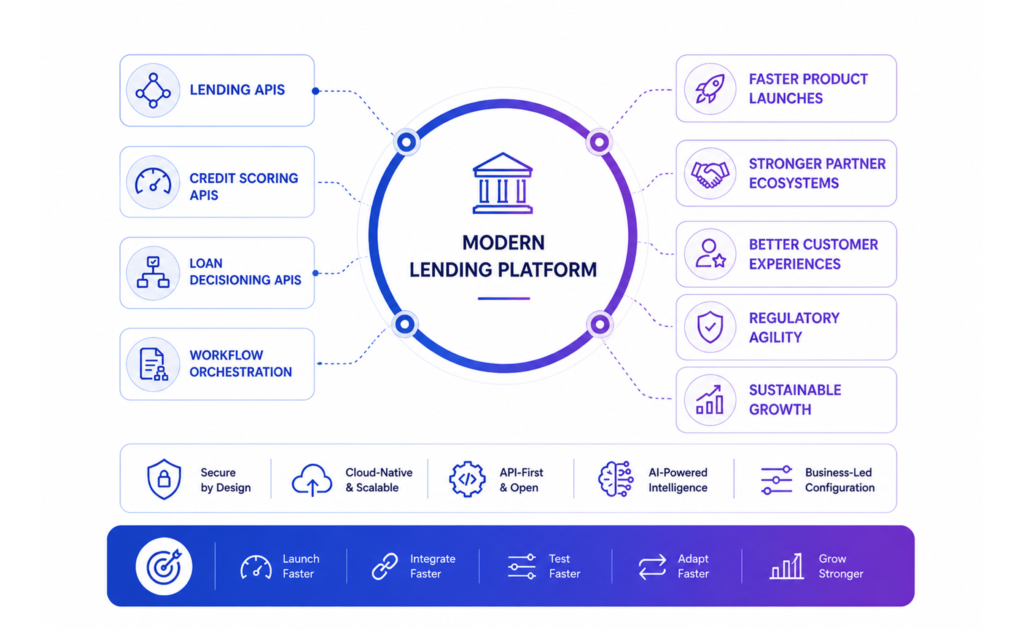
For decades, lenders built their businesses around large loan origination systems designed for scale, control, and compliance. Those systems served the industry well, but the market has changed faster than the technology supporting it.
Today, product launches are measured against fintech timelines, and capabilities like a credit scoring API are becoming essential for faster decisions, more personalised experiences, and seamless digital journeys. The World Bank’s Global Findex research shows that digital financial engagement has become mainstream globally, increasing pressure on lenders to deliver faster and more connected digital experiences.
In this environment, competitiveness is increasingly determined by how quickly institutions can adapt.
That is why many banks, NBFCs, and digital lenders are moving toward a Lending API approach. Instead of relying on tightly coupled systems where every change requires development effort, they are adopting modular architectures that enable faster innovation, easier integration, and greater business agility.
The shift is not simply technological. It is operational and strategic.
Why Traditional Lending Systems Are Slowing Growth
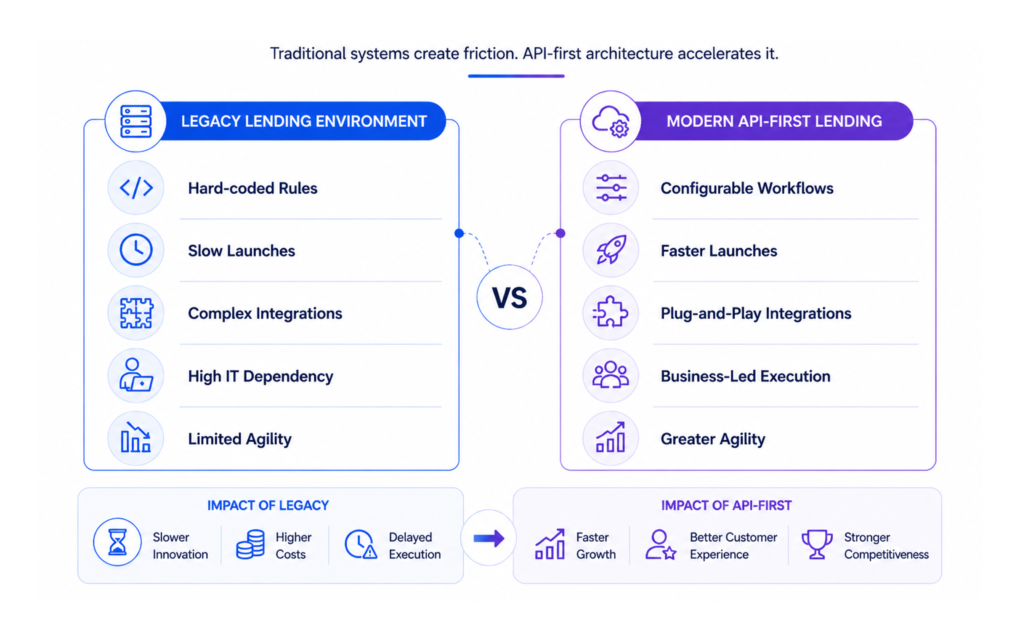
Most legacy lending platforms were designed for stability.
The problem is that stability often came at the expense of flexibility.
Many institutions still operate environments where:
- Business rules are embedded deep within code
- Product changes require lengthy development cycles
- New integrations involve extensive testing and approvals
- Business teams depend heavily on IT for execution
This creates challenges across the lending lifecycle.
Launching a new product may take weeks. Updating underwriting criteria can trigger multiple approval cycles. Integrating a new risk model or fintech partner often becomes a technology project rather than a business initiative.
The impact extends beyond efficiency.
Slow execution affects revenue opportunities, partner relationships, customer experience, and regulatory responsiveness. In markets where digital lenders can launch new offerings within days, delayed execution becomes a competitive disadvantage.
Many organisations are discovering that the real limitation is not their lending strategy. It is the architecture supporting it.
Understanding the API First Lending Model
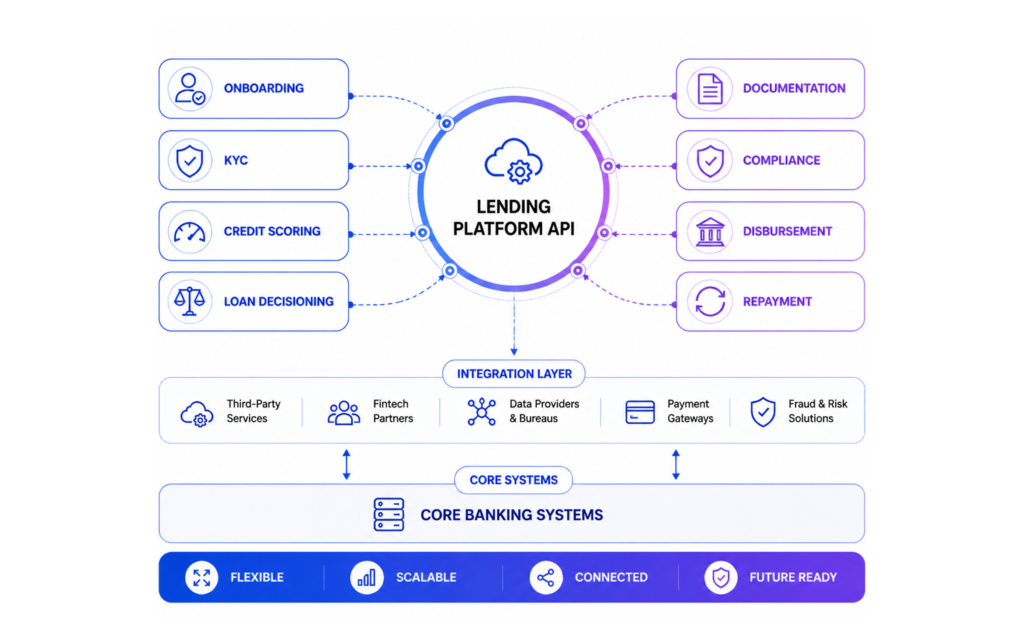
An API first model approaches lending differently.
Rather than treating the lending stack as one large system, it breaks it into modular components that can operate independently while remaining connected.
Typical components include:
- Customer onboarding
- KYC verification
- Credit Scoring API services
- Loan Decisioning API engines
- Documentation workflows
- Compliance controls
- Disbursement and repayment processes
These services communicate through APIs, allowing each component to evolve without disrupting the entire ecosystem.
For business leaders, the benefit is straightforward.
Changes that once required development projects can often be configured, tested, and deployed significantly faster. New capabilities can be introduced without rebuilding existing systems.
This flexibility has made the Lending Platform API model increasingly attractive to lenders seeking faster growth and greater resilience.
The Business Case for Modular Lending
The strongest argument for API first lending is not technology. It is business performance.
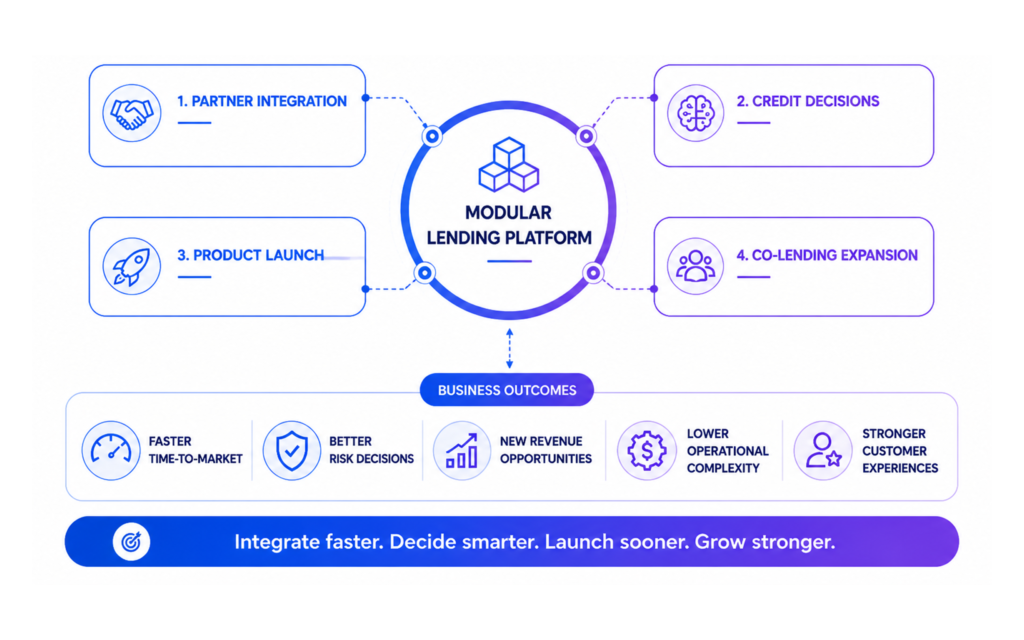
Faster Partner Integration
Growth increasingly depends on external ecosystems.
Whether integrating:
- Alternative data providers
- Fraud solutions
- Credit bureaus
- Fintech distributors
- Co lending partners
integration speed directly impacts business speed.
A modern Lending API architecture reduces dependency on custom development and allows lenders to connect with partners far more efficiently.
Smarter Credit Decisioning
Traditional underwriting models often struggle to incorporate new data sources quickly.
A Credit Scoring API allows lenders to evaluate alternative risk indicators, test new models, and refine underwriting strategies without extensive redevelopment.
Similarly, a Loan Decisioning API enables institutions to adjust policy rules, automate approvals, and improve consistency while maintaining governance.
This creates a more adaptive credit environment where decisions evolve alongside market conditions.
Accelerated Product Launches
One of the most significant benefits of modular lending is faster time to market.
Consider a lender launching a specialised product for self employed borrowers.
In a traditional environment, that may require:
- New business rules
- Additional documentation requirements
- Credit policy adjustments
- Multiple development cycles
Within an API first architecture, many of these changes can be configured directly through business owned workflows.
The result is faster experimentation, quicker launches, and greater responsiveness to market opportunities.
Simplified Co Lending Expansion
Co lending continues to gain momentum across many markets.
However, operational complexity often slows adoption.
A Lending Platform API enables institutions to:
- Configure partner rules
- Automate reporting
- Manage risk sharing frameworks
- Streamline reconciliation
Processes that previously required months can often be implemented far more efficiently.
Four Essentials for a Successful API First Strategy
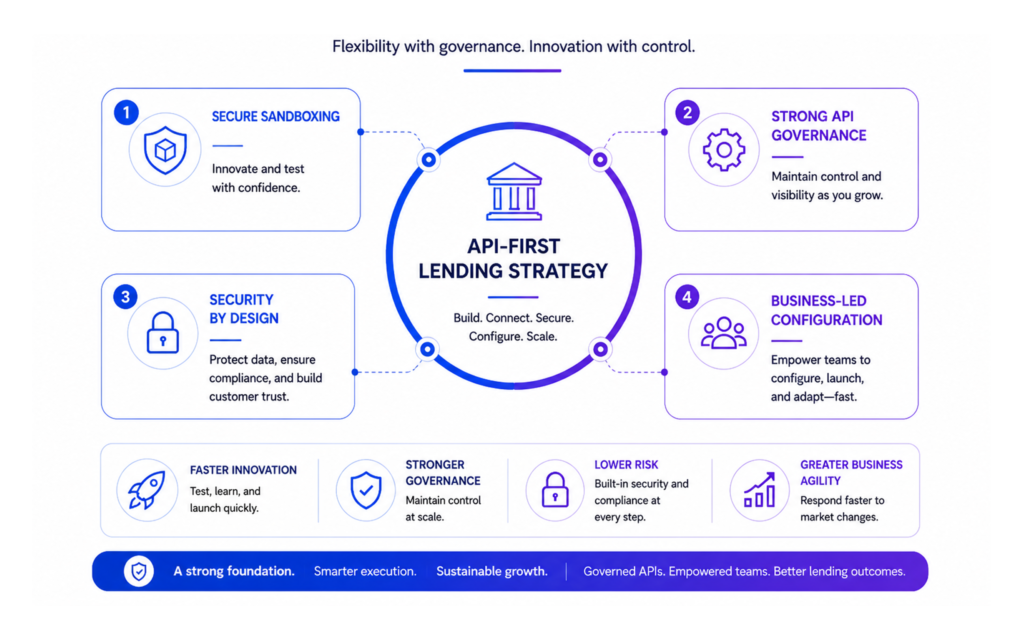
Technology alone does not guarantee success.
The most effective Lending API implementations combine flexibility with governance.
Secure Sandboxing
Innovation requires safe experimentation.
Modern lending platforms provide isolated testing environments where teams can:
- Simulate lending journeys
- Test rule changes
- Validate compliance impacts
- Evaluate partner integrations
This allows organisations to innovate without introducing production risk.
Strong API Governance
As connectivity increases, governance becomes critical.
Effective API management includes:
- Authentication controls
- Access management
- Version control
- Traffic monitoring
- Performance analytics
Without governance, complexity simply shifts from one area to another.
Security by Design
Financial institutions operate under intense scrutiny regarding data security.
Modern Loan Origination API ecosystems should support:
- Encryption
- Role based access
- Audit trails
- Compliance frameworks
- Real time monitoring
Security must remain foundational as lending ecosystems become more connected.
Business Led Configuration
Perhaps the most transformative change is moving control closer to business teams.
Risk, product, operations, and compliance teams should be able to configure key workflows without waiting for development cycles.
Examples include:
- Adjusting underwriting rules
- Modifying document requirements
- Launching regional offers
- Updating compliance controls
This dramatically reduces execution bottlenecks while improving organisational agility.
From Product Centric to Platform Centric Lending
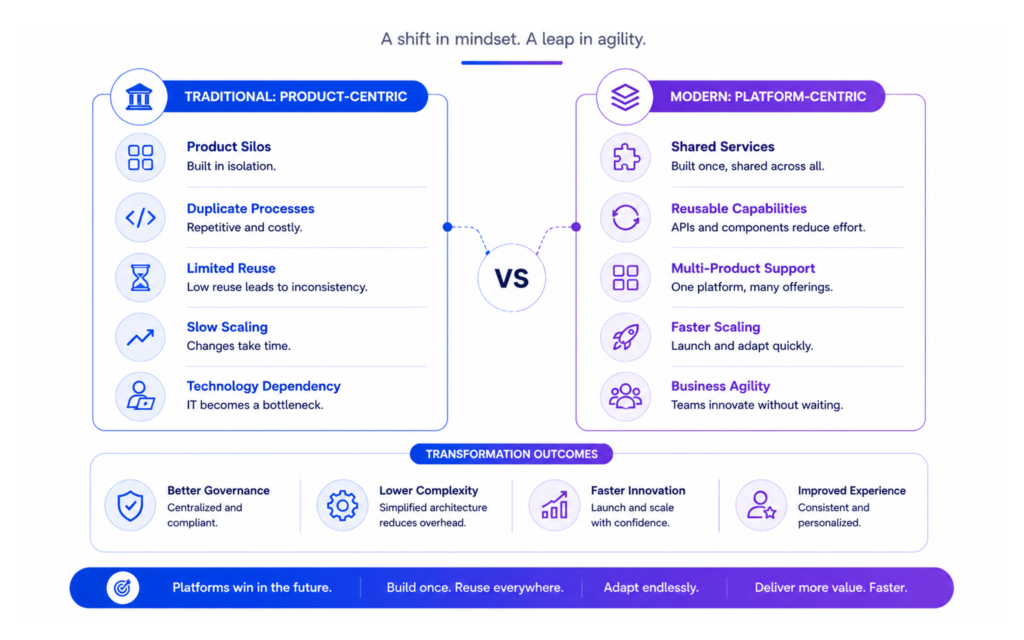
The lending industry is gradually shifting from product centric thinking to platform centric thinking.
Historically, institutions-built technology around individual products.
Today, successful lenders are creating reusable capabilities that support multiple products, partners, and customer segments.
This approach delivers several advantages:
- Faster scaling
- Lower operational complexity
- Better governance
- Improved customer experiences
- Greater adaptability
The shift also changes organisational culture.
Instead of relying exclusively on technology teams, business users become active participants in innovation. Product managers, risk leaders, and operations teams gain greater control over how lending experiences evolve.
That capability becomes increasingly valuable as markets become more dynamic.
The Future of Lending Runs on APIs
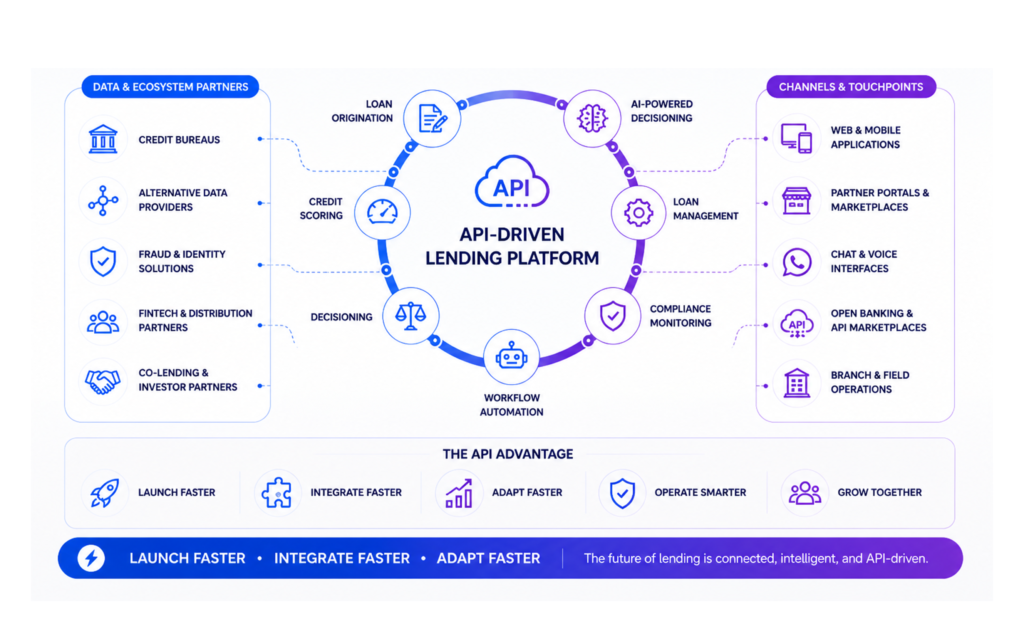
The future of lending will not be defined solely by capital availability or product breadth.
It will be defined by execution speed.
The institutions that win will be those that can launch faster, integrate faster, test faster, and adapt faster while maintaining compliance and risk discipline.
This is where platforms such as ezee.ai fit naturally into the modern lending ecosystem. Through capabilities spanning loan origination, credit decisioning, loan management, AI powered automation, workflow orchestration, and intelligent decisioning, institutions can modernise lending operations without being constrained by legacy architectures.
By combining a Loan Origination API framework, configurable Lending Platform API capabilities, and advanced Credit Scoring API and Loan Decisioning API services, lenders can create the flexibility needed to support future growth while maintaining governance and control.
The question facing lenders today is no longer whether they should modernise.
It is whether their current architecture allows them to compete at the speed the market now demands.
Those still relying on yesterday’s systems may find that the biggest risk is not changing too quickly.
It is changing too slowly.
Frequently Asked Questions
A credit scoring API delivers real-time credit scores and risk assessments from bureaus like CIBIL by pulling borrower data via simple integration.
Lenders use it during underwriting to automate decisions, e.g., approving personal loans instantly or flagging high-risk MSME applicants.
A soft credit check API fetches basic eligibility data without impacting scores, unlike a full bureau pull that accesses complete reports and dings credit temporarily.
| Aspect | Soft Credit Check API | Full Bureau Pull |
|---|---|---|
| Score Impact | None – doesn't ding credit score | Temporary ding on credit score |
| Primary Use | Pre-approvals during online KYC | Final disbursal and full underwriting |
| Business Value | Balances speed and compliance in early stages | Ensures thorough risk assessment |
Credit scoring APIs boost approval rates for thin-file borrowers by tapping alternative data like telco payments and utility bills alongside bureau scores.
They feed rule engines for instant risk bands, cutting manual reviews by 60% per industry benchmarks. “Alternative data unlocks 40 million new customers,” notes CGAP.
For gig workers applying via mobile KYC, APIs blend CIBIL with transaction history for fair decisions.
API-first platforms launch products 3x faster by plugging credit scoring APIs into configurable workflows, skipping custom builds.
Swap providers or add rules without recoding, slashing TAT from weeks to days, 70% faster per fintech reports.
Test MSME gold loans with CIBIL API one week, pivoting to personal loans with alt-data the next.
Lenders need providers with real-time processing, seamless LOS integration, and regulatory compliance for volumes over 1,000 apps daily.
Prioritize scalability and transparency to cut integration time by 50% per industry benchmarks.
For MSME underwriting, test CIBIL API compatibility during KYC; avoid opaque models that fail audits.
Credit scoring APIs charge per query (₹5-20 for retail) or tiered subscriptions for high-volume MSME lending.
Retail pre-KYC uses low-cost soft pulls; full underwriting pulls cost more but drop 70% TAT per reports.
Enterprise plans to add alt-data bundles for thin-file cases.
Platforms like lend.ezee centralize APIs for lenders handling 10,000+ monthly apps across CIBIL, Experian, and alt-data. Plug-and-play hubs scale without recoding, boosting approvals via unified rule engines. Switch providers mid-cycle for gold loans or pivot to gig worker scoring seamlessly.
Lenders trigger bureau APIs post-KYC by sending PAN/mobile via secure calls to fetch scores, exposure, and delinquency data instantly. Systems parse responses for rule engines, automating 80% of retail underwriting per industry flows.
For MSME apps, CIBIL API flags over-limit loans; Experian adds trade history during disbursal checks.
Credit scoring APIs feed JSON scores directly into rule engines, which apply thresholds for auto-approve or manual review. Decisioning systems chain API calls with KYC/alt-data, cutting decision time by 70% via STP workflows. Online personal loan app hits CIBIL API first, then rule engine approves if score >750 and DTI <40%.
- Lenders verify SOC 2 certification, encrypted API keys, and audit logs for every bureau call to meet RBI data norms.
- Check permissible purpose validation and consent workflows, reducing breach risks by 60% per standards.
- For CKYC-linked pulls, ensure PCI-DSS and GDPR controls before live rollout.