
Digital transformation for credit unions is no longer a future initiative or a standalone IT agenda. It now sits at the center of growth, operating efficiency, and competitive relevance as technology budgets rise, operating pressures intensify, and member expectations continue to increase. Yet for many institutions, the real obstacle is not willingness to invest. It is the growing friction created by rising vendor costs, legacy core integration limits, and slow execution models that make every change more expensive than it should be. The result is a dangerous gap between what credit unions need to deliver and what their current technology environment allows them to achieve, putting credit union operating expenses, strategic agility, and member experience ROI under pressure at the same time.
The Cost Pressure Credit Unions Can No Longer Ignore
Rising operating expenses and efficiency squeeze
The credit union system has never been larger and the stakes have never been higher. By the end of the fourth quarter of 2025, federally insured credit unions managed 2.43 trillion dollars in assets and served 144.7 million members. At the same time, industry data shows that credit union operating expenses have been rising faster than revenue, directly impacting earnings and strategic flexibility.
Callahan and Associates analysis of NCUA data shows that operating expenses at credit unions rose about 6 percent year over year in the first quarter of 2024 after an even sharper 11.5 percent increase in 2023. The operating expense ratio climbed to 2.95 percent of assets, while the industry efficiency ratio reached 73.2 percent, meaning the sector spends roughly 73 cents to earn each dollar of income. For many institutions, especially smaller ones, this means there is less room for error when digital transformation for credit unions is funded through incremental vendor contracts rather than through smarter architectures.
Return on assets has also come under pressure. After peaking around 1.04 percent in 2021, ROA for credit unions fell to about 0.66 percent by early 2024, a sign that rising expenses and inefficiencies are eroding profitability even as balance sheets grow. In this context, every decision about credit union vendor management, every integration project, and every new platform directly affects strategic capacity, not just technology operations.
Why this matters for technology strategy
This cost profile creates a clear mandate. Digital transformation for credit unions must reduce unit cost to serve, accelerate revenue producing activity, and improve member experience ROI, rather than simply adding more line items to the technology budget. Vendor relationships that consume budget without delivering measurable gains in efficiency, growth, or risk reduction are no longer sustainable at scale.
Credit union operating expenses are no longer a background metric. They are now a visible constraint that boards, CEOs, and CIOs must address through better architectures, better vendor choices, and better operating models.
Why Technology Budgets Keep Rising but Friction Keeps Growing
Technology is taking a larger share of expenses
Industry surveys show that technology has become one of the largest and fastest growing components of credit union operating expenses. Jack Henry’s 2025 FinXTech Credit Union Survey found that the median credit union now budgets about 17 percent of noninterest expenses for technology, a significant allocation inside the overall cost base. Two thirds of surveyed institutions increased their technology budget for fiscal year 2025 versus 2024, with a median increase of about 10 percent.
In parallel, many institutions are carving out specific funds for innovation. The same survey reported a median of roughly 330 thousand dollars allocated to emerging technologies and new digital initiatives inside the overall technology budget. These numbers confirm that digital transformation for credit unions is not a slide in a strategy deck. It is a material financial commitment that continues to grow year after year.
Where are these budgets going?
Alkami Research found that technology to improve member experiences is a top investment priority for credit unions in 2025, alongside fraud prevention, cybersecurity, and back office efficiency improvements. Boards and executives are rightly focusing spend on capabilities that protect members and strengthen digital engagement.
Why initiatives keep falling short?
The same Jack Henry survey asked credit unions why technology projects failed to meet their
objectives. The pattern in the responses is consistent:
- Insufficient vendor support or weak vendor performance
- Integration challenges with existing systems
- Implementation timelines significantly longer than projected
- Low employee adoption of new tools and workflows
- Budget constraints emerging mid-program
This is not a failure of governance or ambition. Many of these institutions have disciplined
procurement processes, clear objectives, and capable internal teams. The problem is that the
current vendor model makes it structurally too expensive and too slow to deliver change at the
pace the market demands.
Technology spending keeps climbing because the underlying architecture keeps forcing institutions
to buy their way out of constraints that architecture created in the first place.
When Every New Capability Comes with a New Invoice
The expansion of vendor driven cost
For many institutions, each new capability takes the form of a new contract, a new module, or a new specialist solution. Over time, this creates a lattice of overlapping vendors that all charge recurring fees, implementation fees, integration fees, and sometimes change order fees whenever requirements evolve.
This vendor centric approach often started as a way to move faster than a single legacy platform could support. It worked when digital expectations were modest. Today, however, it means that digital transformation for credit unions can look and feel like an endless sequence of procurements and renewals. New lending journeys, new onboarding flows, or new compliance workflows are often negotiated as separate projects, not as configuration inside a unified platform.
From a cost perspective, this model can quietly inflate credit union operating expenses. Each small enhancement may be reasonable on its own, but the cumulative effect is a steady upward drift in vendor spend and internal management overhead.
The risk of fragmented accountability
A second consequence is fragmented accountability. When a member experience spans three or four systems and two or three vendors, it becomes harder to assign clear responsibility for outages, delays, and member complaints. If a lending journey stalls, the core, the online banking provider, the decision engine, and the document platform may all point to each other.
This diffusion of responsibility impacts member experience ROI because issues take longer to diagnose and fix, and internal teams spend more time coordinating vendors than improving journeys. Over time, it also weakens the institution’s ability to hold any single provider to performance expectations.
How Vendor Lock In Turns Simple Change into Expensive Change
The structural challenge of legacy cores
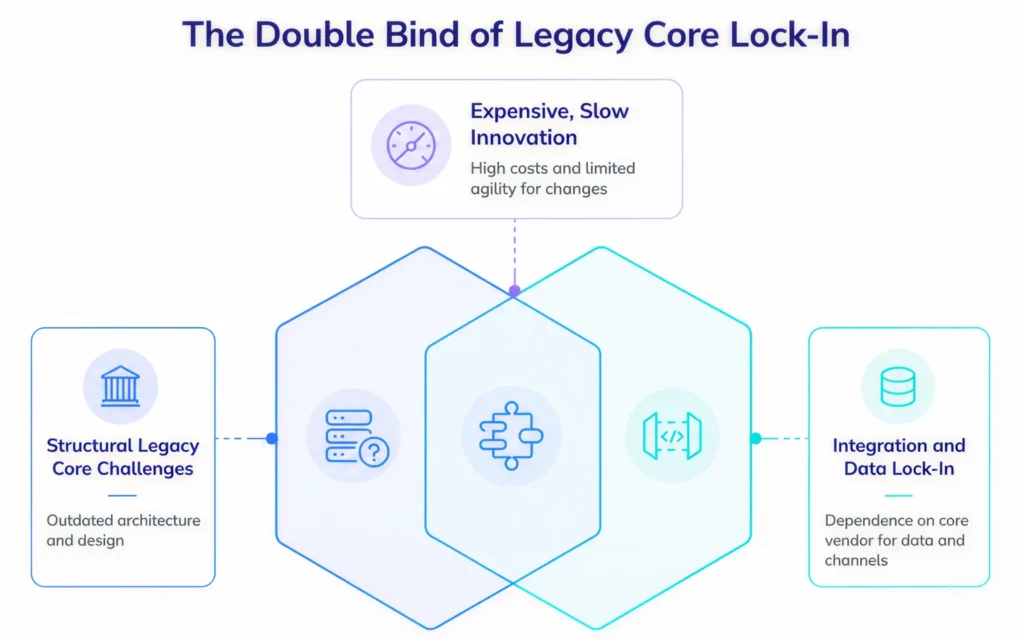
Legacy core integration is at the centre of the lock in problem. Many cores were designed for branch centric, batch oriented operations. They were not built for the real time, API driven experiences members now expect. As a result, even simple changes often require core vendor participation, professional services, or complex middleware work.
Industry analysis of on premise core banking environments suggests that maintaining traditional core infrastructure can consume well over half of an institution’s technology budget once hardware, staffing, security, and upgrade costs are fully accounted for. One recent comparison estimated that legacy core platforms maintained in house can consume around 64 percent of banking IT budgets, leaving only a minority of spend available for innovation. While individual credit union numbers will vary, the directional lesson is clear. When the core and its surrounding ecosystem consume most of the technology budget, every incremental initiative is competing for a small slice of remaining funds.
Lock in through data and integration paths
Vendor lock in is not only about contracts. It is also about data access patterns and integration paths. When a core or a primary digital provider controls the primary integration channels and data structures, the practical effect is that nearly every new journey must pass through them, even when other vendors or internal teams could execute faster.
This dependence turns routine updates, such as adjusting underwriting criteria or adding a new member communication step, into formal projects that require external timelines and fees. Over time, the institution loses the ability to experiment quickly, test new products in market, or respond to niche member segments without initiating a new vendor workflow.
The Hidden Cost of Integrations, Exceptions, and Workarounds
Integration as an ongoing tax
Integration is now one of the biggest sources of friction in digital transformation for credit unions. In the Jack Henry credit union survey, respondents pointed to integration challenges with existing systems as a key reason that technology projects failed to meet objectives, alongside issues like vendor support and implementation delays.
Each custom integration requires design, development, testing, and monitoring. When integration is point to point rather than platform based, these costs accumulate as an ongoing tax on every new initiative. The institution ends up with a fragile web of one off connections that are sensitive to system upgrades, vendor changes, and regulatory updates.
Workarounds and exceptions that never die
When systems cannot be integrated cleanly, staff often build workarounds. Manually rekeying data from one system to another, downloading and uploading files between platforms, or maintaining local spreadsheets to bridge process gaps are all common examples.
These workarounds are costly in time and risk. They raise credit union operating expenses by consuming staff capacity that could be used for relationship building and advisory conversations. They also create exception paths that are hard to audit and hard to automate later. The longer these patterns persist, the harder it becomes to achieve credible member experience ROI because the true end to end cost of serving each member is obscured by manual effort.
Why More Spending Still Fails to Deliver Better Outcomes
Underperforming technology initiatives
When technology initiatives underperform, the reasons are often predictable. The Jack Henry survey asked credit unions why certain technology projects failed to achieve objectives. Respondents highlighted insufficient vendor support or weak performance, longer than expected implementation time, integration challenges, lack of employee adoption, shifts in priorities, and budget constraints.
These responses confirm a pattern many executives recognise. The issue is not a lack of ambition or a lack of governance. Many institutions have clear objectives and disciplined processes. The problem is that the current stack and vendor model make it too hard and too expensive to deliver change at the speed the market demands.
Vendor management and compliance risk
There is also a risk and compliance dimension to this problem. Regulators expect strong credit union vendor management practices that include clear oversight of third party risk, performance, and security. Recent enforcement cases have highlighted how weak vendor management can lead to operational disruption and compliance failures when vendors are not properly governed.
When digital transformation for credit unions relies on many vendors without a central orchestration layer, the complexity of oversight can outpace the capacity of internal risk teams. The result is a landscape where costs are rising and risk is harder to control, not easier.
The Real Problem Is Not Just Price. It Is Loss of Control
Cost is a symptom of deeper dependence
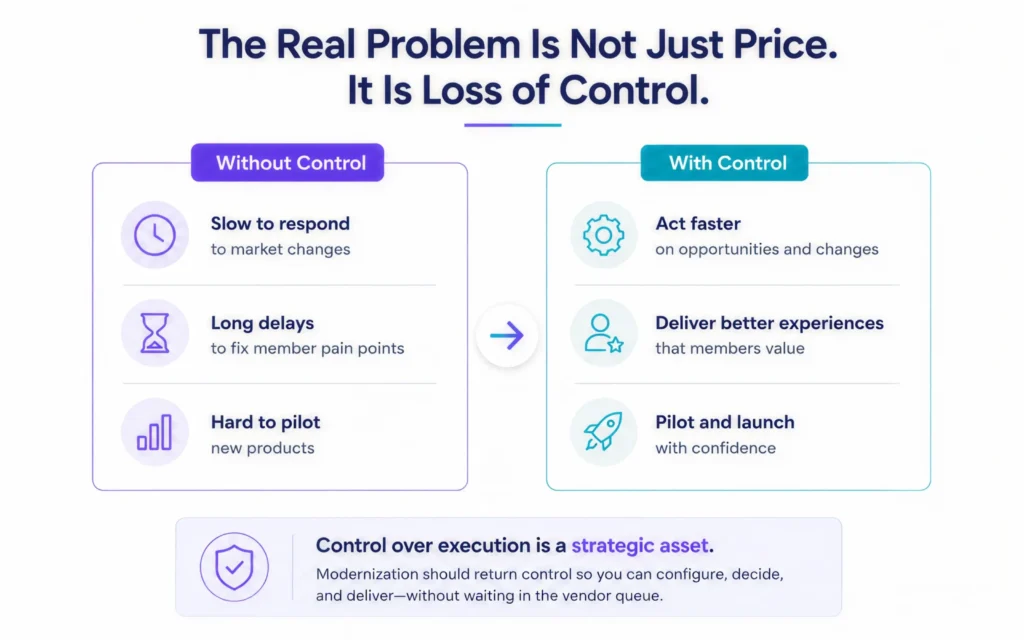
Rising invoices are visible. Lost control is more subtle. When an institution cannot change a member journey, launch a new loan product, or update a workflow without scheduling a vendor project, it has already ceded a significant degree of strategic control.
This can show up in several ways:
- Slow response to rate changes or competitive offers
- Long delays between identifying a member pain point and delivering a fix
- Difficulty piloting new products with small segments before scaling
In each case, the limit is not imagination. It is the current architecture and vendor model.
Control as a strategic asset
For credit union leaders, control over execution is now a strategic asset. Digital transformation for credit unions must therefore be evaluated not only on its cost and feature set, but on how much control it returns to the institution.
A model that allows business and product teams to configure experiences, manage rules, and orchestrate workflows without constant vendor intervention will support better member experience ROI over time. It will also make it easier to align technology with strategy, because the institution can act on decisions without waiting in the vendor queue.
What Credit Union Executives Should Demand from Technology Partners
Non negotiable capabilities
To break the cycle of rising cost and slow execution, executives can reset expectations for technology partners. At a minimum, modern platforms should provide:
- Open, well documented APIs that make legacy core integration simpler rather than harder
- Data access models that allow the credit union to unify member and loan data without deep dependencies on a single provider
- Clear, transparent pricing that ties recurring fees to delivered capacity or value rather than opaque modules
- Strong implementation support with accountable timelines and measurable outcomes
- Tools for configuration that business users can operate, so that small changes do not require formal projects
These expectations apply across the spectrum from loan origination and servicing to digital banking, collections, and workflow automation. They are central to effective credit union vendor management and to long term control over member experience ROI.
Alignment to business outcomes
Executives can also ask vendors to show how their platforms will explicitly improve key metrics such as approval times, funding times, pull through rates, cross sell penetration, and cost per account or cost per loan. If a proposed solution cannot articulate and measure these kinds of outcomes, it risks becoming another line item in credit union operating expenses without a clear path to return.
How to Modernize Without Funding a Full Core Replacement
Modernization as a layered strategy
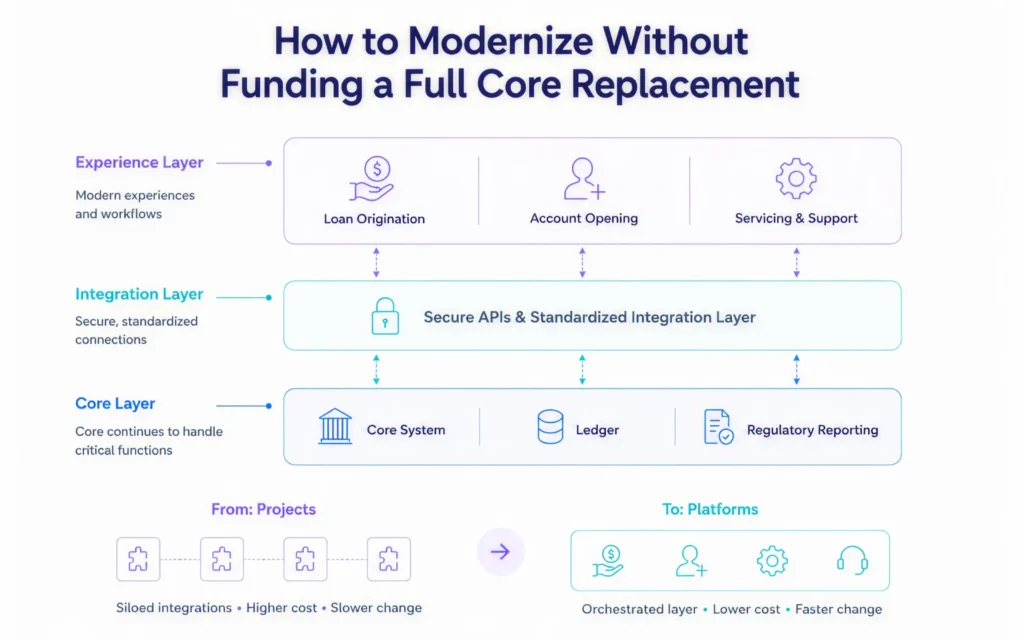
The good news is that modernizing does not always require a full core conversion. Industry commentary from credit union leaders and vendors increasingly emphasises progressive, layered approaches where institutions modernize experiences and workflows around existing cores rather than attempting single stage replacements.
For example, cloud native platforms can sit above legacy cores and orchestrate journeys such as loan origination, account opening, and servicing while the underlying core continues to handle ledger and regulatory reporting. Over time, more functions can be migrated or refactored, but the institution can already reap benefits from faster configuration, better member experience, and more efficient operations.
Moving from projects to platforms
A key principle is to shift from project based integration to platform based orchestration. Instead of building a new point integration for each initiative, credit unions can adopt a digital layer that standardises connections to the core and other enterprise systems, and then reuse that layer for multiple journeys. This approach reduces the hidden tax of integrations and makes it easier to manage change centrally.
For many institutions, this model represents the most practical form of digital transformation for credit unions. It allows them to reduce dependence on any single vendor, improve speed to market, and manage credit union vendor management more coherently, all without writing a single cheque for a risky all or nothing core transformation.
Why ezee.ai Offers a Smarter Path to Speed, Flexibility, and ROI
ezee.ai is built around one operating principle: credit unions should control their own member
journeys not wait in vendor queues to act on decisions already made in the boardroom.
1. A unified orchestration layer above the core
ezee.ai sits above existing core systems and connects to them through pre-built, maintained
connectors eliminating custom point-to-point integrations on each new initiative.
Institutions modernize lending origination, member onboarding, decisioning, and servicing
without touching the core and without funding a core replacement. The integration cost is paid
once. The platform serves every journey built on top of it.
2. Business teams configure. Vendor queues disappear.
Workflows, decisioning rules, member communication sequences, and escalation paths are all
configurable by business users through no-code interfaces. When policy changes whether driven
by a rate environment, a regulatory update, or a competitive response the institution makes
the change on the same day. No service request. No timeline negotiation. No professional
services invoice.
3. Data that drives real decisions
Every journey orchestrated through ezee.ai generates structured data on cycle times, approval
rates, member drop-off, and outcome quality. Executives see exactly where efficiency is being
lost and exactly where member value is being created giving leadership a direct line between
platform investment and business outcome.
4. Implementation measured in weeks, not transformation cycles
The ezee.ai deployment model is designed for institutions that need to demonstrate value before
the next board cycle, not after a multi-year program. Live lending and onboarding journeys
typically move from scoping to deployment in weeks. That is the time-to-value standard every
technology partner should be held to.
5. The strategic outcome for credit union independence
Credit unions that build on ezee.ai shift the economic logic of their entire technology
investment. Operating costs tied to vendor coordination and integration overhead decline. The
cost of launching a product, responding to a rate move, or fixing a member journey drops from a
vendor project to a configuration update made that afternoon. And member experience ROI becomes
a metric the institution owns, measures, and improves on its own terms.
Vendor lock-in does not have to be the price of staying independent. With the right
orchestration platform, credit unions can reduce legacy dependency, accelerate execution, and
compete with the speed and precision members now expect without surrendering control of the
relationships that define the institution’s value.
A path to growth with control
The result is a stronger economic and operating model for credit unions. Instead of absorbing fragmented vendor fees and rising integration overhead, institutions gain a platform that supports scale, speed, and continuous improvement. The cost of launching a new product, responding to market shifts, or refining a member journey drops from a vendor led project to an internal configuration change. That gives leadership more control over credit union operating expenses, clearer visibility into member experience ROI, and a more agile path to growth without sacrificing independence.
Frequently Asked Questions
Credit union consolidation is the reduction of standalone institutions through mergers, usually when one credit union combines into another. It is increasing because leadership continuity and digital investment pressure are harder to manage independently; federally insured credit unions fell from 4,455 to 4,287 in 2025, and NCUA approved 157 mergers.
Some credit unions choose to merge because modernization needs capital, execution discipline, and leadership depth they may not have. McKinsey says up to 75% still operate legacy loan origination platforms, and NCUA linked succession planning gaps to merger risk when key leaders exit.
Consolidation changes ownership and governance, while modernization improves workflows, channels, and decisioning without giving up independence. In practice, modernization means digitizing applications, automating underwriting rules, or reducing manual reviews; consolidation means becoming part of another institution.
Credit unions can stay independent by removing manual work from lending and service operations rather than adding more staff to manage complexity. A modern lending setup can automate KYC, bureau pulls, rule-based underwriting, and exception routing, which matters when many credit unions still rely on legacy platforms.
The biggest risk is a slow, inconsistent member experience that weakens growth before the financial damage becomes obvious. McKinsey notes credit unions remain below 10% in digital sales while regional banks exceed 30%, and customers dissatisfied with digital channels are twice as likely to switch providers.
A loan origination system supports independence by making lending faster, more consistent, and less dependent on merger-driven scale. It can automate application intake, KYC, credit bureau checks, policy rules, and exception handling, helping smaller teams compete without expanding headcount.
Boards should assess whether inefficiency, governance gaps, or leadership continuity are the real constraints. With ezee.ai, credit unions can digitise operations, reduce dependency on individuals, and gain real time control. This enables independent growth and stability, avoiding mergers driven purely by operational limitations.
Look for configurable rules, digital intake, KYC integrations, audit trails, and low code control. ezee.ai enables instant policy changes, faster approvals, and minimal vendor reliance. This ensures agility, compliance, and long term independence, without being constrained by legacy systems or IT bottlenecks.
Prioritise API integrations, modular workflows, automation, and phased rollout. ezee.ai works above the core, enabling gradual transformation across journeys. This allows credit unions to modernise safely, reduce risk, and scale efficiently, without costly or disruptive core system replacements.
Credit unions should prepare by creating a written succession plan for key roles, assigning board ownership, and reviewing it on a defined schedule.
NCUA approved the final rule in late 2024, and it took effect on January 1, 2026