Why AI Debt Collection Is Entering a New Era
The collections industry is undergoing a major transformation. Traditional recovery processes built around manual prioritisation, agent driven outreach, and fragmented workflows are being replaced by intelligent, automated systems.
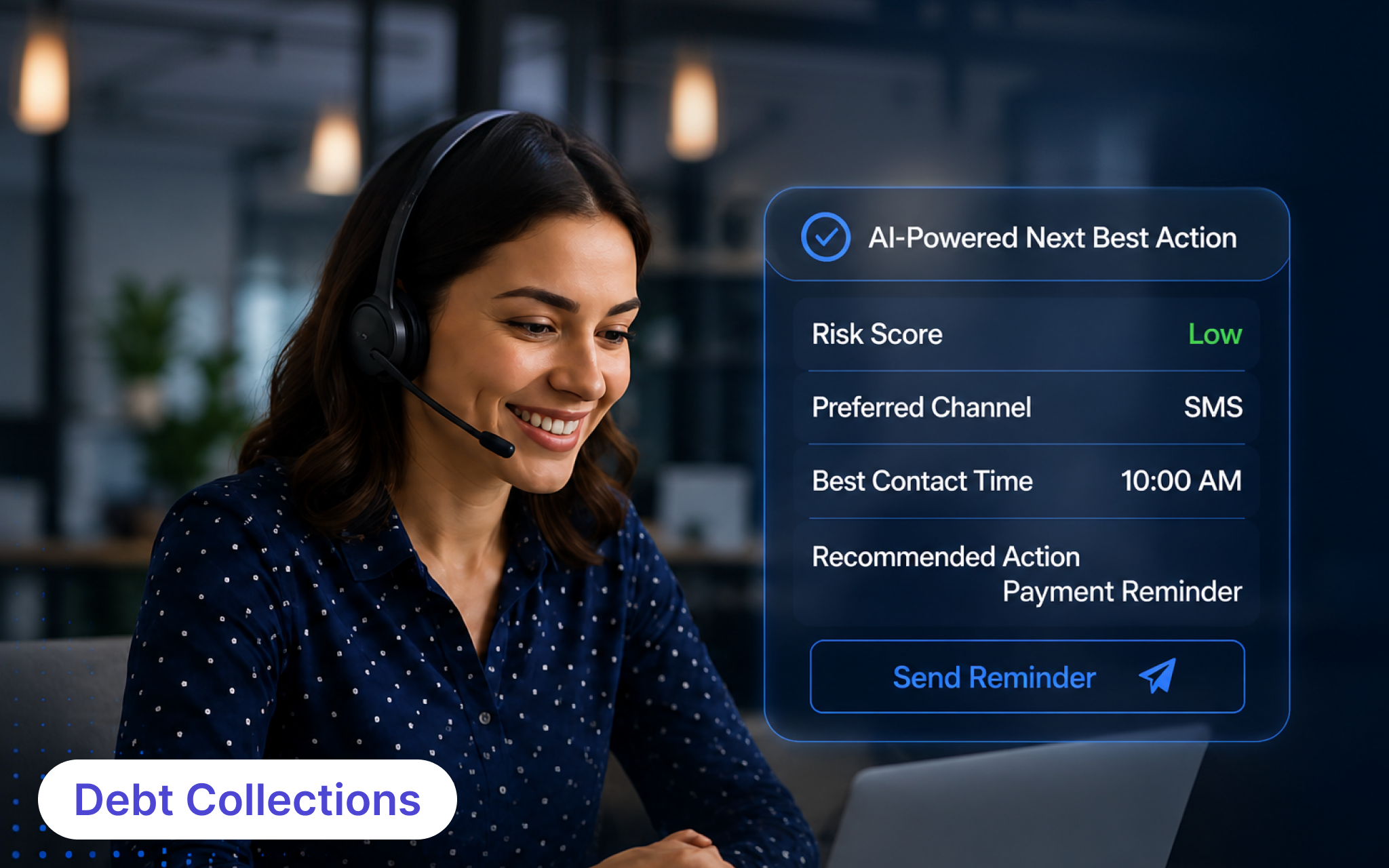
Today, ai debt collection solutions can analyse accounts at scale, personalise outreach, optimise contact timing, identify repayment probabilities, and continuously monitor risk. The emergence of agentic AI takes this further by enabling systems to plan actions, adapt to responses, and coordinate complex workflows with minimal intervention.
For banks, NBFCs, fintech lenders, and collection agencies, the benefits are significant:
- Higher recovery rates
- Lower operational costs
- Better customer engagement
- Faster decision making
- Improved scalability
However, collections remain one of the most heavily regulated functions in financial services.
Regulations governing borrower treatment, communication practices, privacy, consent, and automated decisioning continue to tighten. A compliance failure can lead to regulatory penalties, litigation, reputational damage, and customer attrition.
The challenge is clear: how can organisations leverage ai debt collection while remaining fully compliant?
The answer lies in adopting a compliance first AI strategy from the very beginning.
Why Compliance First AI Matters More Than Ever
Many organisations treat compliance as a review stage at the end of implementation.
That approach no longer works.
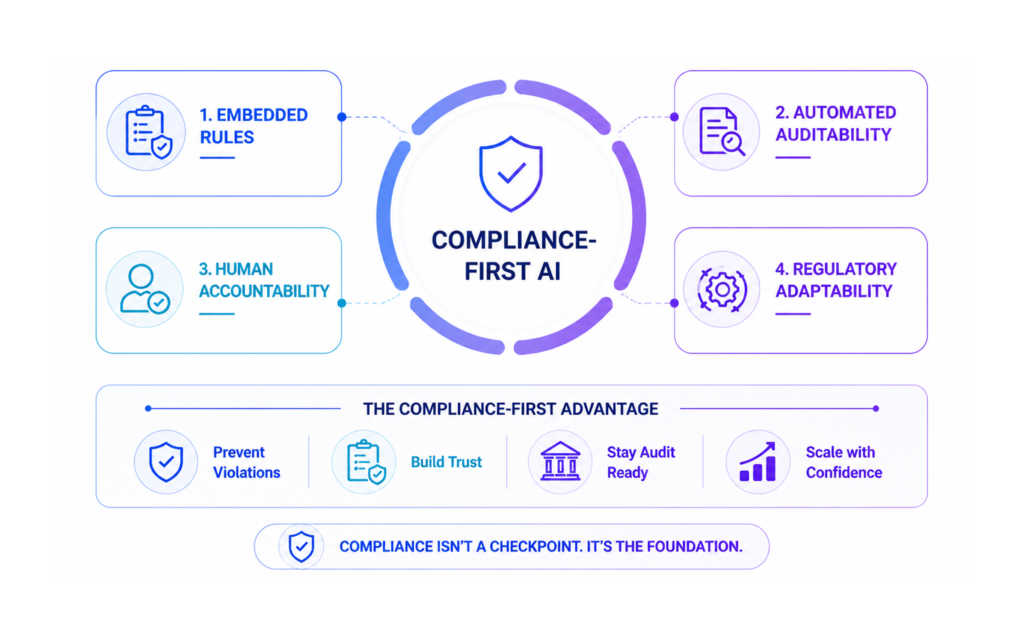
A compliance first AI framework embeds regulatory requirements directly into workflows, models, and decision logic. Instead of asking whether a process is compliant after deployment, the system ensures compliance before any action occurs.
Key principles include:
Regulatory Rules Embedded into Workflows
Before outreach begins, the system verifies:
- Communication frequency limits
- Permitted contact windows
- Customer preferences
- Required disclosures
- Jurisdiction specific requirements
This prevents violations before they happen.
Automated Auditability
Every decision, action, and recommendation is logged automatically. Comprehensive audit trails create transparency for regulators, compliance teams, and internal auditors.
Human Accountability
Even with advanced automation, regulators continue to expect human oversight. A compliance first AI model ensures high impact decisions remain reviewable and escalated when necessary.
Regulatory Adaptability
Rules continue to evolve across jurisdictions. Modern systems must allow policy updates without requiring major redevelopment efforts. Organisations that adopt compliance first AI are far better positioned to scale automation safely.
The Regulatory Landscape Shaping Collections in 2025
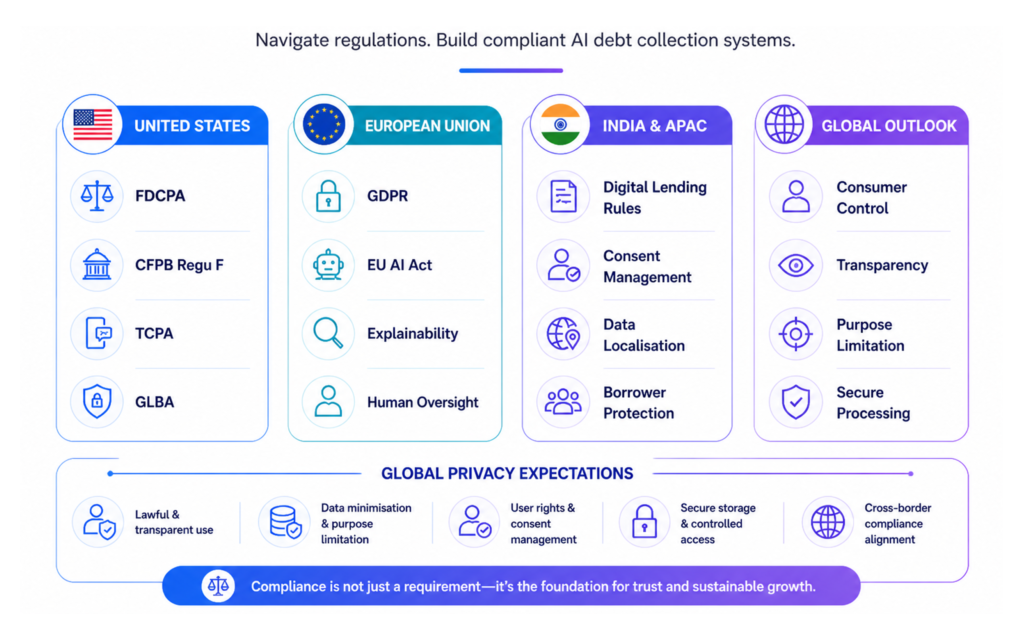
AI driven collections operate within an increasingly complex regulatory environment.
United States
Collections activity remains heavily influenced by:
- FDCPA
- CFPB Regulation F
- TCPA
- GLBA
These frameworks govern communication frequency, consent management, borrower protections, and acceptable outreach practices.
AI systems must ensure:
- Contact timing restrictions are respected
- Communication limits are enforced
- Consumer preferences are honored
- Automated outreach remains compliant
European Union
The combination of GDPR and the EU AI Act significantly raises expectations for automated decisioning.
Collections platforms must support:
- Explainability
- Transparency
- Human oversight
- Fairness monitoring
- Data minimisation
AI systems involved in financial decision making are increasingly treated as high risk applications.
India and Asia Pacific
Digital lending regulations continue evolving rapidly.
Regulators are placing greater emphasis on:
- Borrower protection
- Responsible collections
- Data localisation
- Consent management
These requirements directly influence how ai debt collection platforms are designed and deployed.
Global Privacy Expectations
Across jurisdictions, privacy regulations are converging around several themes:
- Consumer control over data
- Transparency
- Purpose limitation
- Secure processing
Compliance can no longer be separated from technology architecture.
Building Ethical and Explainable AI Collections
Regulatory compliance is only part of the equation. Organisations must also address ethical considerations.
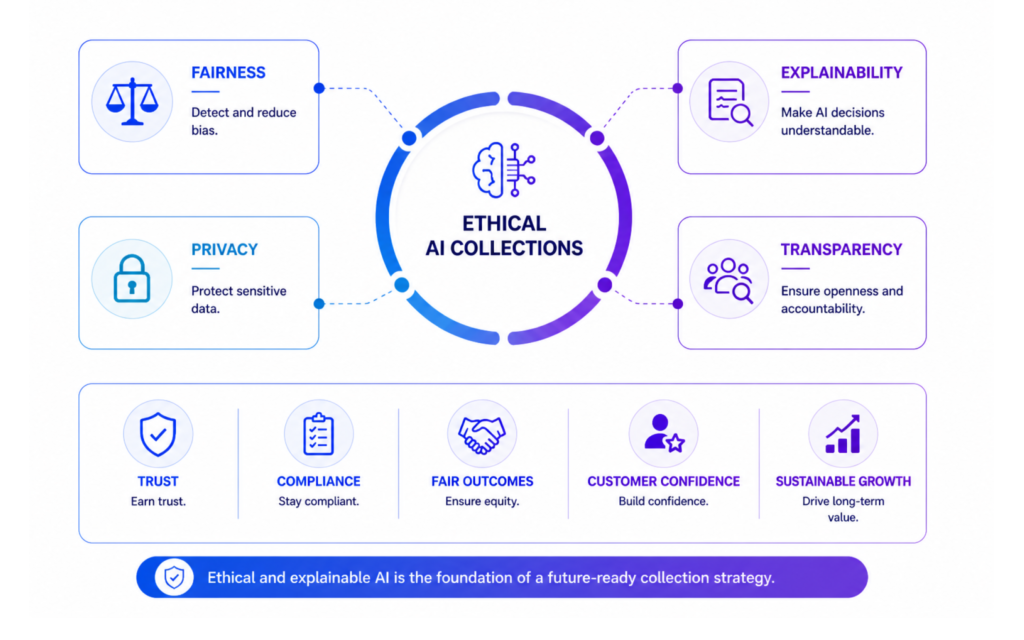
Fairness
Historical collections data can contain embedded biases. Without monitoring, AI systems may unintentionally create unfair outcomes across customer segments.
Strong governance requires:
- Diverse training data
- Bias testing
- Fairness audits
- Continuous monitoring
Explainability
Borrowers, regulators, and internal teams increasingly expect explanations for automated decisions. Recent CFPB guidance reinforces this expectation by clarifying that organizations using complex algorithms and AI driven decisioning remain responsible for providing clear and specific explanations for outcomes that affect consumers.
When AI recommends a settlement strategy, escalation path, or repayment option, organisations must understand why.
Explainable models improve:
- Trust
- Compliance
- Audit readiness
- Operational transparency
Privacy
Collections involves highly sensitive personal and financial information.
Ethical AI frameworks apply strict controls around:
- Data access
- Data retention
- Encryption
- Usage limitations
The strongest ai debt collection programs combine efficiency with transparency and fairness.
Data Governance and Model Governance Essentials
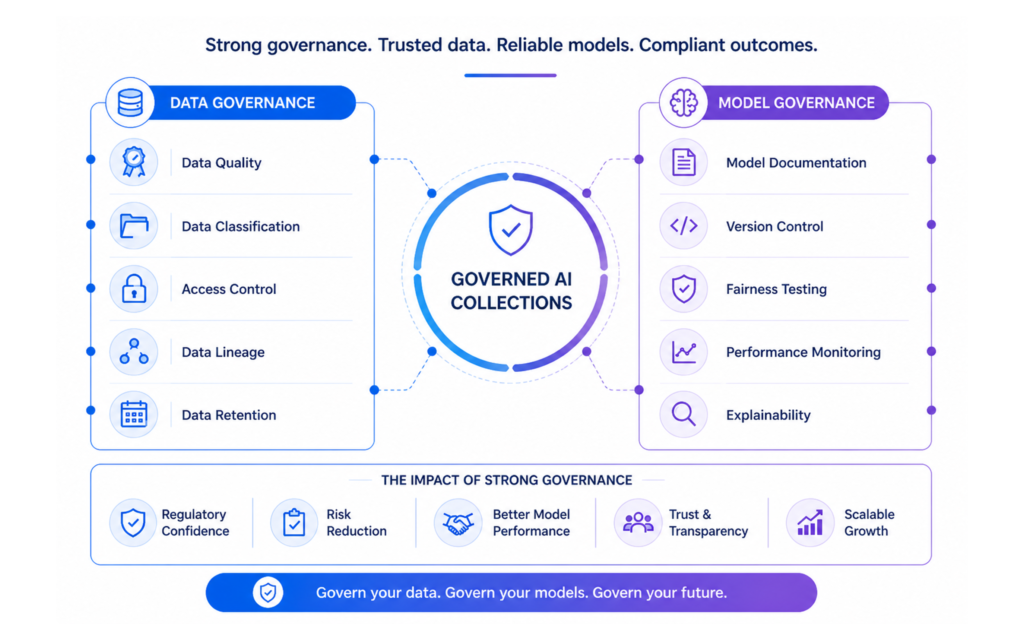
Technology alone cannot guarantee compliance. In regulated collections environments, strong governance structures are essential to ensure AI operates responsibly, consistently, and within regulatory expectations. This is especially important in Compliance first AI environments, where governance defines how innovation can scale safely.
Data Governance Priorities
Effective governance starts with disciplined control over the data that supports AI systems. This includes data classification, quality management, access controls, lineage tracking, and retention policies. Clean, well-governed data strengthens compliance readiness while also improving model reliability and accuracy.
Model Governance Priorities
AI models require ongoing oversight throughout their lifecycle. Critical controls include model documentation, version management, performance monitoring, fairness testing, and explainability reporting. These practices align closely with responsible AI governance frameworks promoted by the World Bank, which emphasize ongoing monitoring, transparency, accountability, and risk management throughout the AI lifecycle.
Designing a Compliant Agentic AI Collections Workflow
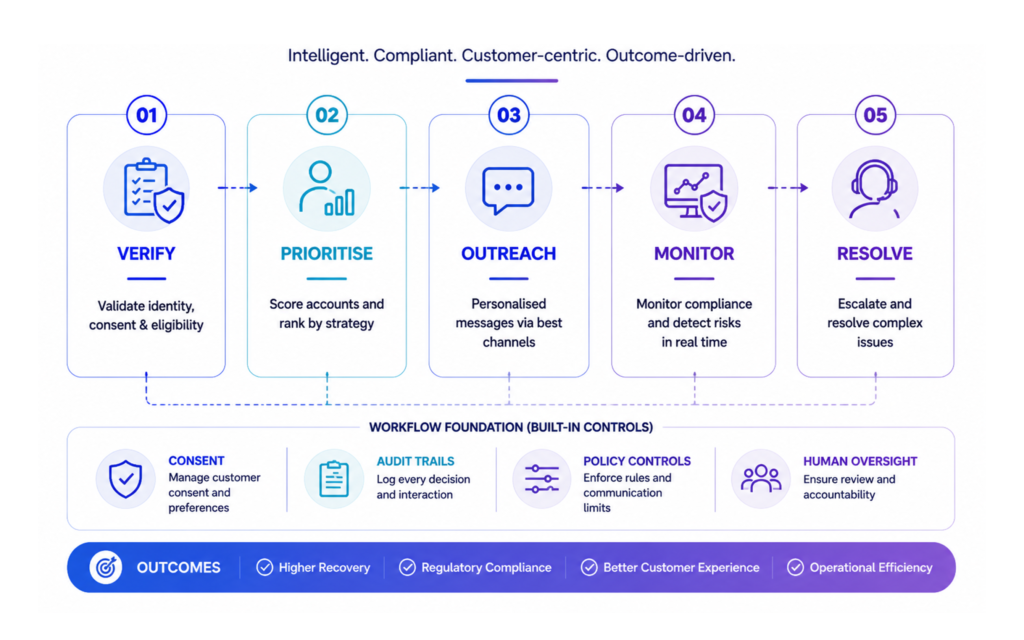
The rise of Agentic AI introduces a more adaptive operating model for collections. Unlike traditional automation, agentic AI systems can evaluate context, coordinate actions, and optimise outcomes within defined compliance guardrails. This makes them increasingly valuable in both ai debt collection and broader Automated debt recovery strategies.
A compliant workflow typically follows five stages.
- Verification and Eligibility: The system confirms right-party contact, consent status, communication preferences, and any existing disputes. Only accounts that meet regulatory and policy requirements move forward.
- Intelligent Prioritisation: Accounts are ranked using factors such as recovery probability, account value, regulatory sensitivity, and customer circumstances. This improves resource allocation while reducing unnecessary compliance risk.
- Personalised Outreach: Agentic AI selects the best channel, contact time, message approach, and escalation threshold. Each communication is designed to remain effective while staying within regulatory boundaries.
- Real-Time Compliance Monitoring: Throughout the process, the system monitors contact frequency, message content, consent status, and policy adherence. Potential issues are identified early, helping teams prevent violations before they occur.
- Human Escalation: More complex cases are routed to human specialists. This includes disputes, hardship requests, fraud concerns, and legal escalation. This balance between automation and human judgment is central to effective ai debt collection strategies.
Human Oversight and Risk Controls
Regulators consistently emphasize the importance of human supervision. Automation should support faster decisions, not remove accountability.
Effective oversight frameworks include supervisory reviews for high-impact actions, real-time monitoring of system behaviour, and exception management for sensitive cases. Audit readiness also matters, with detailed logs capturing decisions, actions, recommendations, and supporting rationale. Periodic validation helps confirm that systems continue operating as intended. Human oversight remains one of the strongest safeguards in compliance-first AI environments.
Scaling AI Debt Collection Across Markets
For global organisations, regulatory fragmentation creates additional complexity. A collections platform operating across multiple jurisdictions must adapt to local requirements without losing consistency. This is where governance intersects directly with Digital lending regulations, especially when firms expand across markets with different compliance standards.
Successful deployments typically rely on data localisation, dynamic compliance controls, localised communications, and strong partner governance. These capabilities become increasingly important as ai debt collection expands across markets.
A Practical Implementation Roadmap
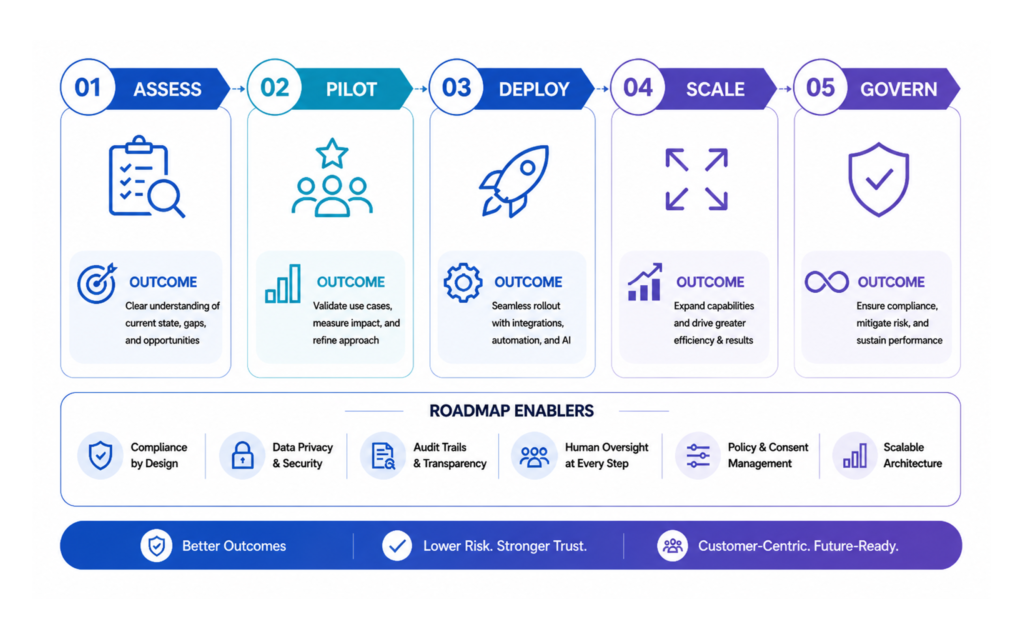
Successful implementation usually follows a phased approach.
Phase 1: Assessment
Review current processes, compliance maturity, data quality, and technology readiness.
Phase 2: Pilot Selection
Choose a focused use case with measurable outcomes, such as account prioritisation, outreach optimisation, or early-stage collections.
Phase 3: Controlled Deployment
Run AI alongside existing processes while monitoring performance and compliance closely.
Phase 4: Scaling
Expand gradually across portfolios, products, and geographies.
Phase 5: Continuous Governance
Maintain fairness testing, compliance monitoring, model reviews, and regulatory readiness assessments.
This phased approach reduces risk while accelerating value creation.
Turning Compliance Into Competitive Advantage
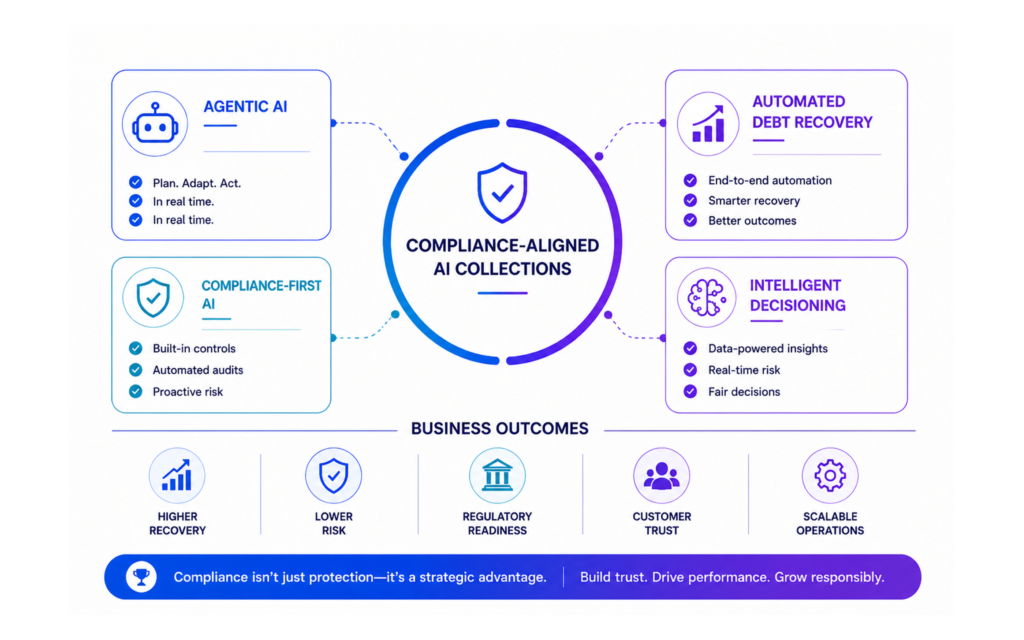
The future of collections belongs to organisations that can balance efficiency with accountability.
AI adoption alone is no longer enough.
The real differentiator is the ability to combine AI debt collection, compliance first, agentic AI, and automated debt recovery into a single operating model that remains transparent, auditable, and regulator ready.
This is where platforms such as ezee.ai fit naturally into the modern collections ecosystem.
Through AI powered automation, workflow orchestration, intelligent decisioning, and debt collection capabilities, ezee.ai enables financial institutions to build compliance aligned collections journeys without heavy engineering dependency. Regulatory guardrails, audit trails, governance controls, and intelligent decisioning work together to optimise recovery while maintaining adherence to evolving digital lending regulations.
The organisations that succeed in 2025 will not view compliance as a barrier to innovation. They will treat it as the foundation for sustainable growth.
By embedding compliance into every workflow, decision, and interaction, financial institutions can transform regulatory obligations into a competitive advantage while building more effective, transparent, and trusted collections operations.
Frequently Asked Questions
AI-driven debt collection calls are legal if they follow strict rules like FDCPA and Regulation F in the US, TCPA limits on frequency, EU AI Act high-risk controls for credit scoring, and RBI digital lending guidelines in India. These ensure no harassment, proper disclosures, and time restrictions (e.g., 8am-9pm local time). Voice agents programmed with scripts maintain audit trails, reducing violation risks versus human errors.
AI agents detect compliance breaches in real time by monitoring calls for off-script language, tone violations, and rule deviations like FDCPA limits. They flag issues instantly during borrower interactions in collections of workflows, enabling immediate corrections. Financial firms report 75% of fewer incidents with such monitoring, per industry analysis.
AI stays compliant by automating checks against FDCPA, TCPA, and RBI rules during every call or message in 2025 workflows. It monitors live interactions for keywords and frequency, flagging deviations before escalation to collections teams. Updates pull from regulatory feeds, ensuring 90% faster adaptation per financial reports.
- Lenders should evaluate built-in compliance monitoring, audit trails, and human oversight before adopting AI tools in regulated setups.
- Key checks include integration with credit bureaus, real-time rule enforcement for contact frequency, and scalability for high-volume delinquencies.
- AI systems cut operational costs by 40% while boosting recoveries 10%, but only if they align with FDCPA and RBI guidelines.
Generative AI supports compliance by generating audit summaries and flagging script deviations in real-time debt interactions. In collections, it documents borrower consent and payment talks automatically, creating trails for Reg F reviews. This cuts documentation errors, aiding KYC-to-recovery traceability.
Organizations should implement script enforcement, consent verification, and escalation to humans for complex cases with AI voice agents. Add real-time monitoring for time-of-day and frequency rules under TCPA during delinquency outreach. Bias audits and logs ensure FDCPA alignment, minimizing risks.
Lenders ensure AI outreach compliance by programming agents with TCPA limits like 7 calls per week and 8am-9pm windows. Systems verify consent via prior express records before SMS or calls in collections cycles. Real-time dashboards track adherence, honoring opt-outs instantly.
- Lenders should seek real-time compliance tracking, automated scripting, and omnichannel integration in 2025 AI software.
- Prioritize voice agents with TCPA checks, predictive risk flagging, and API links to LMS for seamless KYC-to-collections flows.
- These features ensure 19% higher recovery rates through ethical, auditable practices under CFPB and EU rules
Model governance maintains compliance by requiring regular audits, bias checks, and retraining against evolving EU AI Act and RBI rules. It inventories models for collections decisions, ensuring explainability in credit bureau integrations. Ongoing monitoring prevents drift, supporting long-term auditability.
- Platforms like collect.ezee enable compliant AI collections via pre-built rule engines that enforce contact limits and consent checks automatically.
- They log every interaction for audits during delinquency workflows, integrating with CIBIL for borrower verification.