

Why Static Allocation Logic Is Hurting Bad Debt Recovery
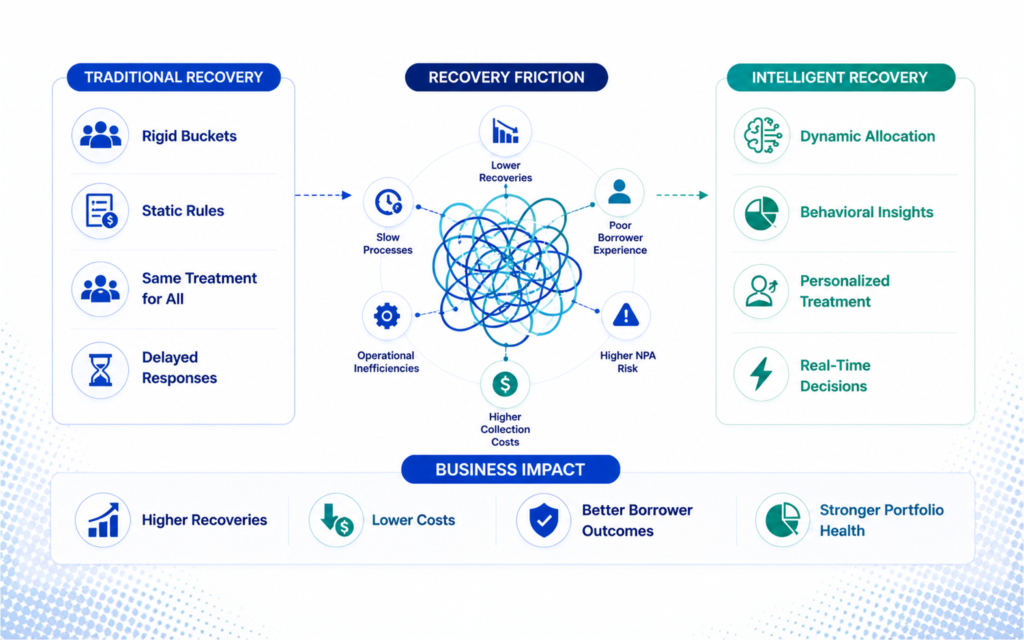
For decades, banks and other lenders have managed repayments, collections, and delinquent accounts through fixed allocation rules.
Today’s borrowers operate in a world of gig income, multiple credit products, real time payments, and volatile cash flows. Yet many financial institutions continue using allocation logic designed for a slower, less dynamic economy. For banks, this can make bad debt recovery less responsive as borrower circumstances change.
The result is declining recovery efficiency.
A borrower making a partial payment may see the amount applied entirely toward fees and charges rather than reducing principal. Another borrower may receive the same treatment strategy as every other account in the same bucket despite displaying completely different repayment behaviour.
These inefficiencies directly impact bad debt recovery outcomes.
What appears to be a simple operational process is increasingly becoming a strategic differentiator. Institutions that continue relying on static allocation frameworks risk lower recoveries, rising operational costs, and weaker portfolio performance.
The challenge is no longer collections alone.
It is how intelligently lenders allocate payments, prioritise actions, and respond to borrower behaviour in real-time – decisions that increasingly shape the effectiveness of bank debt recovery.
The Hidden Costs of Traditional Collection and Allocation Models
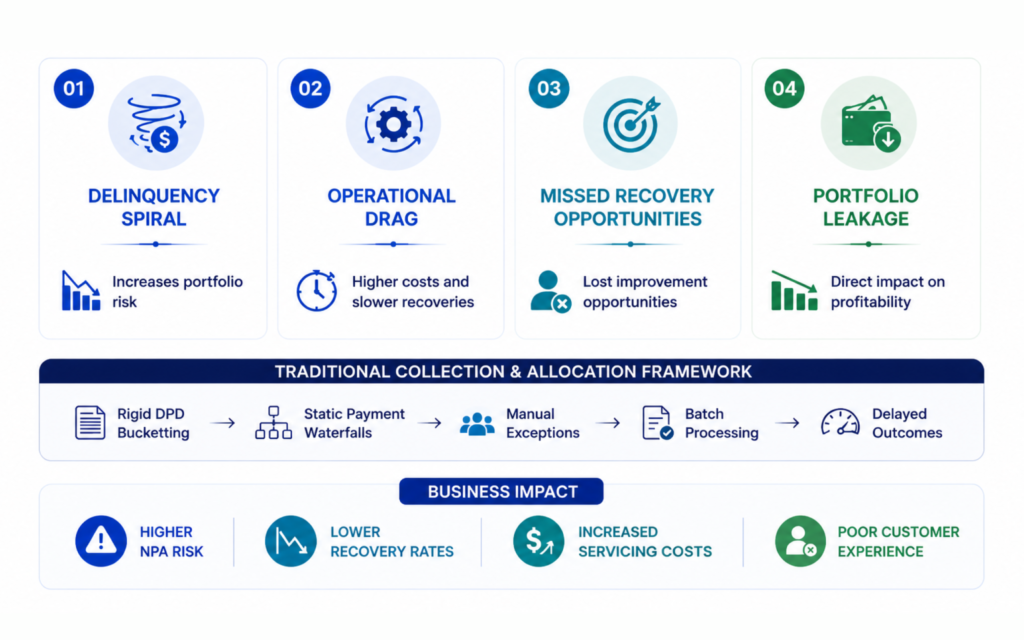
The limitations of legacy allocation frameworks extend far beyond operational inefficiency.
They create measurable financial leakage across the lending lifecycle.
The Delinquency Spiral
Traditional payment waterfalls often prioritise fees and penalties before principal reduction.
For borrowers already facing financial stress, this creates a cycle where payments have little visible impact on outstanding debt. Instead of moving closer to resolution, borrowers become increasingly disengaged.
Over time, this weakens bad debt recovery performance and increases portfolio risk.
Operational Drag
Static allocation rules rarely accommodate exceptions effectively.
Partial payments, co lending structures, payment disputes, settlement agreements, and cross product obligations frequently require manual intervention.
This creates significant operational overhead that modern accounts receivable automation solutions are designed to eliminate.
Teams spend valuable time reconciling exceptions instead of focusing on strategic recovery activities.
Missed Recovery Opportunities
Perhaps the biggest issue is the inability to distinguish between borrowers.
A borrower at Day 31 and another at Day 59 may sit in the same collection bucket but represent completely different recovery opportunities.
Traditional approaches fail to recognise these nuances.
As a result, lenders apply identical treatments to accounts that require fundamentally different engagement strategies, limiting improvements in recovery rates.
How Intelligent Allocation Improves Recovery Performance
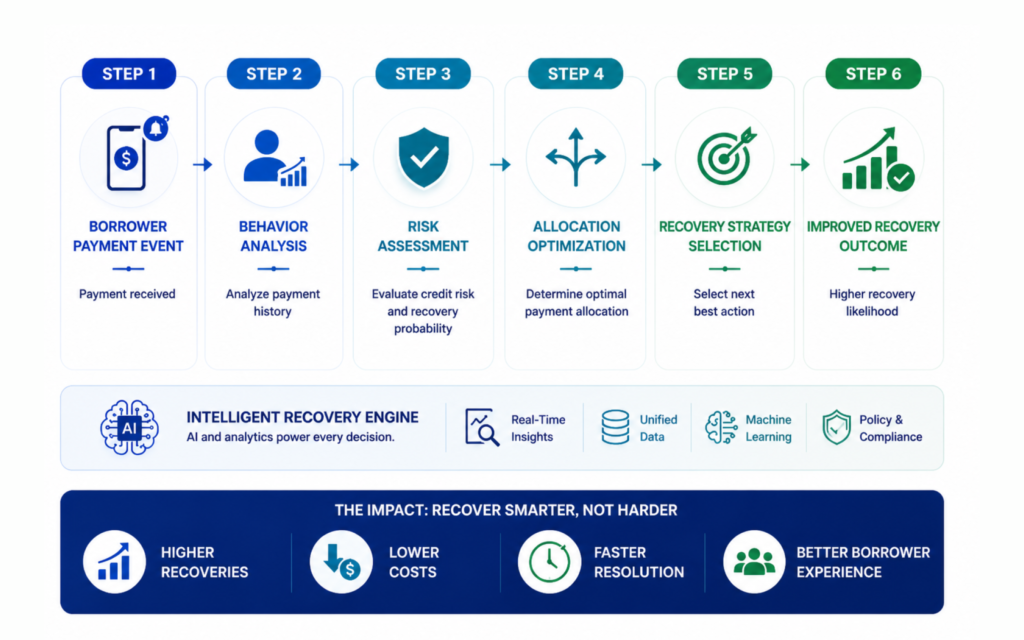
The strongest recovery organisations are moving away from static rules and toward data-driven collections and intelligent allocation models.
Instead of asking where a payment should go based on historical policy, they ask where it should go to maximise recovery outcomes.
This shift is transforming modern debt collection strategies.
Behaviour Driven Prioritisation
Modern allocation engines analyse multiple signals simultaneously:
- Payment history
- Delinquency trends
- Borrower responsiveness
- Risk indicators
- Cash flow patterns
Rather than relying solely on DPD buckets, lenders can prioritise accounts based on actual repayment probability. BIS research on advanced analytics and machine learning highlights the value of granular segmentation and predictive modelling in improving decision quality beyond traditional rule based approaches.
This allows recovery teams to focus effort where it has the greatest impact.
Dynamic Payment Allocation
Intelligent allocation engines can adjust repayment hierarchies based on context.
For example, reducing principal exposure may sometimes create better long term outcomes than aggressively collecting fees.
Similarly, payment distribution can be adapted across multiple obligations to improve overall recovery potential.
The goal is not simply collecting money.
It is maximising sustainable bad debt recovery.
Real Time Decisioning
Legacy systems often process allocation decisions in batches.
Modern platforms operate in real time.
When a borrower makes a payment, the system can instantly evaluate risk, repayment history, current obligations, and recovery objectives before determining the optimal allocation path.
This creates a more responsive and effective recovery process.
The impact can be substantial.
The impact can be substantial when intelligent allocation combines timely data, predictive models, and effective recovery workflows.
Compliance, Automation, and the Rise of Dynamic Recovery
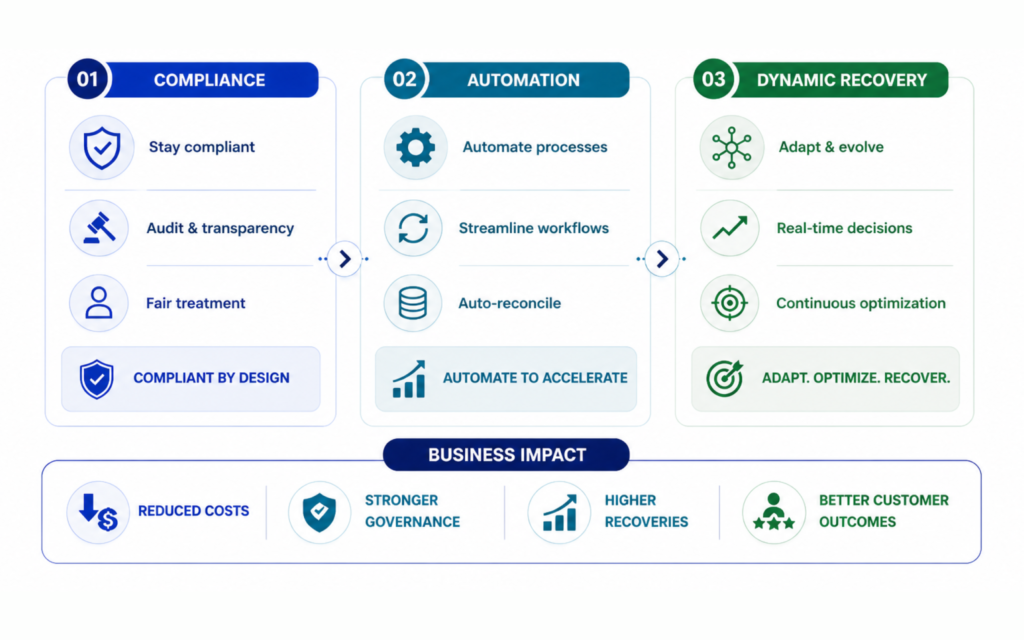
Recovery optimisation cannot come at the expense of compliance.
Allocation decisions operate within strict regulatory frameworks that vary across markets.
In the United States, Regulation Z includes payment-allocation requirements for certain credit card accounts, including rules governing how amounts paid above the required minimum are allocated across balances with different APRs.
In India, RBI requirements covering areas such as digital lending, customer protection, and co-lending add further complexity to recovery operations.
This is where intelligent systems offer another advantage.
Rather than relying on manual interpretation of regulations, allocation rules can be embedded directly into decision frameworks.
A well-designed allocation framework can make decisions more:
- Consistent
- Explainable
- Auditable
- Compliant
At the same time, lenders can leverage accounts receivable automation to reduce manual effort, improve operational speed, and support more effective NPA management.
Automated reconciliation, payment routing, exception handling, and workflow orchestration help eliminate many of the inefficiencies that traditionally slowed recovery operations.
The result is a recovery environment that balances compliance with performance.
For institutions managing large portfolios, maintaining that balance is increasingly important to sustainable recovery outcomes.
The Shift to Dynamic Intelligence: AI, APIs, and Real Time Context
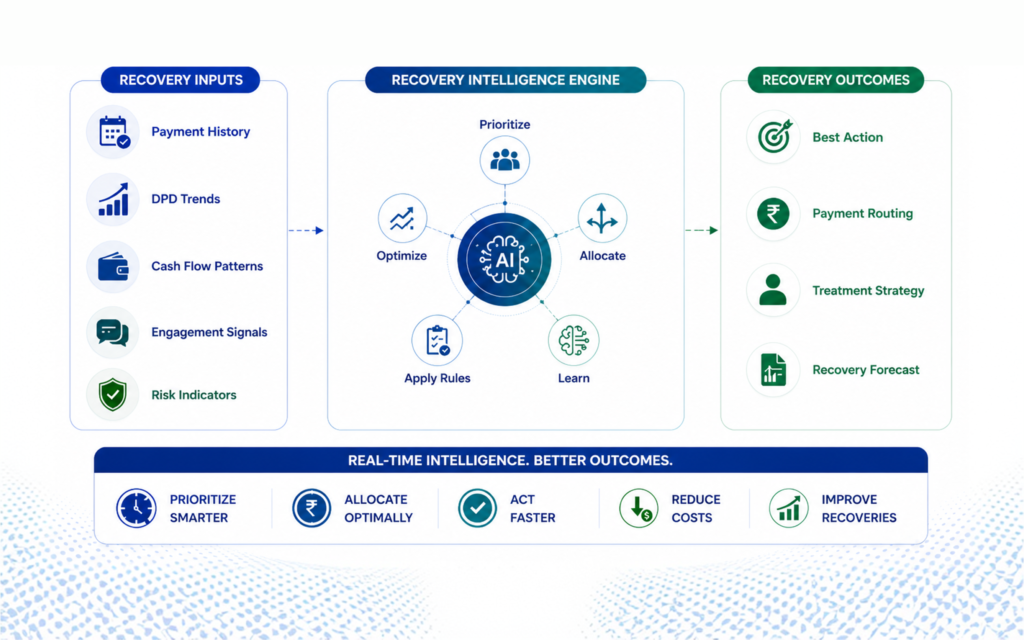
The biggest transformation in modern collections is not automation alone. It is the shift from static rules to intelligent decisioning for more effective bad debt recovery.
Traditional allocation systems operate in batches. Payments are processed based on predefined hierarchies, recovery actions follow fixed schedules, and borrower treatment is largely determined by delinquency buckets. While functional, these approaches struggle to adapt to real world borrower behaviour.
Modern recovery ecosystems operate differently.
Using APIs, lenders can combine payment activity, account performance, behavioural signals, bureau updates, and operational data in real time. AI models then evaluate this information to determine the next best recovery action, payment allocation path, or engagement strategy.
This shift is reshaping debt collection strategies.
Instead of treating all borrowers in a bucket identically, lenders can prioritise accounts based on repayment probability, risk exposure, engagement history, and recovery potential. A borrower showing signs of temporary financial stress may receive a different treatment strategy than one displaying chronic delinquency patterns, supporting more targeted NPA recovery.
The impact extends beyond collections.
Real time intelligence improves bad debt recovery, accelerates decision cycles, and enables more effective accounts receivable automation by reducing manual intervention across payment processing, reconciliation, and exception handling.
The institutions gaining the greatest advantage are not necessarily those collecting the most data. They are the ones turning data into decisions faster than their competitors.
The Future of NPL Management and Recovery Operations
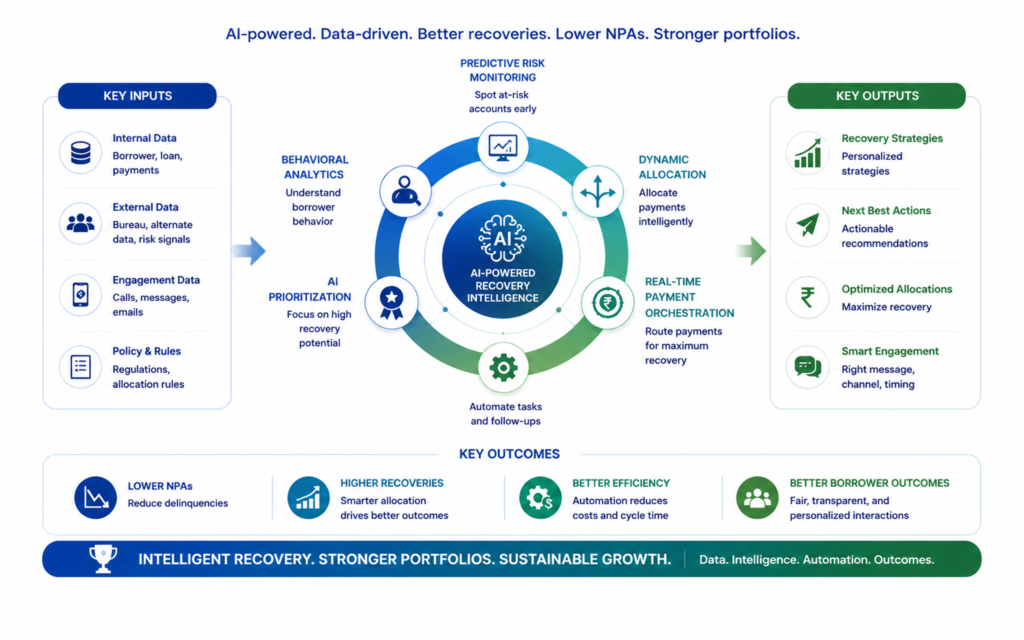
The future of collections and NPA management will be defined by intelligence, not volume.
Historically, success was measured by agent productivity, call volumes, and recovery campaigns. Increasingly, competitive advantage is being determined by the quality of decisions made throughout the recovery lifecycle.
Leading lenders are already combining:
- AI driven prioritisation
- Behavioural analytics
- Dynamic allocation
- Real time payment orchestration
- Predictive risk monitoring
These capabilities are fundamentally reshaping non-performing loan (NPL) management.
Instead of reacting after delinquency occurs, lenders can identify risk signals earlier, intervene proactively, and optimise repayment journeys before accounts deteriorate. This can support more targeted NPA recovery while improving portfolio quality and strengthening long term recovery performance.
Intelligent recovery ecosystems can contribute to lower NPL levels by enabling earlier risk identification, more targeted interventions, and more efficient recovery operations.
This is where platforms such as Collect.ezee and Decision.ezee fit naturally into the transformation journey. By combining workflow orchestration, AI powered automation, recovery intelligence, and real time decisioning, they help lenders modernise allocation logic, optimise debt collection strategies, and improve bad debt recovery performance without replacing existing core systems.
As lending becomes increasingly digital, recovery operations will evolve from a reactive function into a strategic source of portfolio intelligence. The institutions that thrive will not simply be those that collect more. They will be the ones that recover earlier, allocate smarter, and make better decisions at every stage of the lending lifecycle.
Frequently Asked Questions
Bad debt recovery typically involves managing delinquent and non-performing accounts through collection, resolution, restructuring or other recovery actions. Under RBI’s asset-classification framework, NPAs are classified as substandard, doubtful or loss assets based on applicable criteria, with recovery and resolution approaches varying according to the account’s circumstances.
Static bucket-based approaches apply uniform collection strategies across all risk tiers and lack behavioural intelligence. Algorithms with access to borrower contact history, reimbursement patterns, and prior recovery behavior demonstrate significantly better forecasting of recovery outcomes than rule-based buckets alone. Modern ML-informed segmentation outperforms legacy bucket models because it captures borrower-specific propensity, not just DPD stage.
Dynamic allocation optimizes resource deployment in real time based on borrower behaviour and recovery probability. AI-prioritized collections can help lenders focus resources on accounts with higher recovery potential, reducing wasted effort on lower-yield cases. The effectiveness of these strategies depends on portfolio characteristics, data quality, model performance, and how effectively recovery teams act on the resulting priorities.
Predictive analytics can identify accounts showing early signs of delinquency by monitoring behavioural signals, payment drift, engagement decline, and external credit bureau updates. Earlier identification gives lenders an opportunity to intervene before financial stress develops into more severe delinquency.
Lenders should evaluate modern bad debt recovery platforms on five dimensions:
- unified borrower profiling (CIBIL, Experian API integration)
- predictive recovery scoring with expected timeline estimates
- intelligent risk-based segmentation
- multi-channel orchestration (SMS, WhatsApp, voice, legal)
- compliance-first design with audit trails for FDCPA, RBI, and PCI DSS requirements.
AI-driven recovery tools can support NPA management by predicting behavioural risk, prioritising accounts based on recovery potential, and enabling real-time decisioning. They can also automate borrower engagement and reduce manual intervention across collection workflows, helping lenders focus recovery efforts where they are most likely to have an impact.
Several factors influence whether a delinquent account can be recovered before write-off, including:
- Borrower profile: Business experience, education level, conscientiousness
- Loan characteristics: Term length, collateral adequacy, DPD stage
- Collection history: Contact records, reimbursement patterns, settlement attempts
- Regulatory compliance: RBI-mandated documentation of all recovery efforts
Behavioural indicators such as payment drift, engagement decline, new credit inquiries, and income changes can signal financial stress weeks before default. Machine learning models trained on historical contact data, reimbursement patterns, and account activity can support earlier risk identification and more targeted data-driven collections.
Partial payment allocation should follow the applicable loan agreement terms and regulatory requirements governing the recovery process. Write-off approval should follow the lender’s defined authority framework, with relevant factors such as loan size, DPD status, and collateral value considered where applicable. Clear documentation of recovery efforts also supports consistent, auditable bad debt recovery decisions.
Payment orchestration can improve recovery efficiency when borrowers use multiple payment rails and channels by enabling:
- Smart channel routing: Auto-selects bank transfer, digital wallets, or instalments based on real-time success rates
- Retry & reconciliation: Automates partial payment tracking and settlement matching
- Compliance automation: PCI DSS adherence, regulatory reporting, reduced processing delays
References
- Reserve Bank of India — Master Circular: Income Recognition, Asset Classification, Provisioning and Other Related Matters
- Reserve Bank of India — Master Circular: Prudential Norms on Income Recognition, Asset Classification and Provisioning Pertaining to Advances
- Reserve Bank of India — Guidelines on Digital Lending
- Consumer Financial Protection Bureau — Regulation Z, §1026.53: Allocation of Payments
- Bank for International Settlements — Big Data and Machine Learning in Central Banking