
Why Credit Unions Must Rethink Innovation
Fintechs have evolved from emerging disruptors into serious competitors for member relationships. For many credit unions, the challenge is no longer product availability but delivering experiences that match modern expectations. Research consistently shows that younger members increasingly choose institutions based on convenience, speed, and usability rather than branch presence alone.
This shift has elevated driving credit union innovation from a strategic initiative to a business necessity. Similar priorities have emerged across the global credit union sector, where digital transformation and member experience modernization continue to rank among the most important drivers of long term competitiveness.
Credit unions already possess strong foundations: trust, community relationships, and member centricity. The challenge is turning those strengths into digital experiences that feel effortless while improving operational efficiency in banking.
The Experience Gap Costing Growth
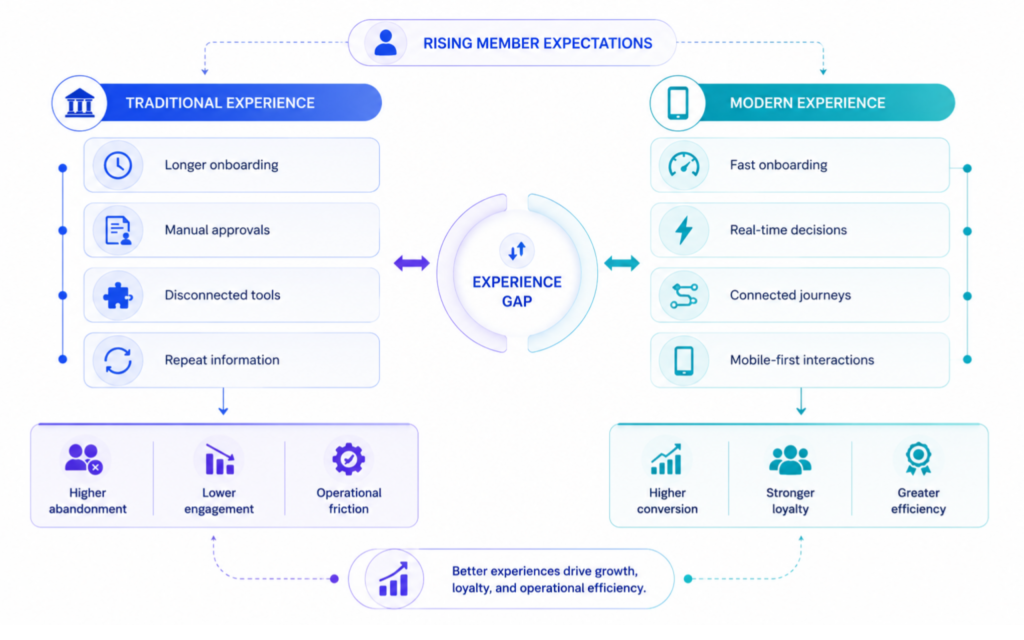
Many institutions underestimate how quickly members disengage when digital experiences feel slow or fragmented.
Consider a few common realities:
- Digital onboarding often takes 7 to 12 minutes.
- Loan approvals may require several days.
- Financial management tools frequently exist as disconnected add ons.
- Members must repeat information across channels.
By contrast, leading fintech’s deliver streamlined journeys supported by strong digital account opening UX, instant feedback, and mobile first design.
The impact is measurable:
- Longer onboarding processes increase abandonment rates.
- Delayed loan decisions reduce conversion opportunities.
- Fragmented experiences lower engagement and product adoption.
- Manual workflows create operational bottlenecks.
What appears to be a technology issue is often an orchestration problem. Accenture research shows that 73% of consumers expect organizations to understand their unique needs and expectations, making disconnected member journeys increasingly difficult to justify.
What Fintechs Get Right About Member Journeys
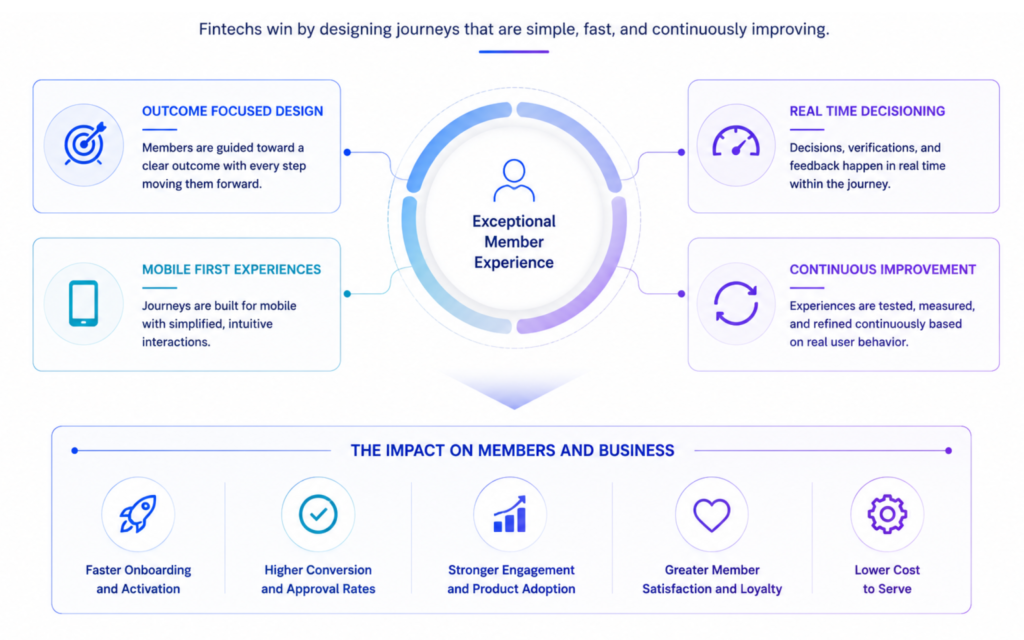
Fintech success is rarely driven by larger budgets alone. Their advantage comes from execution speed and journey design.
Several principles consistently appear in high performing experiences.
Outcome Focused Design
Members are guided toward a specific outcome rather than being forced through internal processes.
Whether opening an account or applying for a loan, every interaction feels connected to progress rather than administration.
Real Time Decisioning
Eligibility checks, verification, and decision making occur within the journey whenever possible.
Even when decisions cannot be instant, members receive clear status updates and next steps.
Mobile First Experiences
Strong digital account opening UX is designed around smartphones rather than desktop workflows.
Applications are simplified, navigation is intuitive, and interactions feel natural.
Continuous Improvement
Fintech teams constantly test and refine experiences.
Instead of quarterly releases, improvements happen frequently based on user behaviour and performance data.
For credit unions, this is an important insight. Competing on features alone is difficult. Competing on experience quality is far more achievable.
From Feature Parity to Member Experience Orchestration
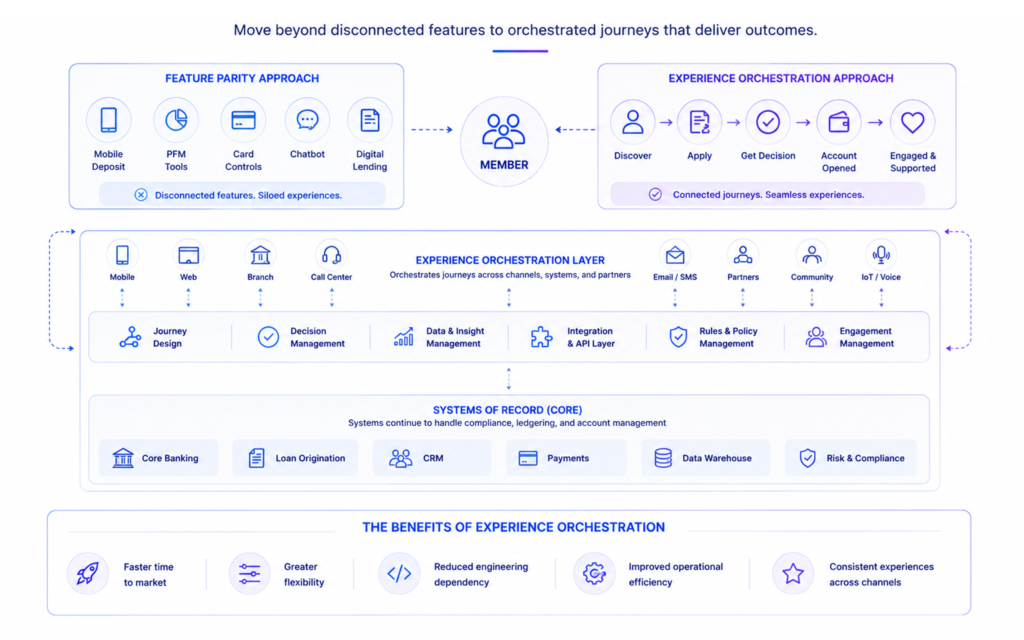
Many institutions respond to fintech pressure by adding more capabilities.
They introduce:
- Mobile deposit
- Personal financial management tools
- Card controls
- Chatbots
- Digital lending features
Yet members rarely experience these capabilities as a connected journey.
This is where member experience orchestration becomes critical.
Rather than asking which feature to add next, credit unions should ask:
- What is the member trying to achieve?
- Which systems support that objective?
- How can every interaction feel connected?
The most effective approach separates the system of record from the system of experience.
Core banking platforms continue handling compliance, ledgering, and account management. An orchestration layer coordinates journeys across channels, systems, and partners.
This enables:
- Faster deployment of new experiences
- Greater flexibility
- Reduced engineering dependency
- Improved operational efficiency in banking
- Consistent member journeys across channels
Experience becomes a strategic asset rather than a collection of disconnected projects.
Fintech Partnerships as Growth Accelerators
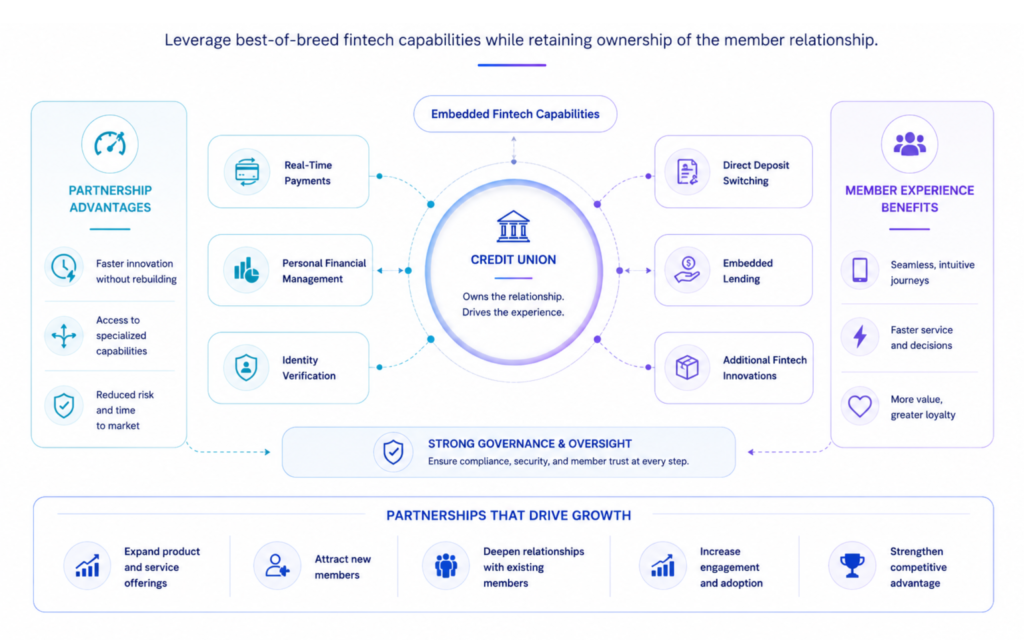
An important shift is taking place across the industry.
Many fintech firms now view credit unions as preferred distribution partners rather than direct competitors. This has expanded opportunities for the modern credit union fintech partnership model.
Common partnership areas include:
- Real time payments
- Personal financial management
- Identity verification
- Direct deposit switching
- Embedded lending experiences
The key is maintaining ownership of the member relationship.
A successful credit union fintech partnership allows specialized capabilities to be embedded into existing journeys while the credit union retains control over branding, compliance, and member trust.
This approach offers two significant advantages:
- Faster innovation without rebuilding capabilities internally
- Greater agility when introducing new services
When supported by strong orchestration, partnerships become growth accelerators rather than dependency risks.
Reimagining Digital Account Opening and Lending
Few journeys influence acquisition and growth more than onboarding and lending.
Unfortunately, many institutions still rely on processes that resemble digitized paper forms rather than modern digital experiences.
A better approach focuses on reducing friction.
Modern Account Opening
Effective digital account opening UX typically includes:
- Embedded identity verification
- Integrated KYC processes
- Guided funding steps
- Minimal initial data collection
- Immediate activation opportunities
Members reach value faster, improving completion rates and engagement.
Smarter Lending Journeys
The same principles apply to lending.
By orchestrating data collection, verification, document management, and decisioning into a single workflow, institutions can:
- Reduce manual effort
- Accelerate approvals
- Improve member satisfaction
- Increase straight through processing
This directly supports both member growth and operational efficiency in banking.
A Practical 90 Day Innovation Playbook
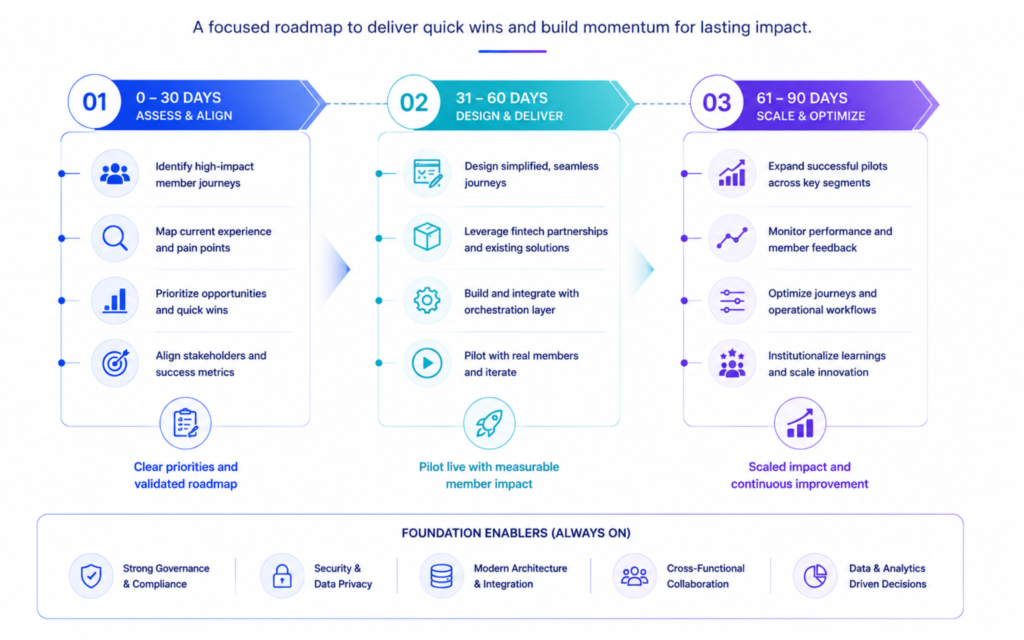
Large scale transformation programmes often delay progress.
Instead, credit unions can begin with a focused 90 day initiative.
Days 1 to 15: Map a High Value Journey
Select a journey with clear friction points.
Examples include:
- New account opening
- Personal loans
- Auto lending
Identify drop off points, delays, and manual processes.
Days 16 to 30: Add One High Impact Capability
Prioritise a capability that creates immediate value.
Examples include:
- Identity verification
- Instant decisioning
- Direct deposit switching
- Financial management tools
Days 31 to 60: Launch an Orchestrated Pilot
Deploy a redesigned journey for a specific segment.
Focus on:
- User experience
- Compliance visibility
- Performance tracking
Days 61 to 90: Measure and Improve
Track outcomes such as:
- Completion rates
- Time to funding
- Loan conversion rates
- Product adoption
Use insights to refine the journey and build the business case for broader adoption.
A focused pilot often creates more momentum than a large transformation roadmap that takes years to show results.
Measuring Success Through Experience Metrics
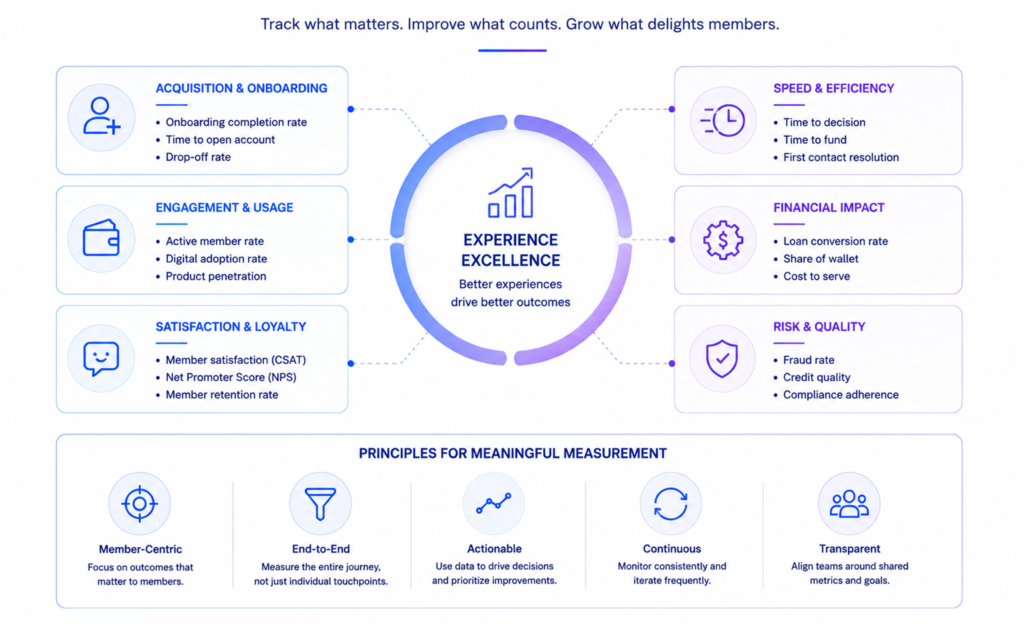
Innovation must produce measurable outcomes.
The most important indicators include:
Onboarding Conversion Rate
Measures how many applicants become active members.
Strong digital account opening UX can significantly improve conversion performance.
Time to Funded Account
Tracks how quickly members gain access to usable funds.
Shorter timelines improve satisfaction and engagement.
Loan Approval to Disbursement Speed
Measures the complete lending experience rather than decision speed alone.
Faster funding often increases acceptance rates.
Product Attachment Rate
Evaluates how many new members adopt additional products within their first 90 days.
This is a strong indicator of relationship growth and successful member experience orchestration.
These metrics transform experience improvements from subjective discussions into measurable growth strategies.
From Digital Projects to Continuous Innovation
The most successful credit unions are moving away from project based transformation and toward product based thinking.
Instead of treating onboarding or lending as one time initiatives, they view them as evolving experiences that can be continuously refined.
This shift allows business teams to respond faster to changing member expectations while maintaining governance and compliance controls.
That is where platforms such as ezee.ai become increasingly valuable. By combining AI powered automation, workflow orchestration, intelligent decisioning, and solutions spanning loan origination, credit decisioning, loan management, and debt collection, institutions can modernise journeys without replacing existing core systems.
The future of driving credit union innovation is not about outspending fintechs. It is about combining member trust with exceptional experiences.
Credit unions that embrace member experience orchestration, invest in stronger digital account opening UX, build strategic credit union fintech partnership ecosystems, and improve operational efficiency in banking will be best positioned to strengthen relationships, increase growth, and remain competitive in a rapidly evolving financial landscape.
Frequently Asked Questions
Demographic segments miss lifetime value because they ignore real behavior like product mix, balances, and engagement across the member lifecycle. Two 35-year-olds can look identical on paper but differ 5–10x in profitability depending on loans held, deposits, and cross-sell depth.
Many digital programs rewire channels and cores but never fix journey-level friction for account opening, lending, or service. Teams chase “digital” KPIs, while members still face abandoned applications, slow underwriting, and inconsistent follow-ups; over 70% of transformations underperform on outcomes, per multiple industry studies.
In the first 90 days, track leading indicators on specific journeys, not just logins or app downloads. For example, monitor application abandonment, STP approval rates, onboarding TAT, and NPS for new digital members; even 10–20% improvements signal you’re fixing real pain, not just adding UX.
Deposit leakage shows up first in behavior, not demographics. Watch for shrinking primary deposits, salary rerouted elsewhere, dormant bill-pay, or card spend shifting off-us over 3–6 months; these signals usually precede formal attrition and can predict churn and lost cross-sell revenue.
Competing for wallet share means deepening relationships with existing members using behavioral and product-level insights. Identify members with checking only, high transacting but low savings, or external mortgage indicators, then trigger targeted offers; firms with strong loyalty effects grow more than 2x industry average.
Behavioral data lets you tune experiences based on what members actually do, not just their age. For example, you can shorten mobile journeys for repeat borrowers, add guardrails for first-time applicants, or surface savings nudges when balances spike boosting satisfaction and cross-sell across Gen Z to retirees.
On ezee.ai, we help credit unions design, test, and automate member journeys without overloading IT. Key capabilities include no-code flow design, API-based integration with core and LOS, event-driven triggers, AI-driven next-best actions, and analytics showing TAT, drop-offs, and 20–30% conversion uplifts.
When the core stays, IT’s role is to expose stable services and guardrails so business teams can safely innovate at the edge. IT manages APIs, security, data quality, and release pipelines, while product and operations use no-code layers to iterate journeys for onboarding, lending, and servicing.
Personalizing for mobile-first members starts with reading real-time behavior during onboarding and applications. For example, shorten forms for payroll-verified applicants, pre-fill KYC from CKYC and existing profiles, and surface BNPL or micro-credit offers when small-ticket card or UPI patterns suggest early credit demand.
ezee.ai acts as a no-code “journey brain” sitting above existing cores, letting credit unions build modern digital journeys fast. Product teams visually design flows, call KYC, CKYC, and bureau APIs, automate underwriting steps, and cut journey steps by 15–30% while IT handles security and compliance.