
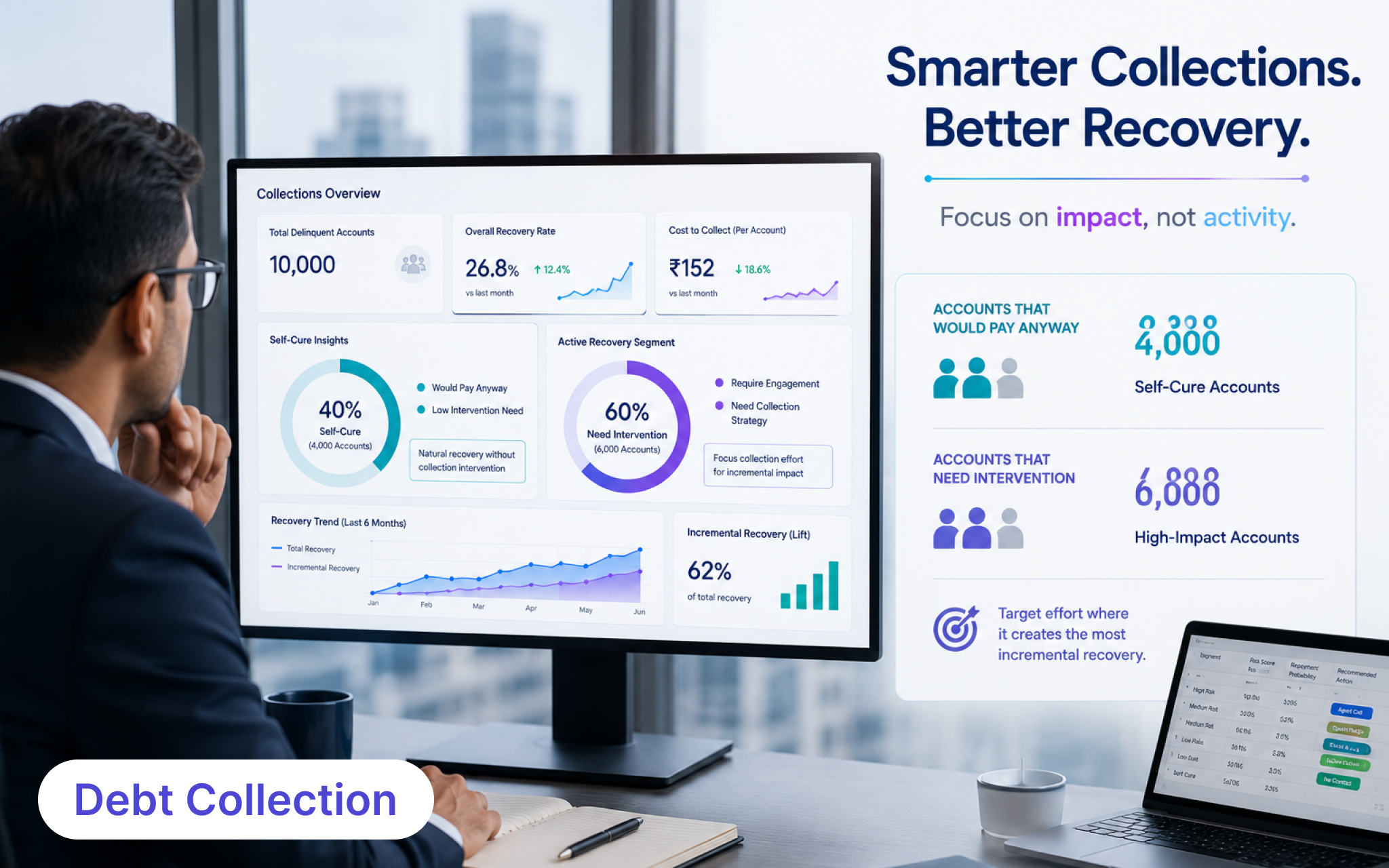
The Hidden Cost Inside Most Debt Recovery Strategies
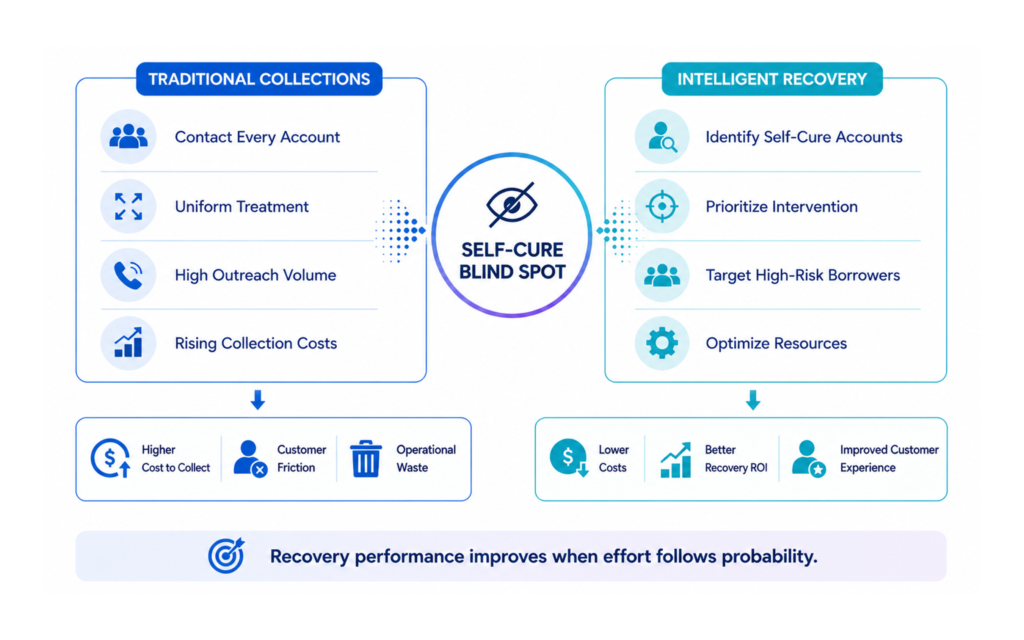
Most lenders believe their collections strategy is working because recoveries continue to come in.
The problem is that many never ask a more important question: how much of that recovery happened because of collections activity, and how much would have happened anyway?
This distinction sits at the centre of modern debt recovery strategies. Effective recovery is not simply about increasing contact volume. It is about identifying which borrowers are likely to self cure, determining where intervention can create incremental recovery, and directing collection resources accordingly.
When borrowers miss a payment, not all of them require intervention. A significant portion will self cure within days because the delinquency was caused by temporary cash flow friction, forgotten payments, or short term circumstances rather than genuine repayment distress. Industry studies and portfolio analyses consistently show meaningful self cure behaviour in early delinquency buckets.
Yet many lenders continue to apply the same treatment to every borrower.
The result is an expensive operating model that increases cost to collect, creates unnecessary customer friction, and often fails to improve incremental recovery.
For institutions seeking sustainable profitability, the challenge is no longer collecting more. It is understanding where collections effort genuinely creates value.
Why Activity Based Collections Destroy Portfolio Value
Most collections organisations are built around activity metrics.
Teams are measured by:
- Calls completed
- Contacts attempted
- Payment promises secured
- Accounts worked
The assumption is simple: more activity produces more recovery.
The economics tell a different story.
Consider a portfolio with 10,000 accounts in early delinquency. If, for illustration, 40 percent of those borrowers would self cure within a few days, thousands of contacts could be directed toward customers who were already likely to pay. Each unnecessary outreach attempt carries operational cost, compliance exposure, and potential customer dissatisfaction.
When multiplied across large portfolios, the numbers become significant.
What appears to be successful recovery can therefore include recoveries that would have occurred without intervention. The critical question is not only how much was recovered, but how much additional recovery was created by the collection activity.
The deeper problem is incentive design.
Third party agencies, internal collections teams, and reporting structures often reward gross recoveries rather than incremental recoveries. This encourages more activity, not necessarily better outcomes.
Over time, lenders become trapped in a cycle where increasing collections effort appears productive, even when it is reducing overall portfolio efficiency.
Understanding Self Cure Behaviour in Early Delinquency
To improve collections performance, lenders first need to understand borrower behaviour.
Early-stage delinquency does not always indicate sustained repayment difficulty. Some borrowers may resolve a missed payment within a short period because of temporary cash flow friction, a missed transfer, or simple oversight.
Borrowers can therefore move through different stages of early delinquency, with the likelihood of self-cure changing over time.
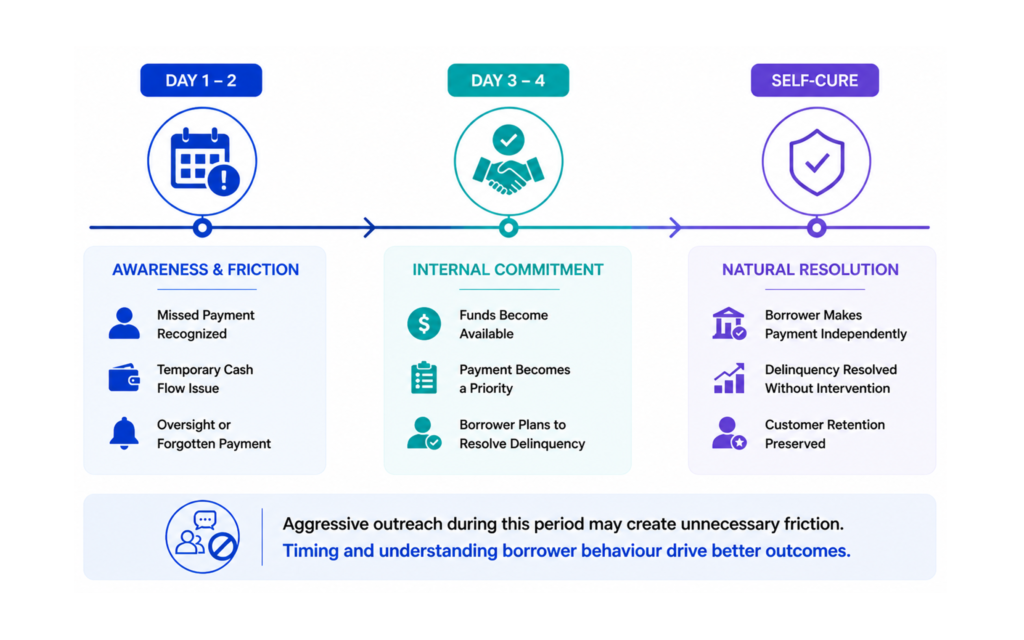
Days 1 to 2: Awareness and Friction
The borrower recognises a missed payment.
The cause may be temporary liquidity constraints, a missed transfer, or simple oversight. During this stage, some borrowers may already be planning corrective action.
Days 3 to 4: Internal Commitment
Cash flow improves, priorities adjust, or funds become available.
Some borrowers may decide independently to resolve the delinquency without external intervention.
This behaviour creates what many collections leaders overlook: a potential self-cure window.
Contacting borrowers aggressively during this period can sometimes create more friction than value, particularly when repayment was already likely.
This is why effective debt recovery strategies increasingly focus on timing, behavioural signals, and probability of self-cure rather than blanket outreach. The objective is not to avoid intervention altogether, but to distinguish accounts where intervention is likely to add value from those that may resolve without it.
From Mass Outreach to Intelligent Debt Collection Segmentation
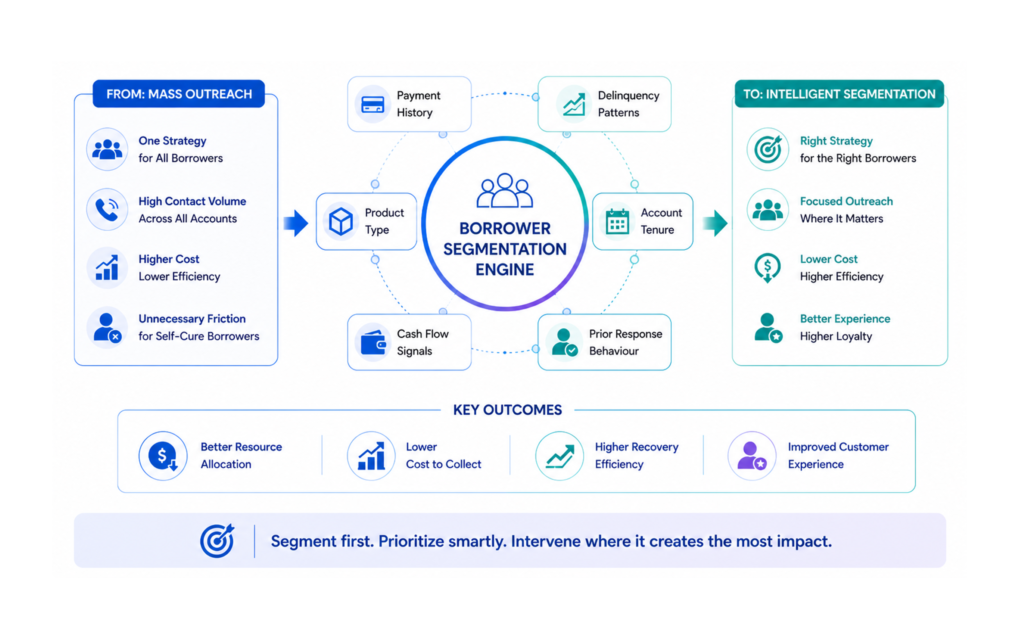
A more targeted collections strategy moves away from volume-based outreach toward debt collection segmentation.
Instead of treating all delinquent accounts equally, lenders can segment borrowers based on expected behaviour, repayment patterns, and the likelihood that different forms of intervention will create incremental recovery.
Key segmentation factors include:
- Payment history
- Delinquency patterns
- Product type
- Account tenure
- Cash flow indicators
- Prior response behaviour
The objective is simple.
Allocate resources where they are most likely to create incremental impact.
A borrower with a high probability of self-cure requires a different strategy from a borrower showing signs of escalating financial stress. The former may be suitable for a lower-cost or delayed intervention, while the latter may require earlier and more targeted engagement.
This approach changes collections economics.
Instead of maximising contacts, lenders can focus on maximising recovery efficiency by matching the level of intervention to the expected needs and behaviour of each segment.
The Role of Holdout Groups
One of the most useful tools for evaluating collection effectiveness is holdout testing.
A small group of accounts receives no contact during a defined early-delinquency window. Their performance provides a baseline for estimating the level of recovery that may occur without collection intervention.
The comparison between contacted and non-contacted groups helps lenders estimate incremental recovery, the additional recovery associated with the intervention rather than recovery that would likely have occurred anyway.
Without this baseline, lenders cannot accurately determine whether collection efforts are generating incremental value or simply taking credit for recoveries that would have occurred naturally.
Holdout testing therefore gives lenders a practical way to evaluate whether a collection strategy is improving recovery outcomes, reducing unnecessary intervention, and allocating resources more efficiently.
Digital First Collections and the New Recovery Model
Technology can help lenders operationalise this shift from blanket outreach to differentiated intervention.
Digital first collections reflect a growing recognition that human outreach should be focused where it is most likely to create incremental value. When accounts have a high probability of self-cure or require only a simple payment prompt, lenders can use lower-cost digital journeys rather than immediately assigning them to agent-led collections.
Examples include:
- SMS reminders
- Mobile notifications
- Self service payment links
- Automated email communications
These approaches can reduce collection effort and cost to collect while maintaining convenient ways for borrowers to resolve overdue payments.
For higher-risk accounts, collections teams can focus on activities that genuinely require human judgement:
- Hardship discussions
- Repayment planning
- Dispute resolution
- Complex recovery scenarios
The result is a more differentiated operating model in which digital channels handle appropriate lower-complexity interventions while human resources are reserved for accounts where direct engagement can create greater value.
Why Collections Workflow Automation Matters
The effectiveness of digital first collections depends heavily on collections workflow automation.
Automation allows lenders to:
- Trigger communications based on defined account conditions
- Route accounts dynamically according to segment or risk
- Monitor borrower responses and changes in behaviour
- Escalate cases when predefined conditions are met
Without workflow automation, segmentation can remain a theoretical exercise. With it, lenders can translate segment-level decisions into consistent, repeatable collection journeys at scale.
This creates a direct link between borrower segmentation, channel selection, and operational execution—allowing lenders to apply the appropriate level of intervention without relying on manual routing for every account.
Measuring What Actually Drives Recovery
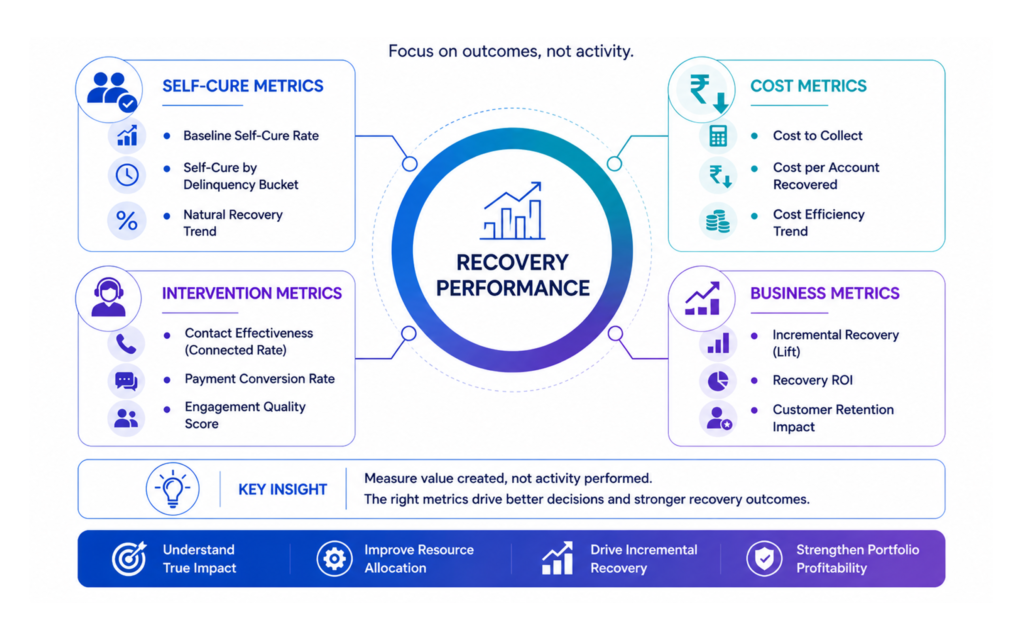
Many lenders still lack visibility into the true economics of collections.
Gross recovery alone does not show whether collection activity created additional value. To understand performance more accurately, institutions need to compare recovery outcomes against the level of self-cure that would have occurred without intervention.
Key measures include:
- Baseline self cure rates
- Cost to collect by segment
- Contact effectiveness
- Recovery lift from intervention
- Customer retention outcomes
Together, these measures help lenders determine whether collections activity is improving portfolio performance or simply increasing operational effort and cost.
For example, a segment may generate strong gross recovery but still deliver limited incremental value if a large proportion of accounts would have self-cured without intervention. Measuring recovery lift alongside cost to collect helps identify where collection resources are creating value and where intervention may be unnecessarily expensive.
When lenders measure incremental value rather than activity volume, they can make more informed decisions about treatment strategies, resource allocation, and collection investment.
Why Collections Must Be Managed Like a Profit Centre
The strategic shift is not only technological. It is also about how lenders evaluate the economic contribution of collections.
Many institutions continue to manage collections primarily as a cost centre, focusing on operational expenses and activity levels rather than the value created by intervention.
A more outcome-oriented model evaluates collections according to their contribution to portfolio value. Under this framework, success can be measured through:
- Net recovery value
- Portfolio profitability
- Recovery ROI
- Customer retention impact
- Regulatory risk reduction
These measures help lenders evaluate whether investments in debt collection segmentation, digital first collections, behavioural analytics, and collections workflow automation are improving outcomes relative to their cost.
The result is a shift from managing collection activity to managing recovery economics. Lenders can then allocate resources toward strategies and segments where intervention is most likely to generate incremental value while avoiding unnecessary collection effort.
The Future of Recovery Is Outcome Based
The collections industry is moving toward a future where intelligence matters more than intensity.
The most successful debt recovery strategies will not be those that contact the most borrowers. They will be those that identify the right borrowers, at the right time, through the right channel, with the right level of intervention.
Making that transition requires more than policy changes. Lenders need the ability to continuously segment borrowers, identify self cure behaviour, orchestrate digital journeys, automate recovery workflows, and measure incremental recovery at scale. In practice, this means moving away from disconnected collections tools and toward unified recovery platforms that combine intelligence, automation, and operational control.
This is where modern collections ecosystems are beginning to evolve. Platforms such as ezee.ai‘s collect.ezee are designed around many of the principles discussed throughout this article, including borrower segmentation, proactive delinquency management, digital first collections, collections workflow automation, personalised communication strategies, and recovery performance visibility. Rather than increasing contact volume, the focus shifts toward improving recovery effectiveness while reducing cost to collect and maintaining stronger customer relationships.
The uncomfortable truth is that many collections operations still measure effort instead of impact.
The institutions that move first toward outcome based recovery, incremental measurement, and value driven collections will gain a significant advantage in profitability, compliance, and customer retention.
Because the future of collections is not about contacting more borrowers.
It is about understanding which borrowers need intervention, which borrowers will self cure, and how to allocate recovery resources where they create the greatest economic value.
Frequently Asked Questions
Self-cure occurs when a borrower resolves an overdue payment without direct collection intervention. This can happen when the delinquency results from a temporary cash-flow issue, a missed payment, or another short-term circumstance rather than sustained repayment difficulty.
Identifying accounts with a higher likelihood of self-cure can help lenders avoid unnecessary intervention and focus collection resources where they are more likely to create incremental recovery.
Lenders can assess signals such as previous repayment behaviour, delinquency history, payment patterns, account characteristics, and responses to earlier collection activity. The specific signals and their predictive value will vary by portfolio and product.
The objective is not to assume that every early-stage delinquency will self-cure, but to estimate the likelihood of self-cure and use that assessment to determine the appropriate level and timing of intervention.
Digital-first collections can provide lower-cost interventions for accounts that require a simple reminder or convenient payment option. Examples include SMS notifications, mobile notifications, automated email, and self-service payment links.
This allows lenders to reserve more resource-intensive human intervention for accounts where direct engagement, hardship support, repayment planning, dispute resolution, or other forms of assistance are more appropriate.
Lenders can improve their collection strategy by moving from uniform outreach toward differentiated treatment. This involves segmenting accounts according to borrower behaviour and risk, assessing self-cure likelihood, selecting appropriate channels, automating repeatable workflows, and measuring the incremental impact of intervention.
The aim is to match collection effort with expected value rather than maximise contact volume across the portfolio.
Lenders should look beyond gross recovery and assess whether collection activity generated additional recovery relative to what would have occurred without intervention.
Useful measures include baseline self-cure rates, recovery lift from intervention, cost to collect by segment, contact effectiveness, and customer outcomes. Holdout testing can provide a practical baseline for estimating incremental recovery.
Self-cure is recovery that occurs without the collection intervention being evaluated. Incremental recovery is the additional recovery associated with that intervention after accounting for the recovery that would likely have occurred without it.
For example, if a group of delinquent accounts has a high natural cure rate, contacting every account may produce substantial gross recovery without creating an equivalent level of incremental recovery. Comparing contacted and non-contacted groups can help lenders distinguish the two.
Holdout testing involves withholding a defined collection treatment from a comparable group of accounts and comparing its outcomes with a contacted group.
The difference between the groups can help lenders estimate the incremental effect of the intervention. This provides a stronger basis for evaluating whether a treatment improves recovery enough to justify its operational cost and customer impact.
Lenders can reduce unnecessary outreach by combining borrower segmentation with automated treatment rules. Accounts with a higher likelihood of self-cure may receive lower-cost or delayed intervention, while accounts showing greater repayment risk can be routed to earlier or more intensive engagement.
Workflow automation helps operationalise these decisions by triggering communications, routing accounts, monitoring responses, and escalating cases according to predefined conditions.
References
- The Analytics-Enabled Collections Model — McKinsey & Company
- Digital Debt Collections and Credit Loss Resilience — McKinsey & Company
- Holistic Customer Assistance Through Digital-First Collections — McKinsey & Company
- The Customer Mandate to Digitize Collections Strategies — McKinsey & Company
- Leveraging Analytics & Virtual Agents for Hassle-Free Debt Collection — Tata Consultancy Services