

Why the Underwriting Process for Mortgage Is Becoming a Growth Bottleneck
The underwriting process for mortgage products sits at the centre of a growing challenge for lenders expanding their Loan Against Property portfolios. Demand for LAP continues to rise across banks, NBFCs, and housing finance companies, yet portfolio growth often fails to keep pace with market opportunity.
The reason is not customer acquisition.
It is underwriting capacity.
Unlike unsecured lending, mortgage backed lending requires lenders to evaluate three separate risk dimensions simultaneously: borrower creditworthiness, property value, and title certainty. In many institutions, these assessments still happen through manual and sequential workflows that stretch approvals across several days or even weeks.
As turnaround times increase, borrowers lose confidence, applications drop off, and competitors with faster approval capabilities capture market share. The World Economic Forum has similarly identified lengthy turnaround times and fragmented lending workflows as major structural constraints within traditional lending models.
For many lenders, underwriting is no longer a risk management function alone. It has become the primary constraint on growth.
At its core, the mortgage underwriting process brings together borrower verification, Mortgage Credit Analysis, property and collateral assessment, documentation review, and applicable underwriting criteria to determine whether an application meets the lender’s requirements.
What Is the Underwriting Process for Mortgage Lending?
The underwriting process for mortgage lending is the structured evaluation of a borrower, the property being financed or pledged as collateral, supporting documentation, and applicable lending criteria before a lender reaches an underwriting decision. While the exact workflow varies by product and institution, the core process typically brings together borrower verification, Mortgage Credit Analysis, property assessment, guideline evaluation, and final decisioning.
| Stage | What the lender evaluates | Typical outcome |
|---|---|---|
| 1. Application and document review | Application data, identity information, income records, financial documents and property-related documents | Complete and usable application package |
| 2. Borrower verification | Income, employment, assets, liabilities and other information relevant to repayment capacity | Verified borrower profile |
| 3. Mortgage Credit Analysis | Credit history, existing obligations, repayment capacity and overall borrower risk | Credit risk assessment |
| 4. Property and collateral assessment | Property value, collateral characteristics, title information and related risks | Property risk assessment |
| 5. Underwriting guideline evaluation | Eligibility criteria, credit policy, product rules and applicable risk thresholds | Policy and eligibility assessment |
| 6. Underwriting decision | Combined borrower, credit, property and policy findings | Approve, condition, refer for review, or decline |
These stages are closely connected, but traditional underwriting often processes them sequentially across multiple teams and systems. That creates delays when one verification depends on another being completed first.
Where Traditional Mortgage Underwriting Loses Time
Most delays are not caused by a single process.
They accumulate across multiple stages of Mortgage Credit Analysis and operational handoffs.
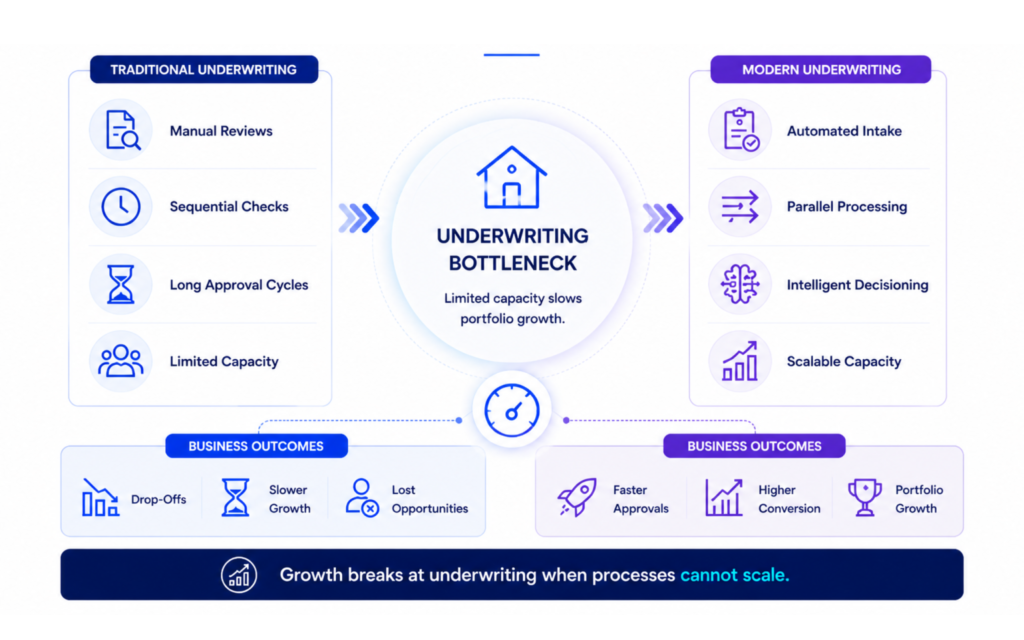
Documentation and Verification
Mortgage lending requires extensive documentation.
Income records, employment proofs, property documents, title records, tax filings, and valuation reports must all be reviewed and validated.
In traditional environments, experienced underwriters often spend a significant portion of their time performing routine verification tasks rather than evaluating risk.
This creates a costly mismatch between expertise and workload.
Sequential Workflows
Many lenders still process applications in a linear sequence.
Document verification completes before valuation begins. Property assessment finishes before title scrutiny starts. Credit analysis waits for supporting reports.
The result is predictable.
Every delay compounds the next one, extending overall Turnaround Time (TAT) in Lending far beyond what borrowers expect.
Hierarchical Approvals
Even after assessments are completed, files often move through multiple approval layers.
Branch managers, regional credit teams, and senior committees review applications sequentially, creating additional waiting periods that add little value to straightforward cases.
Even when Mortgage Underwriting Guidelines are clearly defined, manual approval layers can make policy execution inconsistent across teams and cases.
Rewiring Mortgage Credit Analysis Through Automation
Modern mortgage underwriting is increasingly moving from sequential processing toward parallel execution and automation. Rather than optimising individual steps in isolation, lenders can redesign the workflow so that multiple verification and assessment activities progress simultaneously.
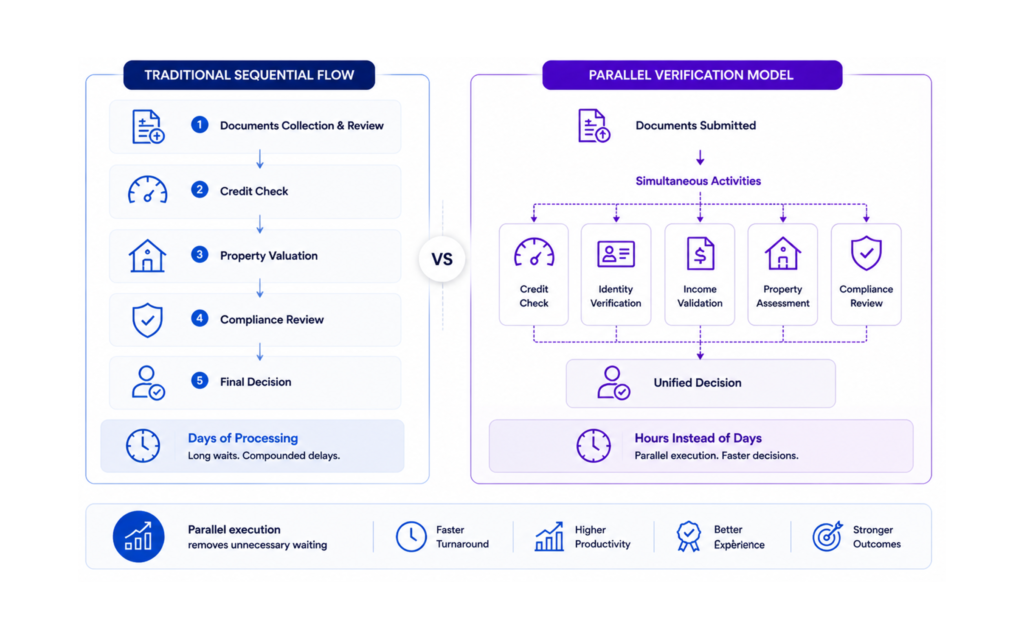
Immediate Digital Intake
The moment documents are submitted, intelligent systems begin extracting and structuring information automatically.
Income details, borrower information, property data, and supporting records can be extracted and structured automatically, creating usable data earlier in the underwriting workflow.
This creates a standardised data foundation before underwriting even begins.
Parallel Verification
Modern Mortgage Credit Analysis can move beyond strictly sequential processing by allowing independent verification activities to run in parallel. Credit bureau checks, identity verification, income validation, property assessment, and other applicable reviews can be orchestrated simultaneously where dependencies allow.
By reducing unnecessary dependencies between independent activities, lenders can shorten overall turnaround time while preserving required review and control points.
This single shift often delivers the largest improvement in operational efficiency.
Intelligent Risk Segmentation
Not every application requires the same level of review.
Low risk applications can move through predefined workflows with minimal intervention, while complex cases are routed to experienced credit professionals.
This allows underwriting teams to focus their expertise where it creates the greatest value.
How Automated Underwriting Systems Improve Speed and Quality
Faster underwriting does not inherently mean weaker credit decisions. When appropriately designed and governed, an Automated Underwriting System can improve decision consistency by applying defined policies, thresholds, and decision logic systematically across applications.
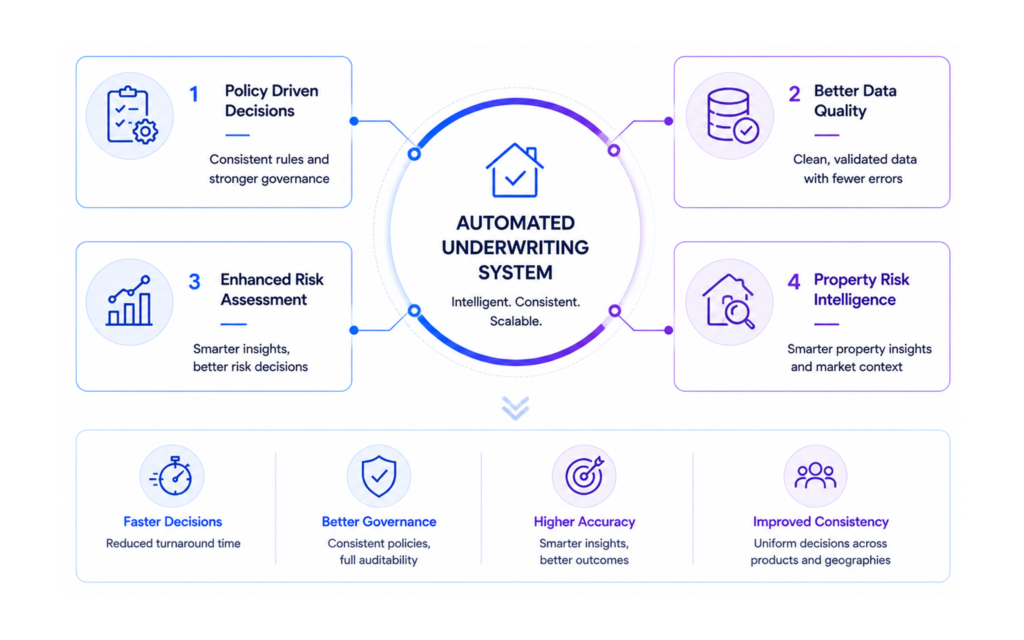
Policy Driven Decisions
Traditional underwriting frequently depends on individual judgement.
While experience remains valuable, it can also create inconsistency across teams and locations.
An Automated Underwriting System applies the same policies, thresholds, and decision logic across every application.
This improves governance while reducing variability.
Better Data Quality
Automated extraction and validation tools reduce errors associated with manual data entry.
Underwriters work with clean, structured information rather than reviewing large volumes of unstructured documentation.
This gives underwriters more consistent information for assessment while reducing the manual effort required to process documentation.
Enhanced Risk Assessment
Modern decisioning systems can evaluate multiple variables and data sources within a structured underwriting framework. Depending on the lending model and applicable policies, these may include income stability, repayment patterns, property characteristics, and other relevant data sources.
This enables more sophisticated Mortgage Credit Analysis without increasing operational effort.
Property Risk at Digital Speed
Property assessment has historically been one of the slowest components of mortgage lending.
Today, automated valuation models, market data integrations, and AI-driven analysis can support faster assessment of eligible properties by bringing relevant data into the underwriting workflow.
Physical inspections remain important for certain cases, while automated valuation approaches can reduce manual effort for properties and scenarios that meet the applicable criteria.
Compliance, Governance, and Scalable Decisioning
Speed only matters if it remains compliant.
When appropriately designed and governed, automation can strengthen governance by applying defined policies consistently and maintaining traceable decision records.
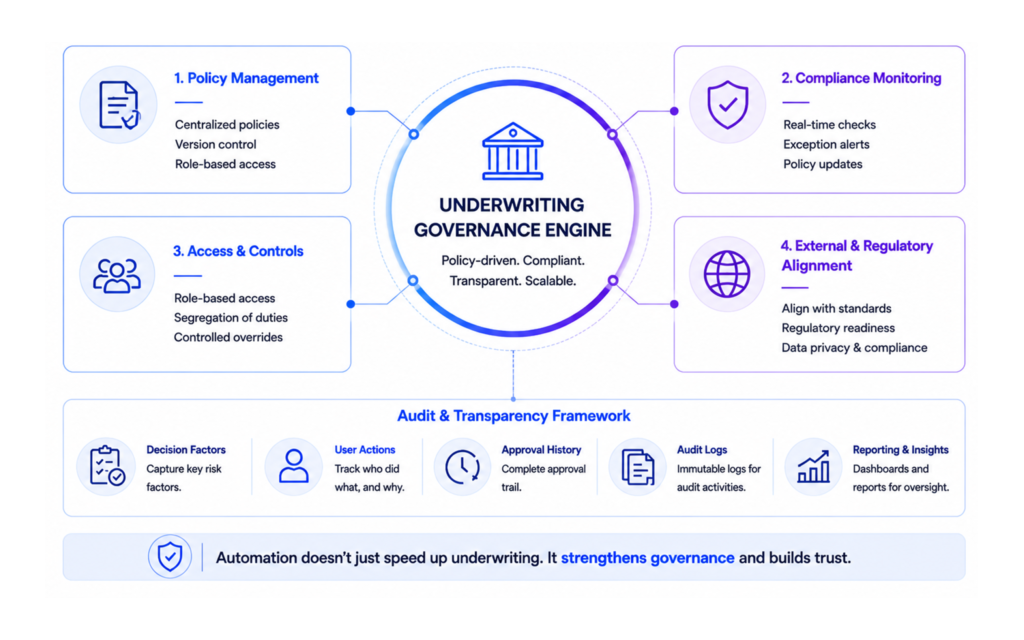
Consistent Policy Enforcement
When Mortgage Underwriting Guidelines are embedded directly into workflows, every application is evaluated against the same standards.
This reduces inconsistencies and improves audit readiness.
Traceable Audit Trails
Modern underwriting platforms record:
- Data inputs
- Decision factors
- Policy outcomes
- User actions
- Approval history
This creates a traceable record of underwriting activity for internal teams, auditors, and, where applicable, regulators.
Real Time Compliance Monitoring
Approved regulatory and policy changes can be incorporated into decision frameworks and workflows. This reduces reliance on manually communicating and applying policy updates across multiple teams and locations.
This allows compliance to scale alongside lending growth.
Fair and Explainable Decisions
Automated decisioning systems can provide explanations for approvals, declines, and conditional outcomes when the underlying decision logic is designed to be explainable.
This can improve transparency and support more consistent customer communication and governance.
What Happens When Turnaround Time Falls From Days to Hours
Reducing Turnaround Time (TAT) in Lending does far more than improve operational efficiency.
It changes the economics of growth.
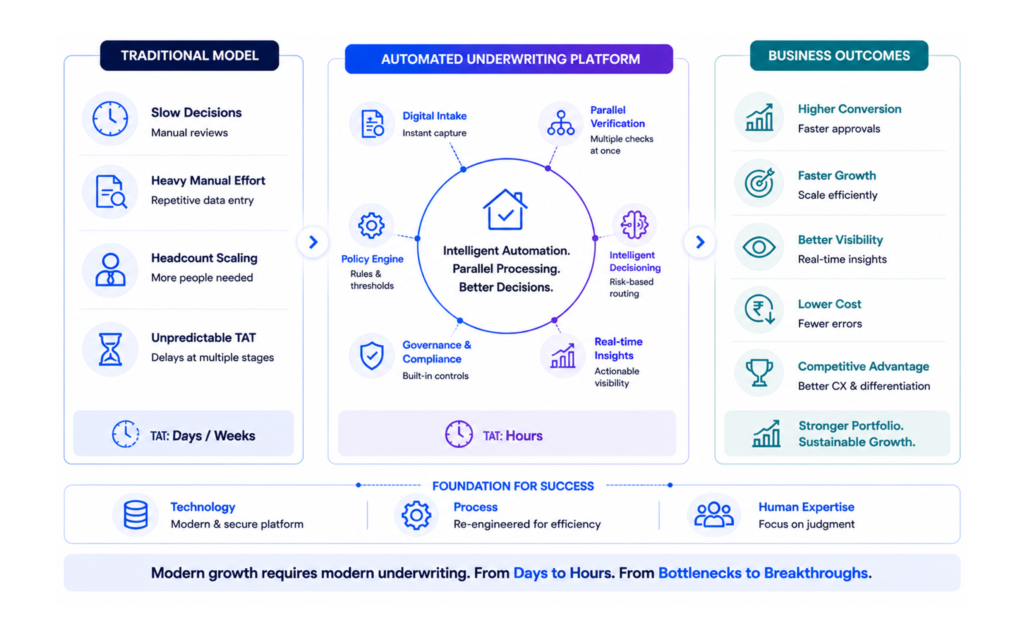
Higher Conversion Rates
Faster decisions can reduce application abandonment by giving borrowers greater certainty during the lending journey.
When approvals and required conditions are communicated sooner, lenders can create a smoother path from application to completion.
Scalable Growth
Traditional underwriting scales through headcount.
Automated underwriting scales through infrastructure.
This can allow lenders to increase application volumes without relying on a proportional increase in underwriting headcount.
Better Portfolio Visibility
Connected underwriting environments can provide near real-time visibility into:
- Application trends
- Risk concentrations
- Approval performance
- Emerging portfolio risk indicators
This can help lenders identify emerging issues earlier and respond with greater speed.
Stronger Competitive Positioning
In increasingly competitive mortgage markets, faster underwriting can become a meaningful differentiator.
Borrowers are more likely to value lenders that provide timely decisions, clear requirements, and greater certainty throughout the application journey.
Reducing unnecessary underwriting friction can therefore strengthen the overall borrower experience while supporting lenders’ growth objectives.
The Future of Mortgage Underwriting
The future of the underwriting process for mortgage lending is not about replacing human expertise.
It is about allowing experienced professionals to focus on judgement rather than administration.
As automated underwriting systems mature, lenders can increasingly combine AI-powered analysis, intelligent decisioning, workflow orchestration, and policy-driven governance within a more integrated operating model.
As automated underwriting systems continue to mature, lenders will increasingly combine AI powered analysis, intelligent decisioning,, and policy driven governance into a single operating model.
Platforms such as ezee.ai can support this transformation by bringing AI-powered automation, workflow orchestration, intelligent decisioning, loan origination, and credit decisioning into a connected lending environment. For lenders, this can help modernise underwriting workflows while maintaining defined policies, governance controls, and human oversight for cases that require additional judgement.
The lenders best positioned to scale mortgage lending will not necessarily be those with the largest underwriting teams.
They will be the institutions that reduce Turnaround Time (TAT) in Lending, modernise Mortgage Credit Analysis, and deploy Automated Underwriting Systems that support faster, more consistent, and more scalable decisioning.
Because in modern mortgage lending, growth no longer breaks at the demand layer.
It breaks at the underwriting layer.
Frequently Asked Questions
Underwriting is typically a major decision checkpoint in a mortgage application, but it is not necessarily the final operational step. Underwriters assess credit, income, property, and other applicable requirements before issuing approval conditions. Final disbursal may still depend on document fulfilment, legal clearance, and other lender-specific conditions.
Underwriters evaluate borrower creditworthiness, income stability, property value, and legal title integrity. This includes bureau scores, bank statements, property valuation reports, and KYC verification. As RBI has noted, mortgage decisions must balance credit risk with collateral certainty across borrower and asset dimensions.
Mortgage underwriting can become a bottleneck when borrower credit, property valuation, and legal checks are handled sequentially across different teams or vendors. This creates dependencies between activities and can extend turnaround time. Parallelising independent checks and routing exceptions for human review can help reduce unnecessary processing delays.
Lenders can reduce underwriting TAT by automating rule-based checks while reserving exceptions for manual review. Credit, KYC, and valuation data can be evaluated in parallel using decision engines, where the workflow and applicable controls allow. This can reduce unnecessary processing delays without changing established credit policy thresholds.
This is for lenders processing high application volumes with strict compliance needs.
- Configurable rule engines to encode credit and policy logic without code
- Real-time bureau and CKYC integrations to support faster borrower verification
- Audit trails to meet compliance and review requirements
- Parallel workflow support to assess independent credit, income, and property checks concurrently where applicable
- Platforms achieving 70 percent plus straight through processing consistently outperform manual underwriting at scale (industry analysis)
Mortgage underwriting timelines vary by lender, borrower profile, property, documentation quality, and the complexity of legal and verification checks. Traditional workflows can take several business days, while automated data retrieval, parallel verification, and rule-based decisioning can shorten processing time for straightforward applications.
Yes, a mortgage can be declined post underwriting if material risks emerge before disbursal. Common triggers include adverse legal findings, valuation mismatches, or undisclosed liabilities. Lenders may need to reassess risk if new information materially affects borrower eligibility before disbursal.
Common red flags include:
- Income inconsistencies detected through bank statement and income document analysis
- Recent credit score deterioration identified via bureau pulls
- Property title gaps surfaced during legal due diligence
- Inflated property valuations flagged against market benchmarks
- Undisclosed obligations revealed through bureau and banking data
- Industry data indicates income variance and title defects drive most secured loan rejections
Lenders primarily assess borrower repayment capacity, credit behaviour, collateral value, and legal enforceability. This combines bureau data, income assessment, loan-to-value ratios, property valuation, and title checks. Together, these factors help lenders evaluate both borrower risk and the certainty of the underlying asset.
Modern decision engines automate underwriting by applying policy rules consistently across credit, KYC, and collateral data. APIs can retrieve bureau, CKYC, and banking data, while workflows can flag exceptions for review. This allows lenders to standardise repeatable decisioning while directing cases that require additional judgement to the appropriate reviewers.
References
- CFPB — What is the ability-to-repay rule?
Supports the discussion of borrower income, assets, employment, credit history, and monthly expenses in mortgage underwriting.
- Fannie Mae — Comprehensive Risk Assessment
Supports the article’s discussion of comprehensive mortgage risk assessment, including credit history, equity, reserves, reliable income, property collateral, documentation, and automated versus manual underwriting.
- Fannie Mae — General Income Information
Supports the discussion of income stability, documentation, and the expectation that qualifying income will continue.
- Freddie Mac — Underwriting a Mortgage
Supports the article’s explanation of credit reputation, borrower capacity, collateral, documentation, and the core underwriting assessment. - Freddie Mac — What Is Mortgage Underwriting?
Provides an accessible explanation of the mortgage underwriting process, including verification of employment, income, assets, debts, credit history, property value, and the use of automated underwriting systems.
- RBI — Master Circulars
Use this as the India-specific regulatory reference for housing-finance requirements rather than the older PDF link used in my previous recommendation. RBI’s current Master Circular listings include Master Circular – Housing Finance for commercial banks.