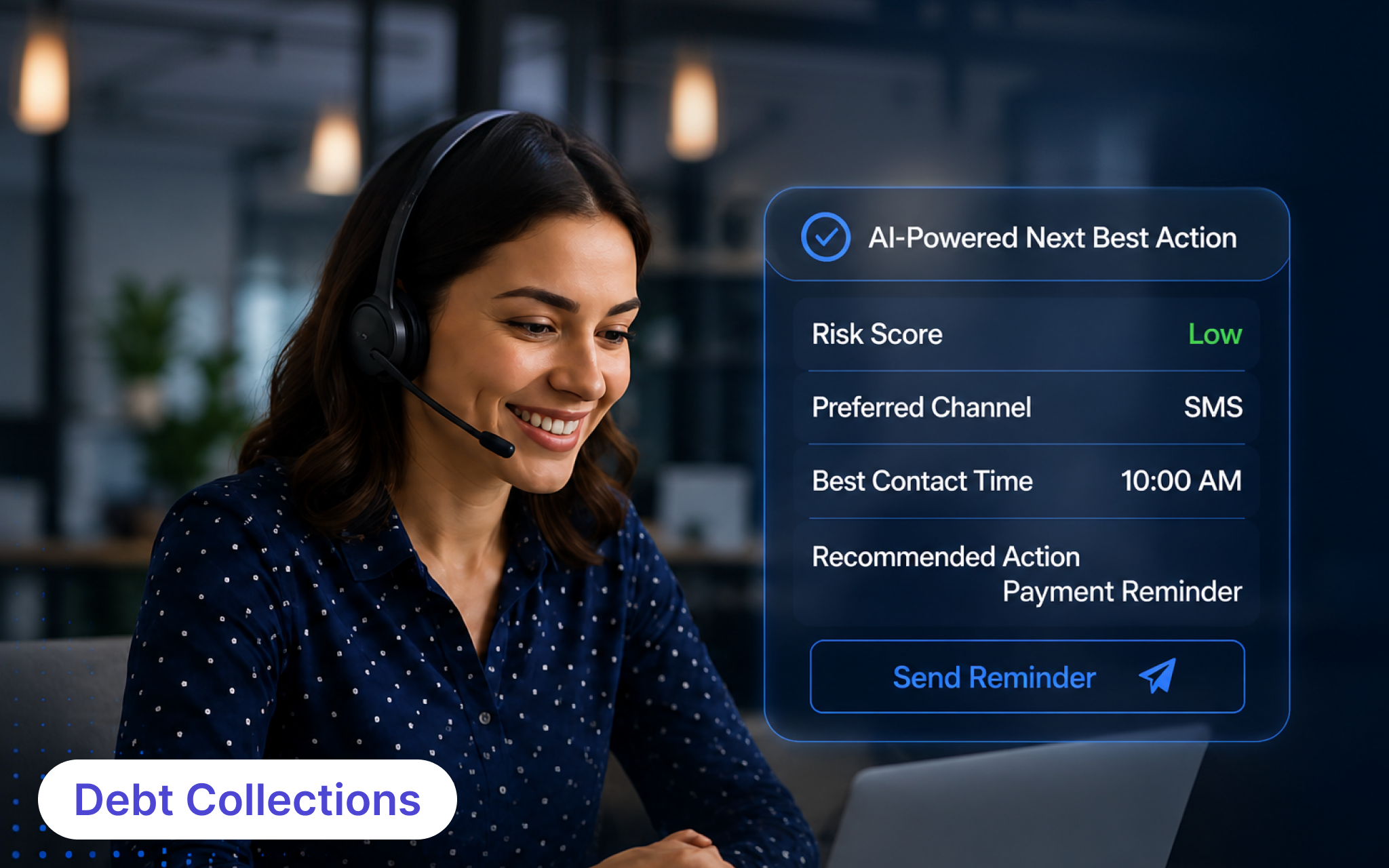
Why AI Debt Collection Is Entering a New Era
The collections industry is undergoing a major transformation. Traditional recovery processes built around manual prioritisation, agent-driven outreach, and fragmented workflows are increasingly being supplemented by intelligent, automated systems.
AI-powered debt collection can help organisations analyse accounts at scale, personalise borrower communications, optimise contact timing, identify repayment patterns, and coordinate collection workflows. Agentic AI extends these capabilities by enabling systems to adapt actions based on changing circumstances and responses.
For banks, NBFCs, fintech lenders, and collection agencies, the benefits are significant:
- Higher recovery rates
- Lower operational costs
- Better customer engagement
- Faster decision-making
- Improved scalability
However, collections remain one of the most heavily regulated functions in financial services.
Regulations governing borrower treatment, communication practices, privacy, consent, and automated decisioning impose important requirements on how collection activities are designed and executed. A compliance failure can lead to regulatory penalties, litigation, reputational damage, and customer attrition.
The challenge is clear: how can organisations implement AI in debt collection while remaining compliant with evolving regulatory requirements?
This guide examines the regulatory considerations, governance controls, human oversight, and practical implementation steps required to deploy AI responsibly in collections.
Why Compliance-First AI Matters More Than Ever
Many organisations treat compliance as a review stage at the end of implementation.
That approach no longer works.
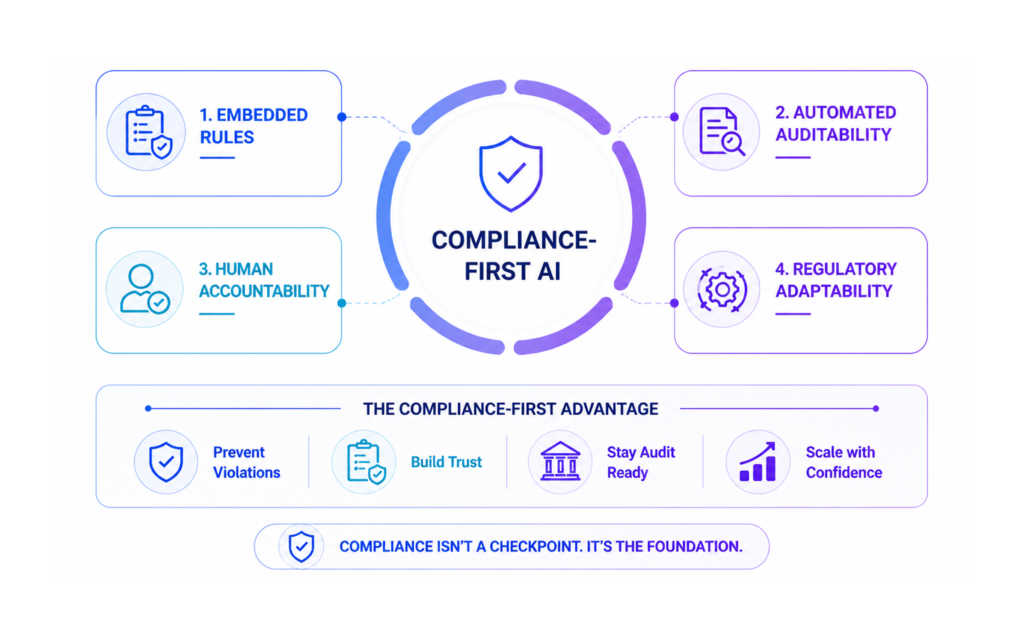
A compliance-first AI framework embeds applicable regulatory requirements and internal policies into workflows, models, and decision logic. Instead of relying solely on post-deployment reviews, organisations can design controls into the collection process so that relevant requirements are considered before an automated action is taken.
Key principles include:
Regulatory Rules Embedded into Workflows
Before outreach begins, the system verifies:
- Communication frequency limits
- Permitted contact windows
- Customer preferences
- Required disclosures
- Jurisdiction-specific requirements
This prevents violations before they happen.
Automated Auditability
Every material decision, action, and recommendation should be traceable through appropriate audit logs. These records can help compliance teams and internal auditors review how collection actions were initiated, what rules or policies were applied, and when human intervention occurred.
Human Accountability
Even with advanced automation, organisations need clear human accountability for high-impact collection decisions. A compliance-first approach should define which decisions can be automated, which require human review, and when an exception must be escalated.
Regulatory Adaptability
Regulatory requirements can vary across jurisdictions and change over time. Collection systems should therefore support configurable policies and controls that can be updated without requiring major changes to the underlying workflow or model.
The Regulatory Landscape for AI Debt Collection
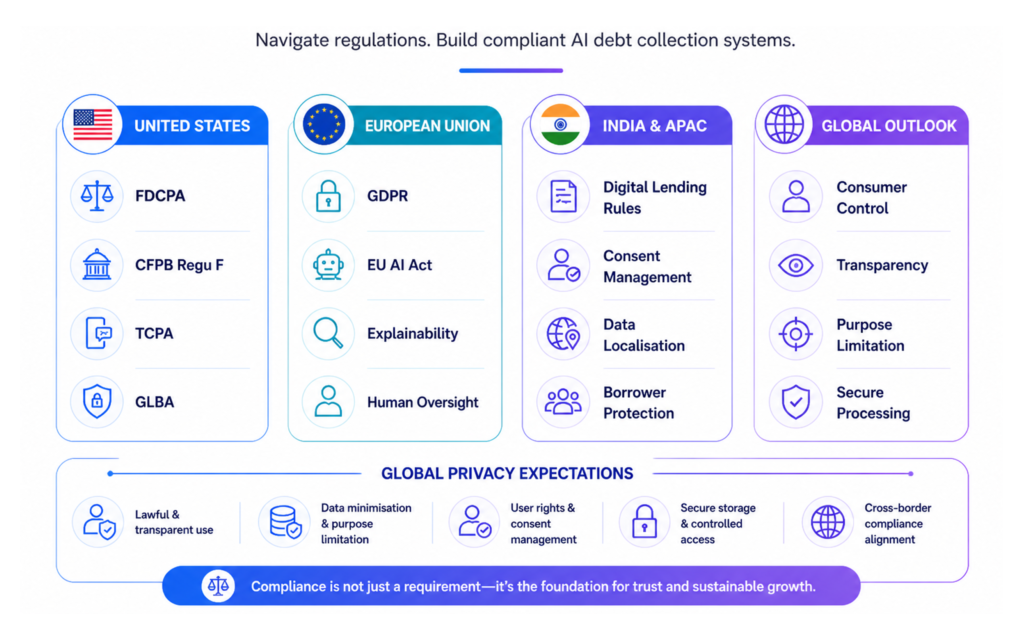
AI-driven collections operate within a regulatory environment that varies by jurisdiction and covers areas such as borrower communications, privacy, data use, consent, and automated decision-making.
United States
Collections activity remains heavily influenced by:
- FDCPA
- CFPB Regulation F
- TCPA
- GLBA
These frameworks address different aspects of debt collection, consumer communications, privacy, and related financial-services obligations. The specific requirements that apply depend on the organisation, the type of debt, the communication channel, and the circumstances of the collection activity.
For AI debt collection compliance, organisations should configure controls that can:
- Apply applicable contact-time restrictions
- Track communication frequency across relevant channels
- Respect consumer communication preferences and restrictions
- Apply required disclosures and escalation rules
- Maintain records of automated actions for review
European Union
The GDPR establishes requirements around the processing and protection of personal data, while the EU AI Act introduces risk-based requirements for certain AI systems. For organisations using AI in lending and collections, the applicable obligations depend on the specific use case, the role of the system, and how personal data and automated decision-making are involved.
Depending on the applicable requirements and AI use case, organisations should consider controls for:
- Explainability
- Transparency
- Human oversight
- Fairness monitoring
- Data minimisation
For AI applications that fall within the EU AI Act’s high-risk categories, organisations may need controls covering risk management, data governance, technical documentation, record keeping, transparency, human oversight, accuracy, and cybersecurity.
India and Asia Pacific
Regulatory requirements vary significantly across India and other Asia-Pacific markets. In India, digital lending requirements place particular emphasis on borrower protection, responsible recovery practices, consent, data governance, audit trails, and oversight of lending and recovery partners.
For organisations operating across multiple APAC markets, AI debt collection workflows should therefore support jurisdiction-specific policies rather than relying on a single regional compliance configuration.
Global Privacy Expectations
Across jurisdictions, privacy regulations are converging around several themes:
- Consumer control over data
- Transparency
- Purpose limitation
- Secure processing
For AI debt collection, these privacy considerations need to be reflected in system design, data governance, access controls, retention policies, and workflow configuration.
Building Ethical and Explainable AI Collections
Regulatory compliance is only part of the equation. Organisations must also address ethical considerations.
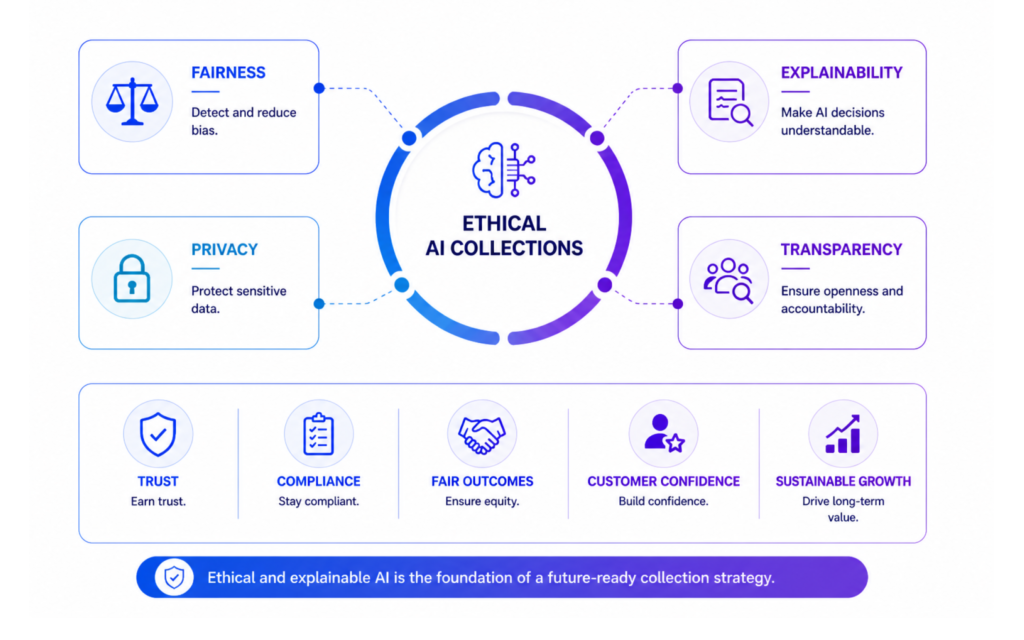
Fairness
Historical collections data can contain embedded biases. Without monitoring, AI systems may unintentionally create unfair outcomes across customer segments.
Strong governance requires:
- Diverse training data
- Bias testing
- Fairness audits
- Continuous monitoring
Explainability
Borrowers, regulators, and internal teams increasingly expect explanations for automated decisions. Recent CFPB guidance reinforces this expectation by clarifying that organisations using complex algorithms and AI-driven decisioning remain responsible for providing clear and specific explanations for outcomes that affect consumers.
When AI recommends a settlement strategy, escalation path, repayment option, or other material collection action, organisations should be able to understand the factors that led to the recommendation and provide an appropriate rationale for review.
Explainable models improve:
- Trust
- Compliance
- Audit readiness
- Operational transparency
Privacy
Collections involves highly sensitive personal and financial information.
AI-enabled collections should apply appropriate controls around:
- Data access
- Data retention
- Encryption
- Usage limitations
Effective AI debt collection requires a balance between operational efficiency, transparency, fairness, and appropriate safeguards for customer data.
Data and Model Governance for AI Debt Collection
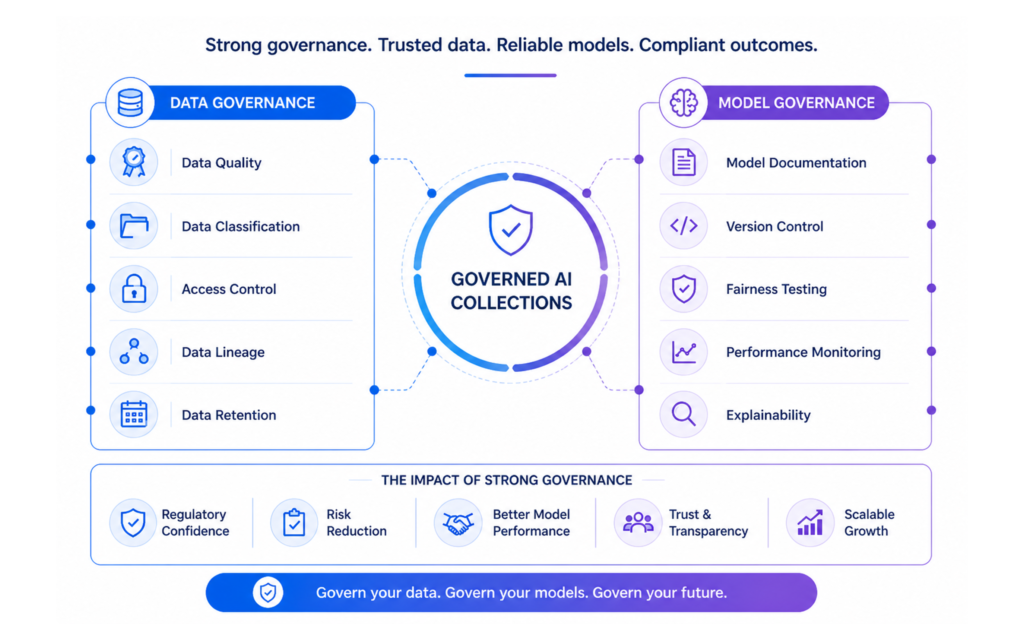
Technology alone cannot guarantee compliance. In regulated collections environments, strong governance structures help ensure AI operates responsibly, consistently, and within applicable regulatory and organisational requirements. This is especially important in compliance-first AI environments, where governance defines how AI systems can be deployed, monitored, and scaled responsibly.
Data Governance Priorities
Effective governance starts with disciplined control over the data that supports AI systems. This includes data classification, quality management, access controls, lineage tracking, and retention policies. Clean, well-governed data strengthens compliance readiness while also improving model reliability and accuracy.
Model Governance Priorities
AI models require ongoing oversight throughout their lifecycle. Critical controls include model documentation, version management, performance monitoring, fairness testing, and explainability reporting. These practices are consistent with principles found in responsible AI governance frameworks published by the World Bank, which emphasises ongoing monitoring, transparency, accountability, and risk management throughout the AI lifecycle.
Designing a Compliant Agentic AI Collections Workflow
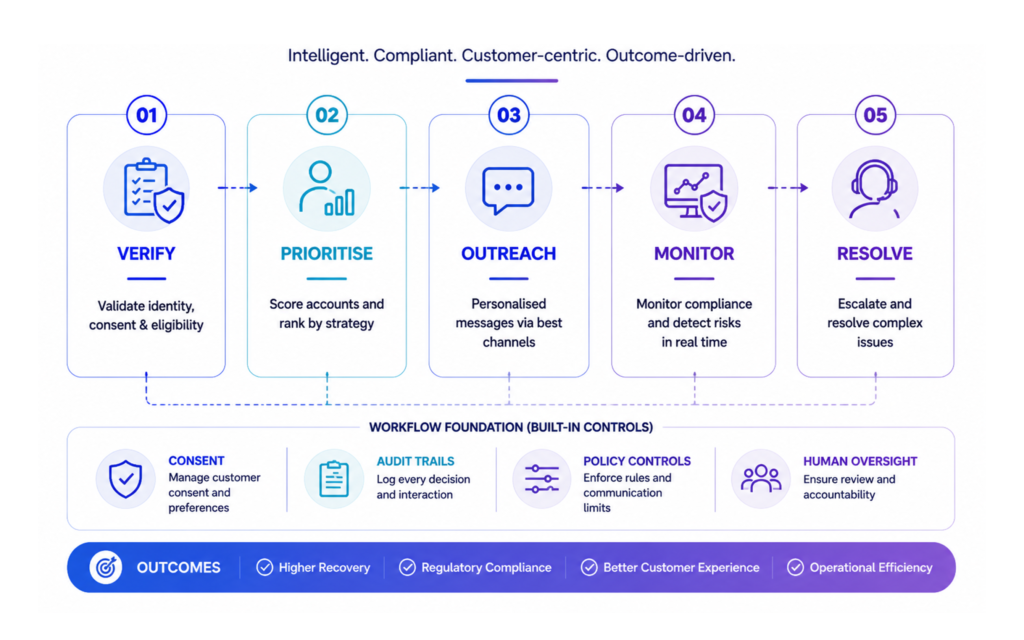
Agentic AI introduces a more adaptive operating model for collections. Unlike traditional automation, agentic AI systems can evaluate context, coordinate actions, and optimise outcomes within defined compliance guardrails. In an AI debt collection workflow, these capabilities can support automated actions while keeping eligibility checks, compliance controls, monitoring, and human escalation within the operating framework.
A compliant workflow typically follows five stages.
- Verification and Eligibility: The system confirms right-party contact, consent status, communication preferences, and any existing disputes. Only accounts that meet regulatory and policy requirements move forward.
- Intelligent Prioritisation: Accounts are ranked using factors such as recovery probability, account value, regulatory sensitivity, and relevant customer circumstances. This can improve resource allocation while helping teams apply appropriate controls to higher-risk cases.
- Personalised Outreach: Agentic AI can determine an appropriate channel, contact time, message approach, and escalation threshold based on configured policies and available customer context. Each communication should remain within applicable regulatory and organisational boundaries.
- Real-Time Compliance Monitoring: Throughout the process, the system monitors contact frequency, message content, consent status, and policy adherence. Potential issues can be identified early, allowing teams to intervene before an action results in a compliance issue.
- Human Escalation: More complex cases are routed to human specialists. This includes disputes, hardship requests, fraud concerns, and cases requiring legal or policy review. Clear escalation criteria ensure that automation does not replace human judgment where additional assessment is required.
Human Oversight and Risk Controls
Human oversight is an important control in AI-enabled collections, particularly where automated systems influence material collection actions. Automation should support faster and more consistent decisions without removing human accountability.
Effective oversight frameworks can include supervisory reviews for high-impact actions, real-time monitoring of system behaviour, and exception management for sensitive cases. Audit readiness also requires detailed logs capturing relevant decisions, actions, recommendations, and supporting rationale. Periodic validation should assess whether the system continues to operate within approved policies, performance thresholds, and risk controls.
Scaling AI Debt Collection Across Markets
For global organisations, regulatory fragmentation creates additional complexity. A collections platform operating across multiple jurisdictions must adapt to local requirements without losing consistency. Governance therefore needs to support jurisdiction-specific policies, particularly when digital lending and recovery activities are subject to different regulatory requirements across markets.
Successful deployments typically rely on data localisation where required, configurable compliance controls, localised communications, and strong governance of lending and recovery partners. These controls allow organisations to adapt collection workflows to jurisdiction-specific requirements while maintaining consistent governance across markets.
AI Debt Collection Implementation Roadmap
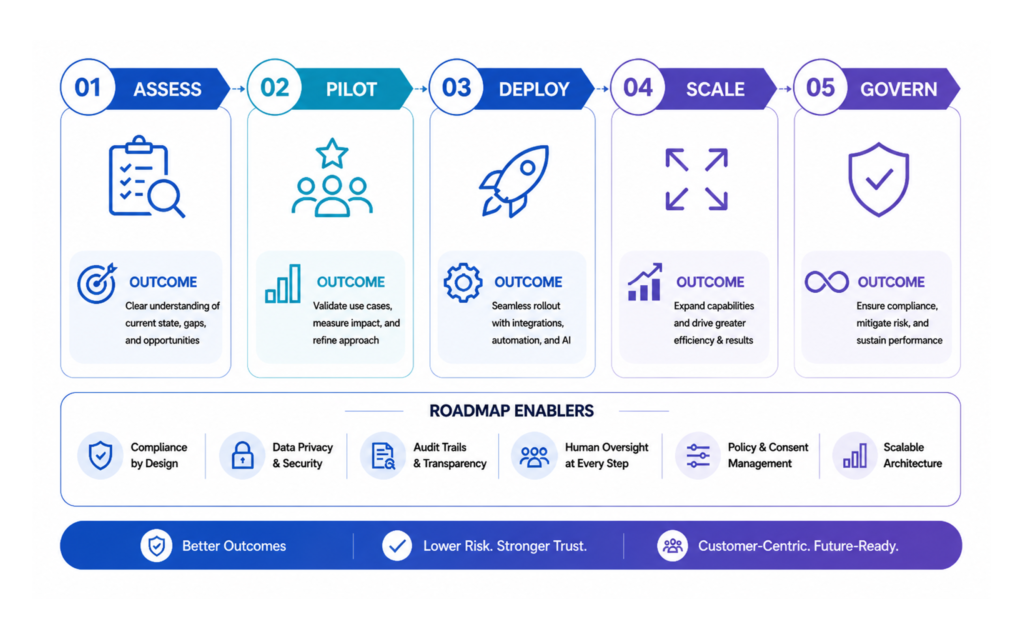
Successful AI debt collection implementation usually follows a phased approach, allowing organisations to validate compliance, technology readiness, and operational performance before scaling.
Phase 1: Assessment
Review current collection processes, compliance maturity, data quality, technology readiness, and the use cases where AI could add value. Identify key regulatory, operational, and data risks before selecting a deployment approach.
Phase 2: Pilot Selection
Choose a focused use case with measurable outcomes, such as account prioritisation, outreach optimisation, or early-stage collections. Define success criteria, compliance requirements, and the data needed to evaluate the pilot before deployment.
Phase 3: Controlled Deployment
Run AI alongside existing processes while monitoring performance, compliance, exceptions, and human escalations closely. Use defined thresholds and review criteria to determine when the system can move beyond the controlled deployment stage.
Phase 4: Scaling
Expand gradually across portfolios, products, and geographies. Apply jurisdiction-specific policies, governance controls, and performance thresholds as automated debt recovery workflows scale across the organisation.
Phase 5: Continuous Governance
Maintain ongoing fairness testing, compliance monitoring, model reviews, performance validation, and regulatory readiness assessments. Update policies, controls, and model configurations as requirements, data, and collection processes change.
Choosing an AI Debt Collection Platform
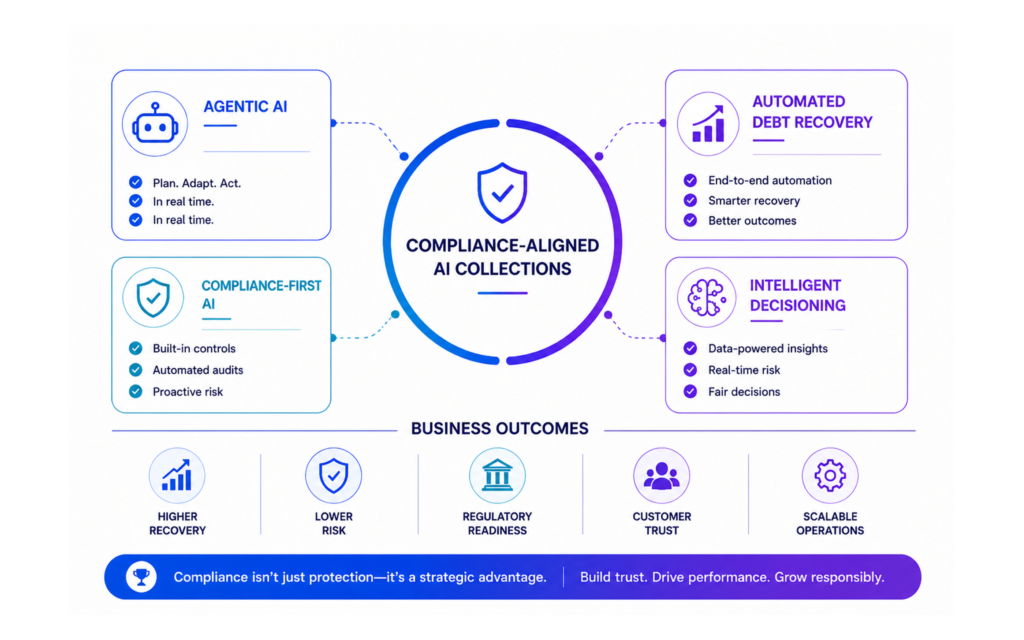
AI adoption alone is not enough. Organisations evaluating an AI-powered debt collection platform should assess whether it can support compliance, governance, workflow orchestration, human oversight, auditability, and scalable operations within their existing collections environment.
Key evaluation criteria include configurable compliance controls, transparent decisioning, audit trails, data and model governance, human escalation, monitoring capabilities, and the ability to adapt workflows across jurisdictions. These capabilities help organisations build automation into collections without separating operational efficiency from risk management.
For organisations looking to operationalise these principles, an AI-enabled collections platform can provide the workflow, decisioning, monitoring, and governance capabilities needed to support implementation at scale.
ezee.ai provides AI-powered automation, workflow orchestration, intelligent decisioning, and debt collection capabilities for financial institutions. These capabilities can support collections journeys with configurable workflows, regulatory guardrails, audit trails, and governance controls, helping teams incorporate compliance considerations into day-to-day collection operations.
Organisations implementing AI in collections should treat compliance as an operating requirement rather than a final review step. Embedding appropriate controls into workflows, decisioning, monitoring, and governance can support responsible automation while maintaining accountability.
Frequently Asked Questions
AI-driven debt collection calls can be used lawfully when the organisation and its collection practices comply with the requirements applicable to the relevant jurisdiction, debt type, and communication channel. In the US, this can include the FDCPA and Regulation F, alongside other applicable communications and consumer-protection requirements. In the EU and India, organisations must assess the requirements applicable to their specific AI use case, data processing, lending activity, and recovery practices. AI voice systems should therefore operate with appropriate consent, communication, disclosure, monitoring, and escalation controls.
AI-enabled collection systems can monitor interactions for predefined compliance conditions, such as prohibited language, missing disclosures, communication-frequency thresholds, or deviations from approved workflows. When a potential issue is identified, the system can flag the interaction for review or trigger an appropriate escalation. The effectiveness of these controls depends on how the rules, monitoring logic, and escalation processes are configured.
AI can support compliance by applying configured rules and policies during collection workflows. For example, systems can monitor communication frequency, consent status, approved messaging, and escalation conditions, while maintaining records for review. Organisations can also update policies and workflow controls as regulatory requirements change, subject to appropriate governance and validation.
Before adopting AI-based debt collection tools, lenders should evaluate regulatory requirements, data quality and governance, model performance, explainability, human oversight, auditability, integration requirements, and the organisation’s ability to monitor and update controls over time. Pilot use cases should also have clearly defined performance, compliance, and escalation criteria before broader deployment.
Generative AI can support compliance monitoring by assisting with interaction reviews, summarising collection activity, identifying potential policy deviations, and organising documentation for human review. Because generative AI can produce inaccurate or incomplete outputs, organisations should apply appropriate validation, access controls, audit trails, and human oversight before relying on its outputs for material compliance decisions.
AI voice agents should operate within approved scripts, communication policies, consent requirements, escalation rules, and applicable contact restrictions. Organisations should also maintain appropriate call records and audit trails, monitor interactions for policy deviations, provide clear escalation paths to human agents, and regularly review voice-agent performance and compliance.
AI debt collection systems should maintain a central record of consent, communication preferences, previous contact attempts, and applicable contact restrictions. For US debt collectors subject to Regulation F, the system should account for the rule’s telephone-call frequency presumptions, including the limit of more than seven calls within seven consecutive days and the seven-day period following a telephone conversation about the particular debt, subject to applicable exceptions. Other communication requirements and time-of-day restrictions should be configured according to the laws and rules applicable to the organisation, debt, consumer, and communication channel.
Organisations should look for configurable compliance controls, workflow orchestration, communication monitoring, audit trails, consent and preference management, human escalation, data and model governance, performance monitoring, and reporting capabilities. The platform should also support jurisdiction-specific policies and allow controls to be reviewed and updated as requirements change.
Model governance provides a structured approach to documenting, validating, monitoring, and reviewing AI models throughout their lifecycle. In debt collection, this can include model documentation, version control, performance monitoring, fairness testing, explainability reviews, approval processes, and periodic validation. These controls help organisations identify model risks and maintain appropriate oversight as models or collection processes change.
ezee.ai supports financial institutions with AI-powered automation, workflow orchestration, intelligent decisioning, and debt collection capabilities. For organisations implementing AI in collections, these capabilities can support configurable workflows, compliance controls, auditability, governance, and human escalation as part of a broader operating model. Organisations should evaluate the platform against their specific regulatory, operational, integration, and governance requirements before deployment.
References
- CFPB — Debt Collection Practices Regulation F
- CFPB — Regulation F, 12 CFR Part 1006
- CFPB — Debt Collection Rule: Communication Practices
- CFPB — Debt Collection Rule: Required Disclosures
- European Union — EU Artificial Intelligence Act
- RBI — Handbook on Regulations at a Glance
- World Bank — Responsible AI Governance