

Why Traditional Credit Scoring Is Reaching Its Limits
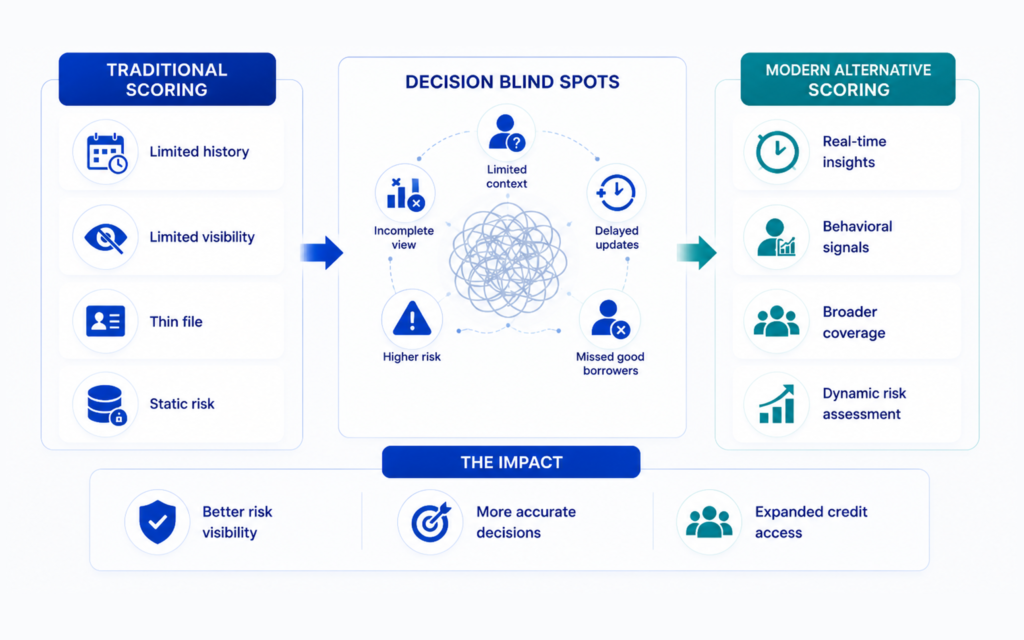
In a world where consumers can open accounts, shop online, and transfer money in seconds, lending decisions still often depend on data that may not capture their current financial behaviour.
This creates a challenge for financial institutions. Traditional bureau scores remain valuable, but they may not provide a complete picture of every borrower’s creditworthiness. Alternative credit scoring expands that view by incorporating additional data that can provide insight into financial behaviour, cash flow, and repayment capacity. This is why alternative data for credit scoring is becoming an important consideration in modern credit underwriting.
The limitations of traditional scoring are becoming harder to ignore:
- Bureau data often reflects historical rather than current financial behaviour.
- Millions of borrowers remain “thin file” or “unscorable.”
- Traditional scores provide limited behavioural context.
- Risk assessment often lacks real time visibility.
The consequences are significant.
Good borrowers are declined because they lack formal credit history. Risky borrowers sometimes appear creditworthy because bureau data has not yet reflected deteriorating financial conditions.
For lenders competing in digital lending, BNPL, SME finance, and embedded finance, these blind spots represent both a growth challenge and a risk management issue.
How Alternative Credit Scoring Supports Credit Underwriting
Modern underwriting requires more than evaluating traditional credit history. It also requires understanding a borrower’s current financial behaviour, capacity, and repayment patterns.
This is where alternative credit data can add value. Alternative credit scoring incorporates data that may not typically appear in traditional credit reports, giving lenders additional signals to assess creditworthiness, particularly for borrowers with limited traditional credit histories.
Instead of relying exclusively on bureau records, lenders can combine traditional and alternative data to gain a broader view of a borrower’s financial capacity, stability, and repayment behaviour.
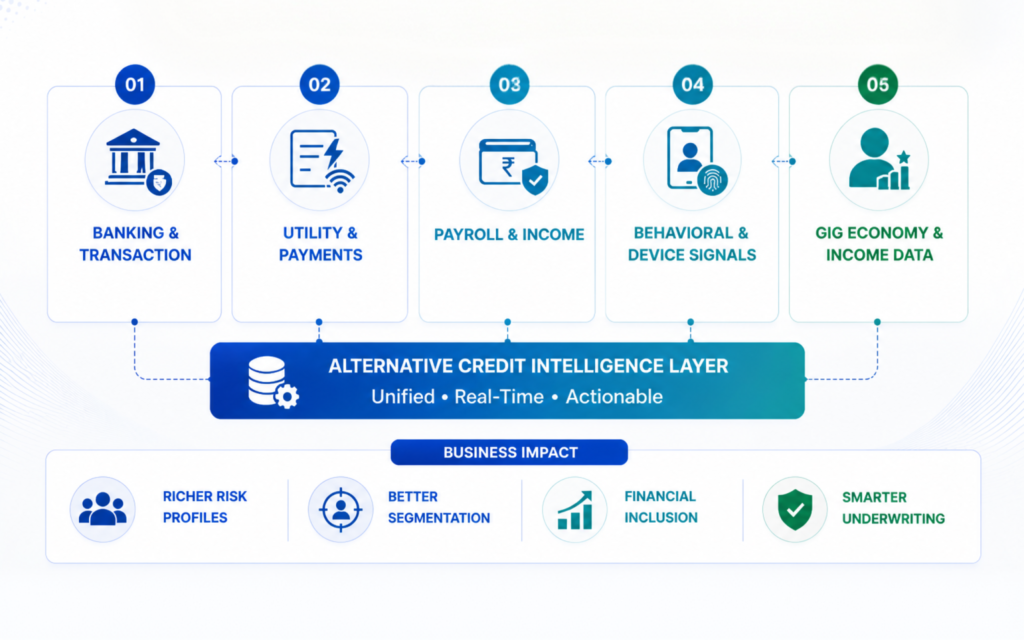
The most common sources include:
Open Banking and Transaction Data
Open banking and transaction data can provide lenders with a more current view of a borrower’s financial activity, subject to the availability of data and appropriate customer consent. Depending on the implementation, this may include income deposits, spending patterns, recurring obligations, account balances, and cash-flow trends.
These signals can help lenders assess financial stability and repayment capacity alongside traditional credit information. For alternative credit scoring, transaction data is particularly useful when a borrower’s bureau history provides limited insight into their current financial position.
For example, a salaried borrower with a limited credit history may have consistent income deposits and manageable recurring expenses that are not fully reflected in their traditional credit profile. Incorporating these signals into the broader credit assessment can give lenders additional context when evaluating the application.
Utility and Telecom Payments
Utility and telecom payment patterns can provide additional insight into a borrower’s payment behaviour, particularly when traditional bureau information is limited. Depending on the data available, lenders may be able to assess factors such as payment consistency, recurring payment behaviour, and the regularity of financial obligations.
These signals can complement traditional credit information within alternative credit scoring models, giving lenders additional context when assessing borrowers with limited or incomplete credit histories. They should be evaluated alongside other relevant financial and credit signals rather than treated as a standalone measure of creditworthiness.
Payroll and Income Verification
Payroll and income data can provide lenders with additional evidence about a borrower’s current income, income stability, and ability to meet financial obligations. Depending on the data available, this may include salary deposits, employment-related income patterns, or changes in income over time.
For alternative credit scoring, these signals can complement traditional credit information when assessing affordability and repayment capacity. This can be particularly relevant for borrowers whose income is variable or whose traditional credit history provides limited insight into their current financial position.
For example, a borrower with irregular income may have a limited or inconsistent bureau profile but demonstrate sufficient cash flow to meet repayment obligations. Incorporating verified income and relevant cash-flow signals can provide additional context for the underwriting assessment.
Behavioural and Device Signals
Behavioural and device signals can provide additional context during digital lending, including information that may support identity verification, fraud detection, and, where appropriately validated, credit-risk assessment. Examples can include application behaviour, device characteristics, and patterns of interaction during the lending journey.
For alternative credit scoring, these signals should be used selectively and evaluated for their relevance, predictive value, data quality, and potential bias. They can complement traditional and other alternative credit data, but should not automatically be treated as indicators of creditworthiness simply because they are available.
This makes governance particularly important when behavioural or device signals are incorporated into automated underwriting decisions.
Gig Economy and Informal Income Data
Gig workers, freelancers, and other borrowers with non-traditional income streams may have financial activity that is not fully captured by conventional payroll or credit records. Alternative income and cash-flow data can provide additional context on the timing, consistency, and sources of their earnings.
For alternative credit scoring, these signals can complement traditional credit information when assessing borrowers whose income does not follow a conventional salaried pattern. The objective is not to treat irregular income as inherently higher or lower risk, but to provide lenders with additional evidence that can be evaluated alongside other relevant credit and financial information.
How Alternative Credit Scoring Supports Real-Time Underwriting
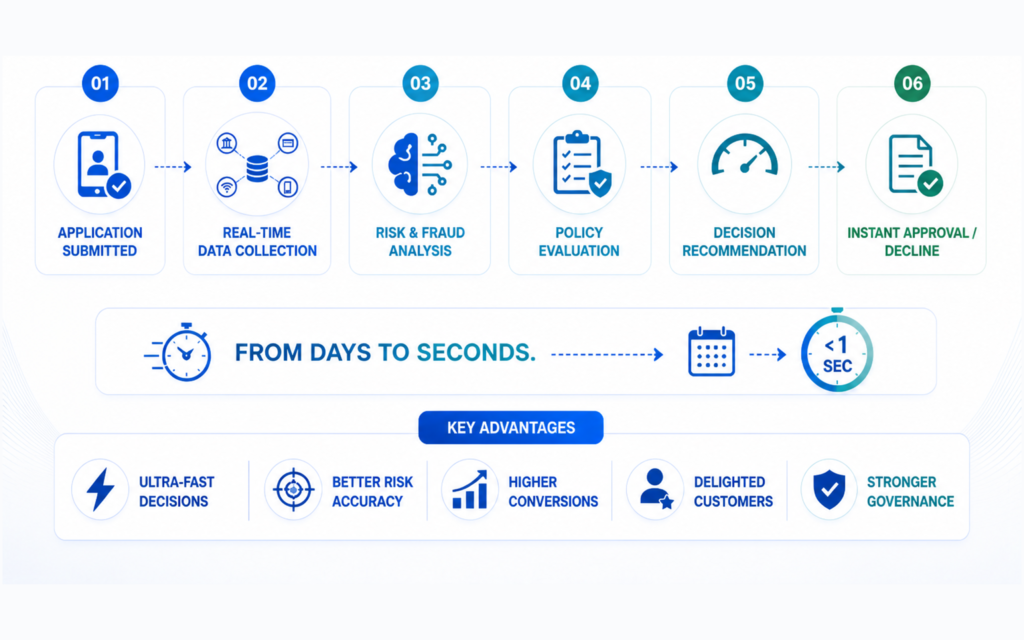
The value of alternative data is not simply having more information.
It is having relevant information available when a credit decision is made.
Modern lending platforms can analyse multiple data streams simultaneously and incorporate relevant signals into the underwriting process, helping lenders make decisions more efficiently.
A simplified workflow looks like this:
- Borrower submits an application.
- Real time APIs collect banking, bureau, behavioural, and alternative data.
- Risk models evaluate affordability, fraud risk, and repayment probability.
- Decision engines apply lending policies.
- Approval, decline, pricing, or limit recommendations are generated instantly.
This approach fundamentally changes underwriting.
Instead of relying on static snapshots, lenders evaluate live borrower conditions.
This approach can significantly reduce underwriting turnaround times by automating data collection, risk assessment, and policy evaluation within the lending workflow.
This is where AI driven underwriting delivers meaningful business value.
Machine learning models can identify patterns that traditional rule based approaches often miss.
For example:
- Consistency of income inflows
- Spending discipline
- Cash flow volatility
- Early signs of financial stress
- Fraud indicators
The result is faster, more accurate, and more scalable credit decisions.
Benefits of Alternative Credit Scoring for Lenders and Borrowers
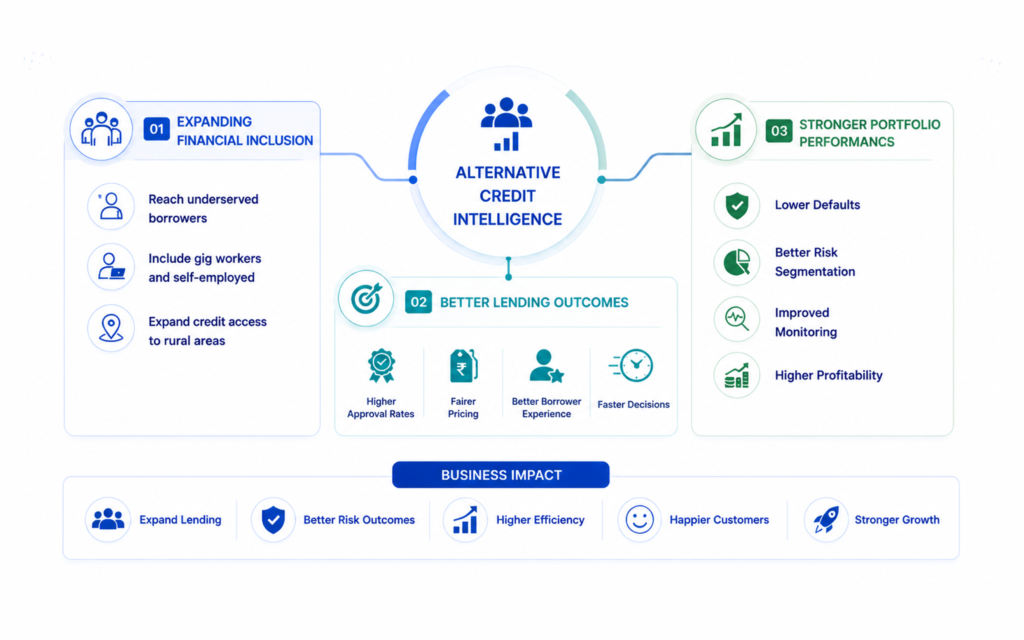
The impact extends far beyond operational efficiency.
Expanding Financial Inclusion
One of the biggest advantages of alternative credit scoring models is the ability to assess borrowers who lack conventional credit histories.
Alternative data can provide additional information for borrowers who may have limited or incomplete traditional credit profiles, creating another pathway for evaluating access to formal credit.
For gig workers, self-employed professionals, first-time borrowers, and other borrowers with limited credit histories, this additional information can help lenders evaluate creditworthiness beyond conventional bureau data.
According to the World Bank, nearly 1.4 billion adults remain unbanked globally. Alternative data provides a pathway for many of these individuals to access formal credit.
Better Borrower Outcomes
When alternative data provides additional predictive value, lenders can differentiate borrowers more effectively.
This can support:
- Higher approval rates
- More risk-appropriate pricing
- Fewer unnecessary declines
- Improved customer experience
When traditional credit scores do not fully reflect a borrower’s financial behaviour, alternative credit data can provide additional context for the underwriting decision.
Stronger Portfolio Performance
For lenders, alternative credit data can support improvements in:
- Processing efficiency
- Underwriting costs
- Risk segmentation
- Portfolio quality
Where alternative data demonstrates incremental predictive value, these improvements can contribute to more efficient underwriting and better-informed portfolio management.
The Risks and Realities of Alternative Credit Scoring Models
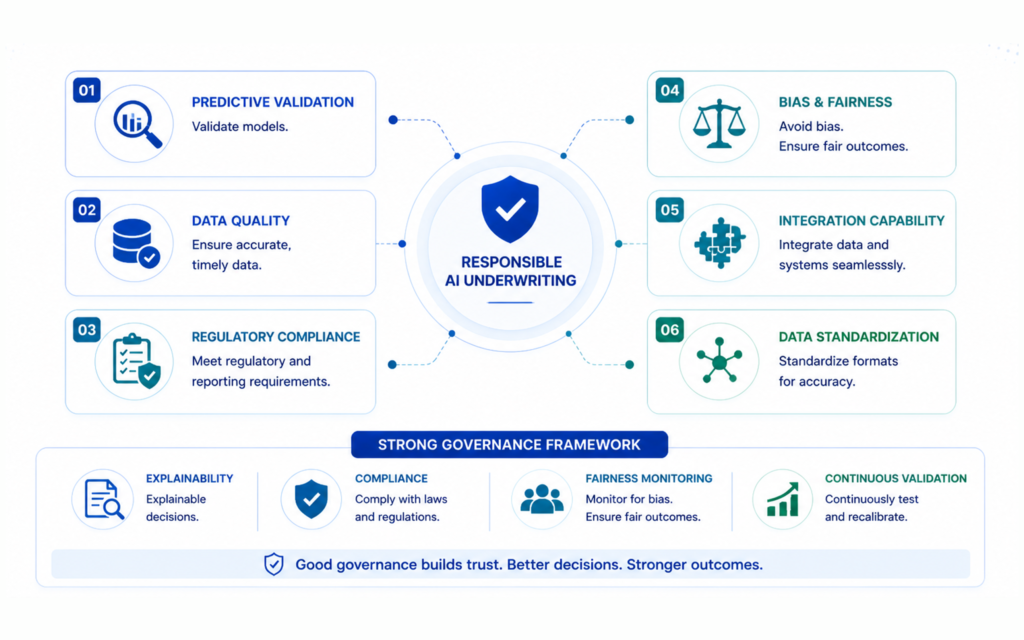
Challenge 1: Predictive Power Validation
Not all alternative data is predictive. Adding non-predictive variables can introduce noise and degrade model performance. Lenders must rigorously validate which alternative data sources provide incremental predictive value. This requires appropriate backtesting, holdout samples, and statistical significance testing.
Pitfall: A vendor claims that “social media follower count predicts creditworthiness.” Without appropriate validation, incorporating such a variable could weaken the model rather than improve it.
Challenge 2: Data Quality
Alternative data must be accurate, complete, and sufficiently distinct from information already used in the model. A late telco payment and a missed utility payment might both be associated with default risk, but if they tend to occur together, including both may add little incremental predictive value.
Missing values, duplicate records, inconsistent data, and fraudulent or manipulated inputs can further reduce data reliability.
Challenge 3: Regulatory & Compliance Complexity
The regulatory requirements governing alternative data vary by jurisdiction and can cover areas such as data use, customer consent, privacy, fair lending, and adverse-action or decision disclosures. Lenders need to understand the requirements applicable to their markets and ensure that automated credit decisions can be explained, governed, and audited.
This makes model explainability, data governance, documentation, and appropriate controls important components of alternative credit scoring implementations.
Challenge 4: Model Bias & Fairness
Alternative credit scoring models can reproduce or amplify biases present in historical data or underlying processes. Variables that appear neutral may also correlate with protected or otherwise sensitive characteristics and contribute to disparate outcomes.
Mitigation requires appropriate model validation, fairness testing, ongoing monitoring, and remediation when material disparities or unintended biases are identified.
Challenge 5: Data Integration Capability Gaps
Deploying alternative credit data within credit underwriting processes requires capabilities across data integration, AI/ML, risk management, and model governance. Some institutions may face gaps in these skills, particularly when moving from traditional underwriting environments to more data-intensive decisioning processes.
Bridging these gaps can require technical integration, upskilling, cross-functional collaboration, and changes to existing operating processes.
Challenge 6: Coverage & Standardization
Alternative data availability and quality can vary significantly by geography and market. Telco payment history may be available in one market but not another, while open banking infrastructure and data-access frameworks can differ substantially across regions.
Lenders operating across multiple markets may therefore face fragmented data landscapes, differences in data standards, and challenges in validating or porting models across geographies.
From Alternative Data to Intelligent Decisioning
Alternative data alone does not create better credit decisions.
Its value comes from turning relevant data into consistent, governed decisions.
This is where modern decisioning platforms become critical.
A mature decisioning approach combines:
- Alternative data sources
- AI driven underwriting
- Policy automation
- Risk controls
- Workflow orchestration
- Continuous monitoring
Case studies can illustrate how these capabilities are applied in practice, including efforts to increase processing capacity, reduce turnaround times, and support lending to previously underserved segments. The specific outcomes depend on the lender, data sources, underwriting model, and implementation.
The common theme was not simply data access.
It was the ability to operationalise data at scale.
Banking at the Speed of Life
The lending industry is entering a period where alternative data is becoming an increasingly important component of credit assessment. For institutions seeking faster decisions, broader access to credit, and more informed risk assessment, the ability to evaluate relevant financial and behavioural signals alongside traditional credit data is becoming increasingly valuable.
The potential benefits extend beyond processing efficiency. When alternative credit data provides relevant and validated signals, lenders can gain additional context for risk segmentation, affordability assessment, and credit decisions. More importantly, these signals can help complement historical credit information with a more current view of financial behaviour.
The challenge now is not access to data. It is turning that data into consistent, explainable, and compliant decisions at scale.
This is where platforms such as ezee.ai fit naturally into the transformation journey. Through decision.ezee, lenders can combine bureau data, banking signals, verification sources, AI driven insights, and alternative credit scoring models within a governed decision layer that connects policy, underwriting, workflows, analytics, and auditability into a single ecosystem.
The institutions best positioned to use alternative credit data effectively will not simply be those with access to more data. They will be those that can translate relevant data into consistent, explainable, and well-governed credit decisions.
As AI driven underwriting and automated decisioning continue to evolve, the ability to combine data, models, policies, and controls within a scalable decisioning process will become increasingly important.
Frequently Asked Questions
Traditional credit data primarily includes information from established credit-reporting systems, such as credit accounts, repayment history, and credit scores. Alternative credit data refers to additional financial, transactional, behavioural, or other relevant information that may provide context beyond conventional credit records.
Examples include banking transactions, utility and telecom payments, verified income information, and selected behavioural signals.
Common alternative data sources include:
- Banking and transaction data, which can provide insight into cash flow and financial behaviour.
- Utility and telecom payment history, which can provide additional evidence of payment patterns.
- Payroll and income data, which can help verify income and assess repayment capacity.
- Behavioural and device signals, which may provide additional context for fraud and risk assessment when appropriately validated.
- Gig-economy and informal income data, including platform earnings and transaction history.
Alternative credit data can improve a credit-scoring model when the data provides validated incremental predictive value. Examples may include transaction patterns, verified income information, and relevant cash-flow signals. Lenders should test these variables for predictive performance, data quality, and potential bias before incorporating them into credit decisions.
Alternative credit data can be particularly useful for borrowers with limited or incomplete traditional credit histories, including some gig workers, self-employed professionals, first-time borrowers, and other borrowers whose financial activity is not fully captured by conventional credit records.
For lenders, the data can provide additional signals for assessing affordability, repayment capacity, and risk when those signals demonstrate relevant predictive value.
In emerging markets, alternative credit data can provide additional information where traditional credit histories are limited or incomplete. Depending on the market and available infrastructure, this may include transaction data, digital payment activity, income information, utility payments, or other relevant financial signals.
Lenders must still assess data quality, consumer protection, regulatory requirements, and model performance before using these signals in credit decisions.
Lenders evaluating platforms for alternative credit scoring should consider capabilities such as data-source integrations, API connectivity, credit-scoring and underwriting models, policy automation, explainability, monitoring, and integration with existing lending workflows.
The appropriate platform depends on the lender’s data environment, products, regulatory requirements, and underwriting objectives.
Key regulatory considerations can include data privacy and permissible data use, consumer consent where required, fair lending and non-discrimination, explainability, adverse-action or decision disclosures where applicable, data governance, and auditability.
Because requirements vary by jurisdiction and lending context, institutions should assess the regulations and supervisory expectations applicable to their markets before incorporating alternative data into credit decisions.
Decision engines can combine alternative data with traditional credit information by feeding relevant signals into scoring models and rule-based decision logic. Eligibility rules, risk thresholds, affordability checks, and other lending policies can then be evaluated within the same decisioning workflow.
The specific architecture depends on the lender’s underwriting process and technology environment.
Lenders can assess the reliability of alternative credit data through source validation, data-quality checks, reconciliation where appropriate, anomaly detection, sample audits, and ongoing monitoring. The specific controls depend on the data source and how the information is used in the underwriting model.
Models should also be monitored over time to identify changes in data quality or predictive performance.
AI systems can analyse alternative credit data alongside traditional credit information to identify patterns relevant to credit-risk assessment. Depending on the model and data available, this may include transaction patterns, income consistency, cash-flow volatility, or other validated signals.
The effectiveness of an AI-driven approach depends on data quality, model design, validation, governance, and ongoing monitoring.
References
- World Bank — World Development Report 2022
- World Bank — ICCR Guidance Note on Alternative Data
- World Bank — International Committee on Credit Reporting
- CFPB — Using Alternative Data to Evaluate Creditworthiness
- CFPB — Joint Statement on Alternative Data in Credit Underwriting
- BIS — The Impact of Fintech Lending on Credit Access for U.S. Small Businesses
- World Bank — Credit Reporting