
Financial institutions are processing more loan applications than ever before across digital channels, partner ecosystems, and embedded lending platforms. As volumes continue to grow, lenders must accelerate approvals while maintaining underwriting quality, regulatory compliance, and customer experience.
Traditional lending operations often struggle to keep pace because manual reviews, disconnected workflows, and legacy technology create operational bottlenecks that become increasingly difficult to scale. As a result, loan processing automation has evolved from an efficiency initiative into a strategic capability for banks, NBFCs, and digital lenders.
This article explores how modern lending platforms combine automation, intelligent decisioning, and cloud-native architectures to process high loan volumes more efficiently while supporting sustainable growth.
What Is Loan Processing Automation?
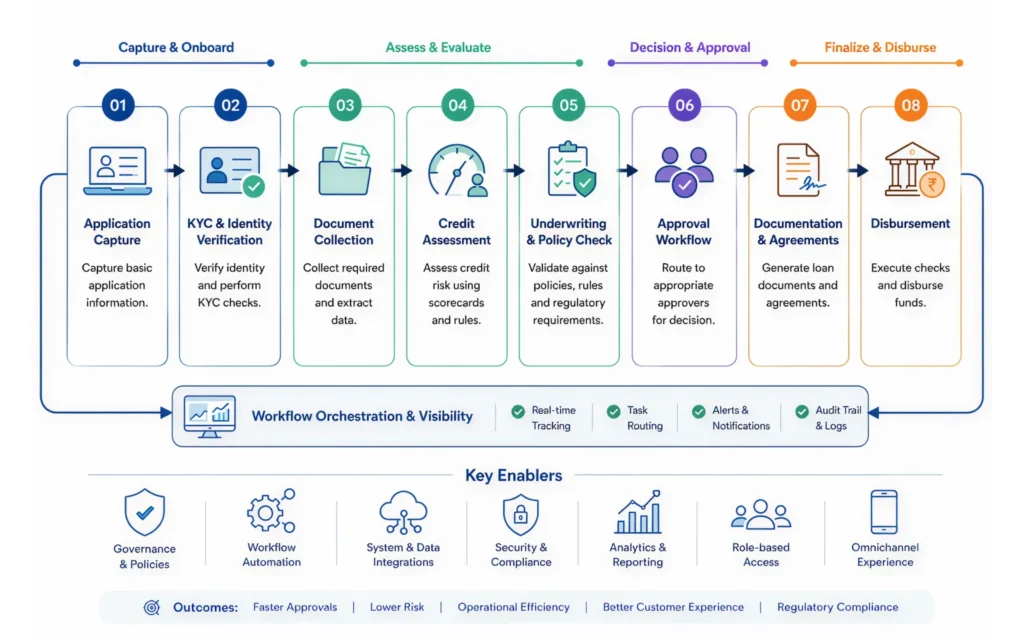
An automated loan processing workflow connects onboarding, underwriting, decisioning, and disbursement within a unified lending platform.
Loan Processing Automation is the use of digital technologies to automate and orchestrate the activities involved in evaluating, approving, and disbursing loans. Rather than relying on manual reviews and disconnected systems, modern lending platforms use workflow automation, business rules, artificial intelligence, and system integrations to streamline the entire loan processing lifecycle.
A typical automated loan processing workflow includes:
- Application capture
- Identity verification and KYC
- Intelligent Document Processing
- Credit bureau and fraud checks
- Underwriting and risk assessment
- Decisioning and approvals
- Documentation and disbursement
By automating these activities, lenders can reduce manual effort, improve decision consistency, accelerate turnaround times, and deliver a better borrower experience while maintaining regulatory compliance.
As lending volumes increase, automation also enables straight-through processing (STP), allowing low-risk applications to move from submission to approval with minimal human intervention. This capability becomes essential for institutions processing hundreds of thousands or even millions of loan applications each year.
Why Loan Processing Automation Becomes Critical at Scale
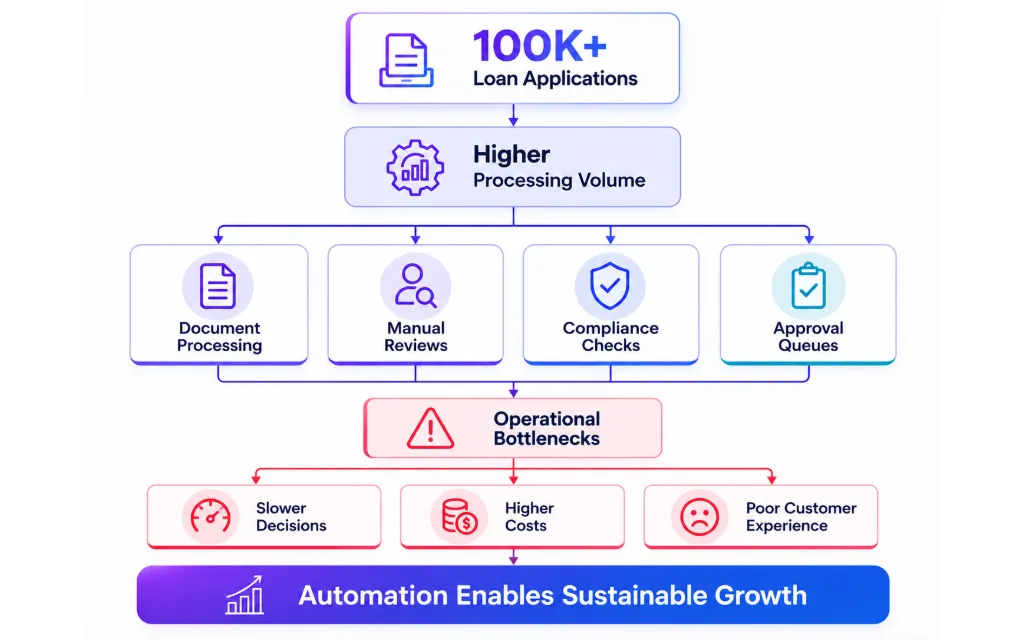
As lending volumes increase, manual reviews, compliance checks, document processing, and approval queues create operational bottlenecks that limit scalability.
Loan Processing Automation is no longer a productivity initiative. At scale, it becomes a business survival requirement.
Processing one million loans annually means handling nearly 2,700 applications every day, with seasonal peaks pushing volumes even higher. Every application triggers multiple parallel activities, including identity verification, document processing, fraud detection, credit assessment, underwriting, compliance validation, and funding decisions.
Many lenders assume scaling from 100,000 loans to one million loans is simply a matter of adding more people.
Scaling from 100,000 to one million loan applications is not simply a matter of hiring more people. As volumes increase, manual reviews create bottlenecks, approval queues grow longer, operational costs rise, and customer expectations become harder to meet.
Modern lending operations cannot rely on manual processes and tightly coupled technology. Legacy platforms often slow under increasing workloads, making it difficult to maintain consistent turnaround times, operational efficiency, and regulatory compliance as lending volumes grow.
Leading financial institutions address these challenges by combining loan processing automation, straight-through processing, intelligent document processing, and cloud-native lending architectures. Together, these capabilities enable lenders to process significantly higher application volumes without creating operational bottlenecks or compromising customer experience.
The Five Bottlenecks That Break High-Volume Lending
As lending volumes increase, operational complexity grows across every stage of the loan processing lifecycle. Processes that work efficiently at lower volumes often become significant bottlenecks at scale. Understanding these constraints helps explain why modern Loan Processing Automation requires a different architectural approach.
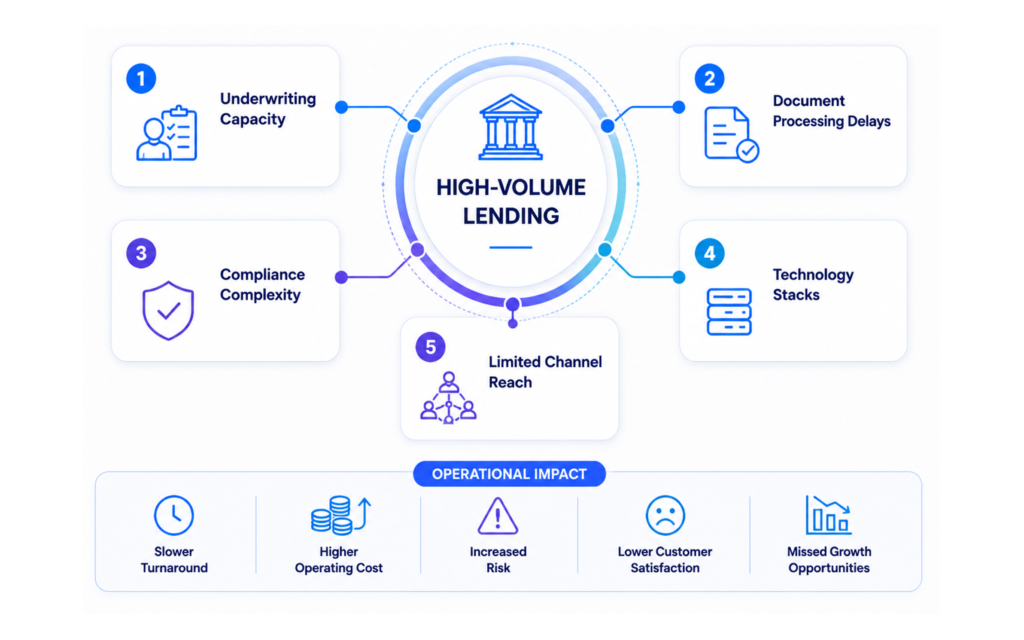
Operational bottlenecks become increasingly visible as lending volumes grow across people, processes, and technology.
Manual Underwriting Capacity
Traditional underwriting teams cannot expand at the same pace as application growth.
As volumes increase, lenders often face longer approval cycles, higher staffing costs, and inconsistent decision quality. What works for thousands of applications quickly becomes unsustainable as lending volumes grow into the hundreds of thousands or millions.
Document Processing Delays
Every application generates supporting documentation.
Income proofs, bank statements, tax records, employment verification documents, and identity records create a significant operational burden when reviewed manually.
For lenders processing millions of documents annually, manual verification becomes one of the largest operational constraints.
Compliance Complexity
KYC, AML, fair lending requirements, and regulatory reporting obligations increase alongside volume.
Without automation, compliance teams become overwhelmed, creating delays while increasing operational risk and audit complexity.
Monolithic Technology Stacks
Many legacy Loan Origination System environments were built around monolithic architectures.
A slowdown in one component often impacts the entire lending process. Scaling becomes expensive because institutions must scale the entire platform instead of individual services, limiting flexibility, resilience, and operational efficiency.
Limited Channel Reach
Modern lending no longer happens through a single application portal.
Borrowers expect access through mobile apps, partner ecosystems, embedded lending experiences, branch channels, and digital marketplaces. Traditional architectures often struggle to support these growing distribution channels while maintaining consistent performance and customer experience.
These bottlenecks cannot be solved by adding more people or expanding existing infrastructure. They require a fundamentally different technology architecture built for automation, scalability, and resilience. The next section explores the architectural foundations that enable financial institutions to process high loan volumes efficiently while maintaining performance and control.
The Architecture Behind Million-Loan Operations
High-volume lending requires more than additional infrastructure. It depends on an architecture that can scale processing capacity, automate decisions, and maintain consistent performance without proportional increases in operational cost. Modern Loan Processing Automation platforms achieve this through several architectural foundations.
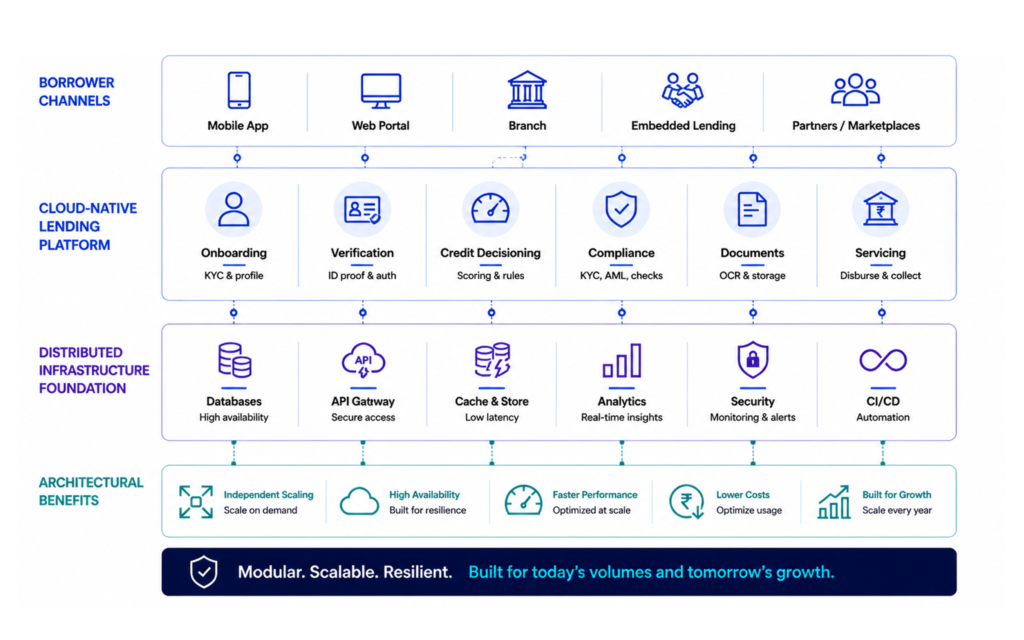
Cloud-native architectures allow lending platforms to scale individual services independently while maintaining resilience and performance.
Cloud-Native Microservices
One of the most important shifts is the adoption of cloud native microservices.
Instead of operating as a single monolithic application, modern lending platforms separate critical capabilities into independent cloud-native services such as:
- Customer onboarding
- Identity verification
- Underwriting
- Compliance
- Document processing
- Disbursement
Each component can scale independently based on demand.
If document volumes spike, only document services expand. If underwriting traffic increases, only underwriting resources scale. This architecture enables financial institutions to scale individual services based on demand, improving resilience, reducing infrastructure costs, and maintaining consistent performance during peak lending periods.
Distributed Data Processing
Processing capacity depends not only on application logic but also on data architecture. Modern lending environments use distributed databases, intelligent caching, and workload partitioning to ensure consistent system performance as transaction volumes grow.
The objective is to maintain low response times and high system availability regardless of application volume.
When thousands of applications arrive simultaneously, lenders cannot afford systems that slow down under pressure.
Business Rules Engine Driven Decisioning
A modern Business Rules Engine (BRE) plays a central role in scalable Loan Processing Automation.
Instead of relying on manual reviews, lenders use rules-driven decisioning to evaluate eligibility, policy compliance, risk thresholds, and pricing logic automatically.
The most advanced platforms allow business teams to modify rules through no-code interfaces, enabling faster responses to market changes without creating IT bottlenecks.
As lending portfolios expand across products, customer segments, geographies, and regulatory environments, configurable business rules help institutions respond faster without creating IT bottlenecks.
Together, these architectural capabilities create the technical foundation for scalable lending operations. Their greatest value, however, is realised through Straight-through processing, where applications move through the lending lifecycle with minimal manual intervention. The next section explores how this operating model transforms lending economics.
How Straight Through Processing Changes Lending Economics
One of the most significant outcomes of Loan Processing Automation is Straight-Through Processing (STP). Instead of moving applications through multiple manual reviews, STP enables eligible loans to progress automatically across the lending lifecycle while predefined business rules, compliance checks, and risk policies are enforced in real time.
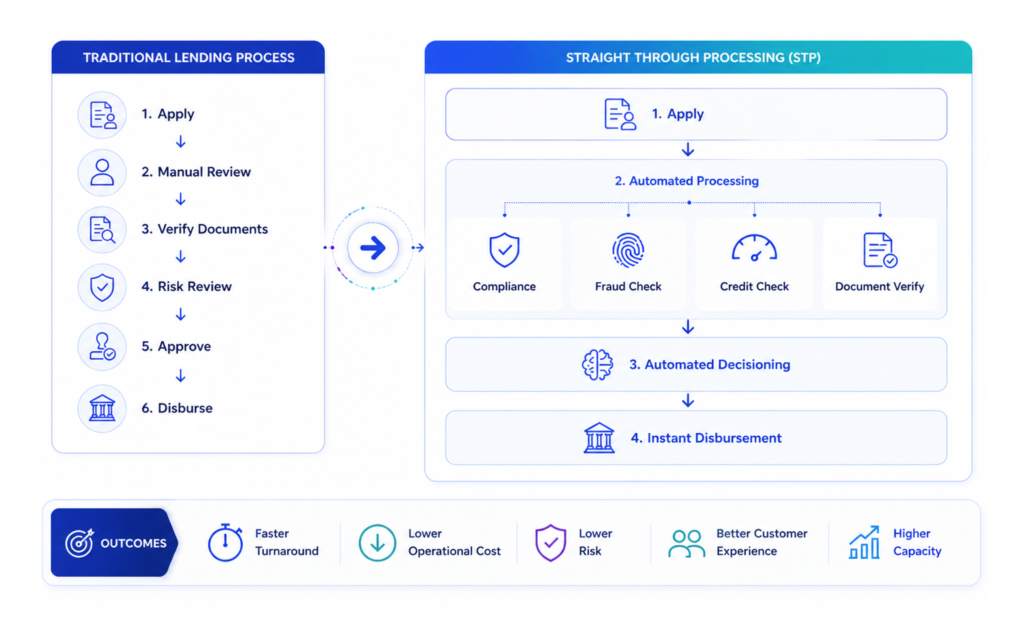
Straight-Through Processing automates loan approvals by reducing manual intervention and executing validation activities in parallel.
Automated Qualification
Borrowers receive immediate feedback on eligibility through automated assessments using credit, income, identity, and behavioural data.
This reduces uncertainty while improving application completion rates.
Automated qualification also reduces unnecessary applications entering downstream workflows, allowing operational teams to focus on higher-value lending activities.
Parallel Workflow Execution
Traditional lending processes often execute activities sequentially, creating avoidable delays. Modern Loan Processing Automation performs multiple validation activities simultaneously, including:
- Compliance checks
- Fraud screening
- Document validation
- Credit assessment
- Underwriting analysis
Because these activities occur in parallel, overall turnaround times decrease dramatically.
Intelligent Routing
Not every application requires the same level of review.
Low risk applications can move directly to approval, while more complex cases are routed to specialists with complete context already available.
This approach improves both efficiency and decision quality.
For many lenders, Straight-Through Processing becomes one of the largest drivers of operational savings because it reduces manual touchpoints while ensuring specialist expertise is applied only where additional review is required.
Straight-Through Processing delivers significant efficiency gains, but high-volume lending also depends on automated compliance, intelligent document handling, and seamless ecosystem connectivity. These capabilities enable financial institutions to scale lending operations without increasing operational risk.
Compliance, Scale, and Embedded Lending
As lending operations scale, success depends on more than processing speed alone. Financial institutions must also automate compliance, manage growing document volumes, and support lending across multiple digital channels. Together, these capabilities enable Loan Processing Automation to scale without increasing operational risk or complexity.
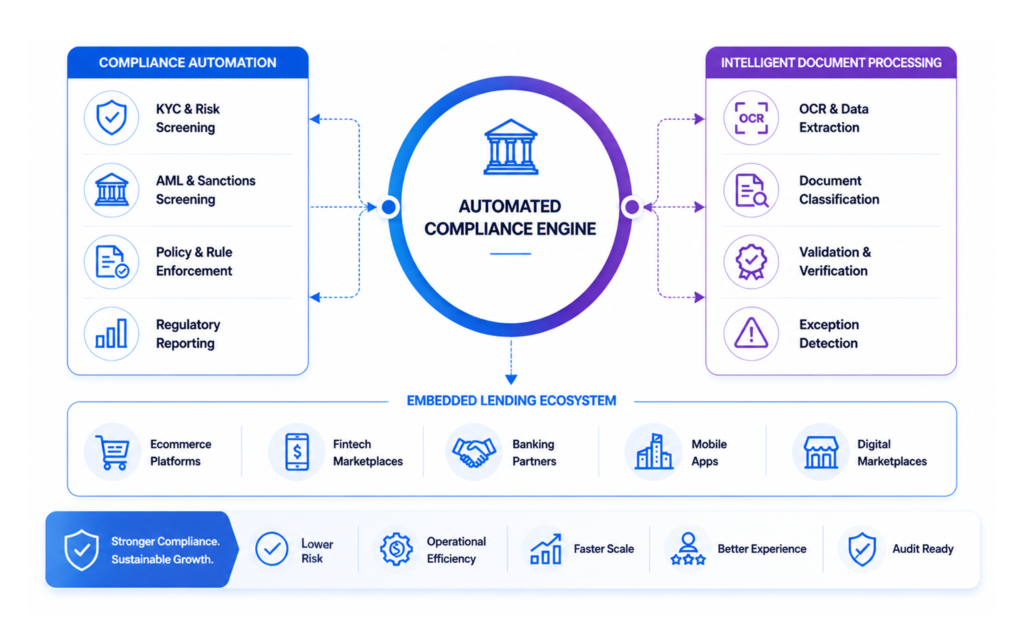
Compliance automation and Intelligent Document Processing improve governance, document accuracy, and operational scalability.
Compliance Automation at Scale
Manual compliance reviews are difficult to sustain at million loan volumes.
Modern lending platforms increasingly embed compliance directly into workflows.
This includes:
- Automated KYC verification
- AML screening
- Policy enforcement
- Audit trail generation
- Ongoing customer monitoring
Rather than treating compliance as a separate process, leading institutions make it an automated component of every lending decision.
The result is lower compliance costs, reduced operational risk, improved audit readiness, and consistent regulatory compliance across high-volume lending operations.
Intelligent Document Processing
Document handling remains one of the most underestimated barriers to scale.
Intelligent document processing combines OCR, machine learning, and automation to:
- Extract borrower information
- Classify documents
- Validate data accuracy
- Identify missing information
- Flag potential inconsistencies
By extracting, validating, and classifying information automatically, Intelligent Document Processing reduces manual effort while improving data quality. It also accelerates underwriting by delivering structured information directly into downstream decisioning and workflow systems.
Instead of hiring hundreds of additional reviewers, lenders can process significantly larger volumes while improving accuracy and consistency.
API-First Lending and Embedded Distribution
The fastest-growing lenders increasingly distribute credit through partner ecosystems rather than relying solely on their own digital channels.
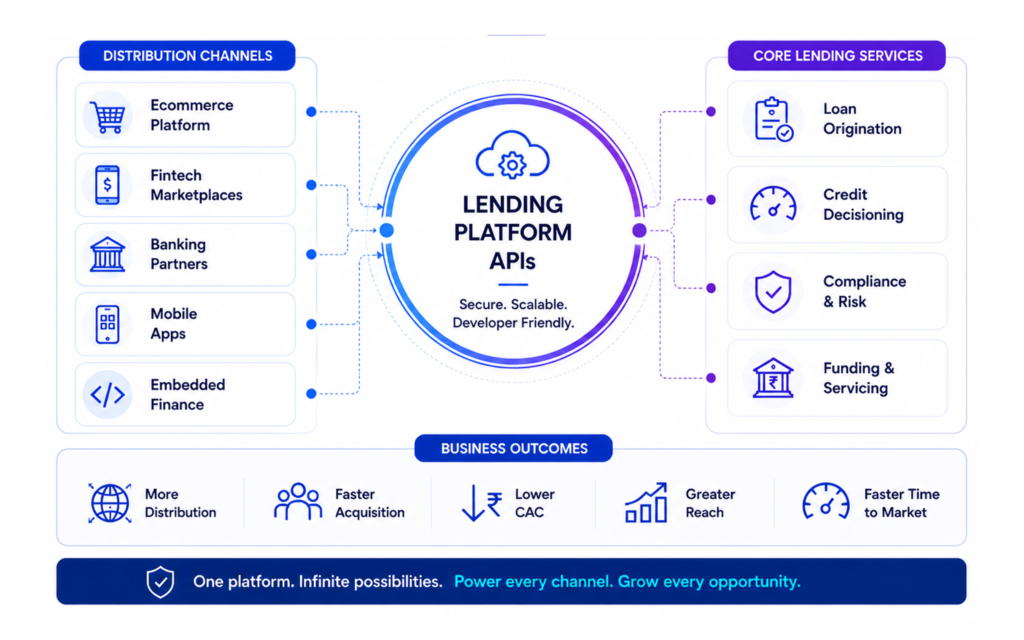
API-first architectures extend lending capabilities across partner ecosystems, embedded finance, and digital channels.
This includes:
- Ecommerce platforms
- Fintech marketplaces
- Banking partnerships
- Mobile applications
- Embedded finance experiences
API-first architectures make this possible by exposing Loan Origination System capabilities, decisioning services, and funding workflows through secure APIs. This allows lending to occur wherever customers choose to engage, while maintaining consistent governance and operational control.
This creates new acquisition opportunities, accelerates partner onboarding, and allows financial institutions to expand distribution without proportionally increasing operational overhead.
Compliance automation, Intelligent Document Processing, and API-first distribution extend Loan Processing Automation beyond operational efficiency. Together, they create the foundation for a scalable, connected lending ecosystem capable of supporting future growth. The final section brings these capabilities together into a unified operating model.
Building a Future-Ready Lending Engine
The future of lending will not be defined by who hires the largest operations team. It will be defined by who builds the most scalable operating model.
Leading financial institutions are already moving in this direction by combining Loan Processing Automation, Straight-Through Processing, cloud-native microservices, Intelligent Document Processing, and Business Rules Engines into a unified lending architecture. Together, these capabilities create a scalable operating model that supports higher application volumes without proportional increases in operational complexity.
Platforms such as ezee.ai bring these capabilities together in a single environment, helping financial institutions connect AI-powered automation, workflow orchestration, intelligent decisioning, loan origination, credit decisioning, and loan management into a scalable lending ecosystem.
When these capabilities work together in a single environment, lenders can reduce operational costs, accelerate approvals, strengthen compliance, and create the flexibility needed to support future growth. Just as importantly, Business teams gain greater control over workflow configuration, decision logic, product launches, and policy changes without becoming dependent on lengthy development cycles.
The institutions that succeed over the next decade will not simply process more loans. They will process them faster, more intelligently, and more efficiently than their competitors.
At million-loan volumes, scale is no longer about adding capacity. It is about building an operating model where growth becomes automatic rather than operationally painful.
For financial institutions evaluating how to modernise lending operations, the priority is no longer automating individual tasks. It is building a connected lending platform that can scale efficiently, adapt to changing business needs, and support long-term digital transformation.
Frequently Asked Questions
Loan Processing Automation uses digital technologies to automate the end-to-end loan processing lifecycle, from application intake and document verification to underwriting, approvals, and disbursement. By replacing manual tasks with automated workflows and decisioning, financial institutions can improve operational efficiency, reduce processing time, and deliver a more consistent borrower experience.
Loan Processing Automation reduces manual effort by automating repetitive tasks such as document verification, compliance checks, underwriting, and workflow routing. This helps financial institutions process higher application volumes, improve decision consistency, lower operational costs, and accelerate loan approvals while maintaining regulatory compliance.
Straight-Through Processing (STP) enables eligible loan applications to move through the lending lifecycle with minimal human intervention. Automated qualification, rule-based decisioning, and workflow orchestration allow low-risk applications to progress quickly while routing complex cases for manual review when necessary.
Intelligent Document Processing automatically extracts, classifies, and validates information from borrower documents using AI and OCR technologies. This reduces manual data entry, improves data accuracy, accelerates underwriting, and enables lenders to manage growing document volumes more efficiently.
A Business Rules Engine (BRE) automates lending decisions by applying configurable business policies, eligibility criteria, pricing rules, and risk thresholds consistently across every application. This improves decision speed while allowing institutions to update lending policies without extensive software development.
Cloud-native lending platforms use independently scalable services that allow critical functions such as onboarding, underwriting, document processing, and compliance to scale based on demand. This improves system resilience, maintains consistent performance, and supports growing lending volumes without scaling the entire platform.
API-first lending enables financial institutions to integrate loan origination, decisioning, and disbursement capabilities into partner applications, digital marketplaces, and embedded finance ecosystems. This expands customer reach while maintaining consistent governance, security, and operational control across multiple distribution channels.
Modern lending platforms embed compliance directly into automated workflows through policy enforcement, identity verification, audit trails, and ongoing monitoring. This reduces manual reviews, improves consistency, and helps financial institutions maintain regulatory compliance as lending volumes increase.
A modern Loan Origination System should support workflow automation, configurable business rules, Intelligent Document Processing, Straight-Through Processing, API integrations, compliance automation, and cloud-native scalability. Together, these capabilities help financial institutions process loans more efficiently while adapting to changing business and regulatory requirements.
Financial institutions can scale Loan Processing Automation by combining cloud-native architectures, automated workflows, intelligent decisioning, Business Rules Engines, and Straight-Through Processing within a unified lending platform. This enables higher processing volumes, improved operational efficiency, and consistent customer experiences without proportionally increasing operational complexity.