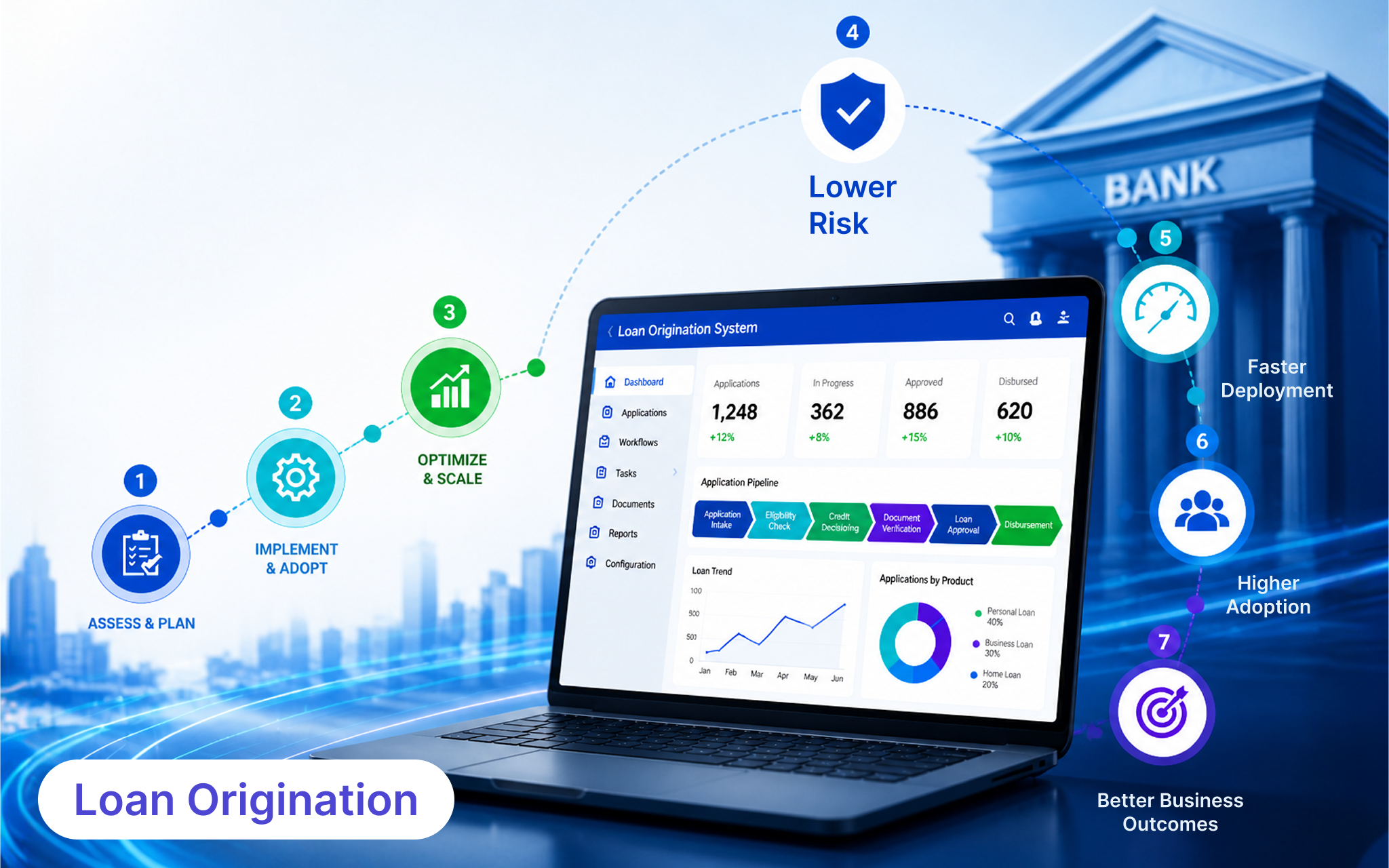
The loan origination process is the foundation of every lending operation, guiding borrowers from application and verification through credit assessment, underwriting, approval, and disbursement. As customer expectations, regulatory requirements, and digital lending models continue to evolve, banks are under increasing pressure to modernize these workflows without disrupting day-to-day operations.
For many financial institutions, implementing or transforming a digital loan origination system is one of the most significant operational initiatives they undertake. Success depends on far more than deploying new technology. It requires aligning business processes, integrating legacy systems, managing organizational change, ensuring regulatory compliance, and maintaining operational continuity throughout the implementation journey.
Institutions that treat loan origination process implementation as a business transformation program rather than a software deployment are better positioned to reduce implementation risk, accelerate adoption, and deliver long-term operational value. This guide explores the common implementation challenges, proven best practices, and practical strategies that help banks build efficient, scalable, and future-ready loan origination processes.
Why Modern Loan Origination Processes Demand More Than Technology
Modern lending is no longer driven solely by faster approvals. Banks are expected to deliver seamless digital experiences while maintaining regulatory compliance, managing operational risk, and adapting quickly to changing market conditions. As a result, the loan origination process has evolved into a connected ecosystem that spans customer onboarding, document verification, credit assessment, underwriting, decisioning, and disbursement.
Unlike traditional lending environments, where many activities were completed manually or through disconnected systems, today’s digital loan origination systems integrate multiple internal platforms, third-party services, and automated workflows into a single lending journey. This includes identity verification, credit risk assessment models, automated underwriting processes, document management, fraud detection, compliance checks, and legacy system integration.
Implementing this level of connectivity requires more than deploying new software. Banks must redesign loan origination workflows, align business and technology teams, establish governance, and ensure that every stage of the lending lifecycle continues to operate reliably throughout the transition. Institutions that focus equally on technology, process, and people are significantly better positioned to achieve successful implementations and long-term operational improvements.
Loan Origination Process Workflow
A modern loan origination process connects multiple business functions, internal systems, and third-party services to deliver a seamless lending experience. Rather than treating each stage as an isolated activity, leading banks orchestrate the entire loan origination workflow through a digital loan origination system that automates tasks, standardizes decisions, and improves operational visibility.
From customer application through verification, credit assessment, underwriting, approval, documentation, and disbursement, every stage depends on reliable integrations, configurable business rules, and coordinated workflows. When these components operate together, banks can improve processing efficiency, reduce manual intervention, strengthen compliance, and deliver a more consistent borrower experience.
The workflow below illustrates the key stages that institutions typically integrate and optimize during Loan Origination Process implementation.
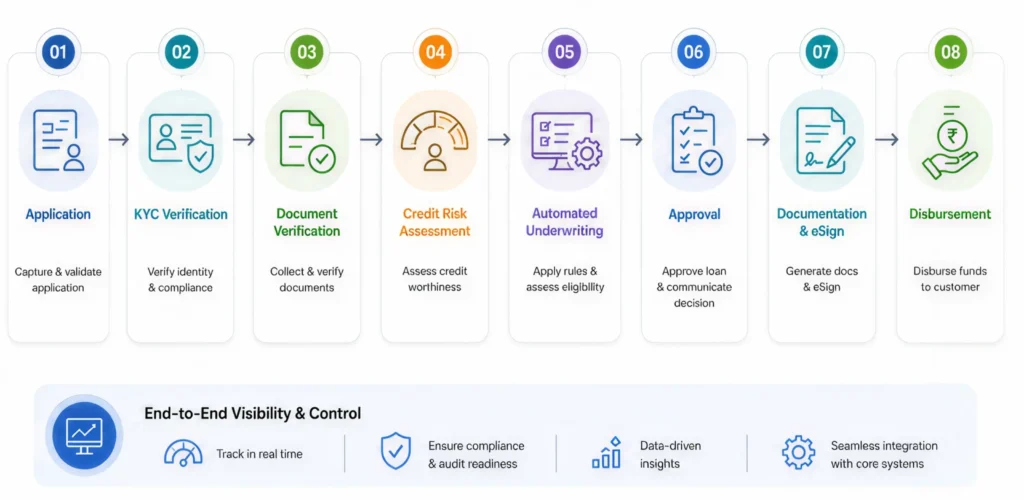
A Digital Loan Origination System streamlines every stage of the loan origination process through automation, compliance, and integrated workflows.
Traditional vs Digital Loan Origination Process
Traditional and digital lending follow the same core stages, but the way they are executed differs significantly. Modern loan origination processes replace manual, disconnected activities with automated workflows, integrated systems, and real-time visibility, enabling financial institutions to improve efficiency, scalability, and customer experience.
| Traditional Loan Origination Process | Digital Loan Origination Process | Implementation Impact |
|---|---|---|
| Paper-based applications | Digital application channels | Faster customer onboarding |
| Manual KYC and document verification | Automated identity and document verification | Reduced manual effort and errors |
| Sequential processing | Workflow automation and parallel processing | Faster turnaround times |
| Manual underwriting | Automated underwriting with configurable rules | Consistent and scalable decisions |
| Disconnected systems | Integrated lending ecosystem | Improved operational visibility |
| Limited process monitoring | Real-time dashboards and reporting | Better governance and compliance |
| Longer processing cycles | Faster loan processing | Improved customer experience |
| Difficult to scale | Configurable and scalable workflows | Faster product launches and growth |
Why Loan Origination Processes Fail Before Go-Live
The loan origination process has become a strategic differentiator for banks competing with digital lenders and fintechs. Faster approvals, seamless onboarding, and automated decisioning are no longer competitive advantages, they are customer expectations. Financial institutions that cannot modernize their lending workflows risk losing both operational efficiency and market share.
Yet for many banks and financial institutions, modernising the loan origination process through a new Loan Origination System remains one of the most complex technology initiatives they undertake. Industry studies consistently show that digital transformation initiatives frequently exceed planned timelines, budgets, or expected business outcomes.
Complex integrations, evolving business requirements, and organizational change often create implementation challenges long before a solution reaches production.
The challenge is not simply implementing new technology.
It is managing legacy system integrations, regulatory requirements, data migration, employee adoption, and operational continuity while maintaining an efficient loan origination workflow throughout the implementation lifecycle.
Financial institutions that approach loan origination process implementation as a business transformation initiative rather than a software deployment are better positioned to improve adoption, reduce implementation risk, and achieve long-term operational value.
The Biggest Risks in LOS System Implementation
Even well-planned loan origination process implementations can encounter unexpected challenges. Understanding where these risks originate helps financial institutions anticipate potential obstacles, prioritize mitigation strategies, and build a more resilient implementation roadmap before deployment begins.
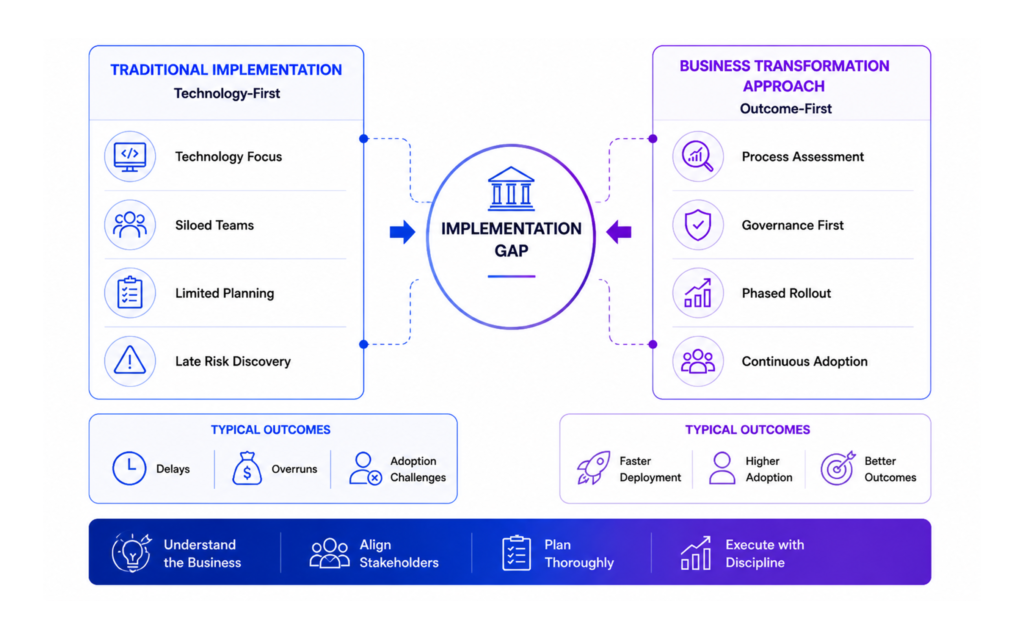
Modern loan origination process implementations focus on business transformation, governance, and phased execution rather than technology deployment alone.
Legacy Infrastructure Complexity
Most banks and financial institutions operate across multiple systems accumulated over years of growth. Core banking platforms, document repositories, customer databases, and third-party integrations often create complex legacy system integrations with hidden dependencies that increase implementation effort and complicate loan origination system deployments.
Even seemingly simple integrations can become significant project risks if discovered late.
Resource and Expertise Constraints
Unlike larger institutions, Tier 2 banks rarely have dedicated transformation teams.
Limited internal capacity often affects implementation planning, testing, governance, and post-deployment support, making resource allocation a critical success factor.
Technology teams are often balancing multiple priorities, including:
- Regulatory projects
- Infrastructure maintenance
- Cybersecurity initiatives
- Day-to-day operations
As a result, implementation programmes frequently compete for attention and resources.
Change Resistance
Technology adoption is ultimately a people challenge.
Loan officers, underwriters, operations teams, and branch staff often have years of experience with existing processes. Without structured change management, training, and stakeholder engagement, new systems often lead to resistance, manual workarounds, and lower adoption across the loan origination workflow.
Compliance and Data Risks
Every digital loan origination system must support regulatory obligations for customer onboarding, credit assessment, auditability, data protection, and operational transparency throughout the lending lifecycle.
Implementation gaps can create operational disruptions, regulatory exposure, and reputational risk. In highly regulated lending environments, compliance failures often become more costly than technology failures.
These risks rarely occur in isolation. Legacy technology, resource limitations, compliance obligations, and organizational change often reinforce one another, increasing implementation complexity. The good news is that most of these challenges can be anticipated and mitigated through structured planning, phased execution, and strong governance, as explored in the next section.
Eight Proven Strategies to Reduce Implementation Risk
While every financial institution has unique lending products, regulatory requirements, and technology environments, successful loan origination process implementations consistently follow a common set of principles. The strategies below help banks reduce implementation risk, improve adoption, and accelerate the transition to a modern digital loan origination system.
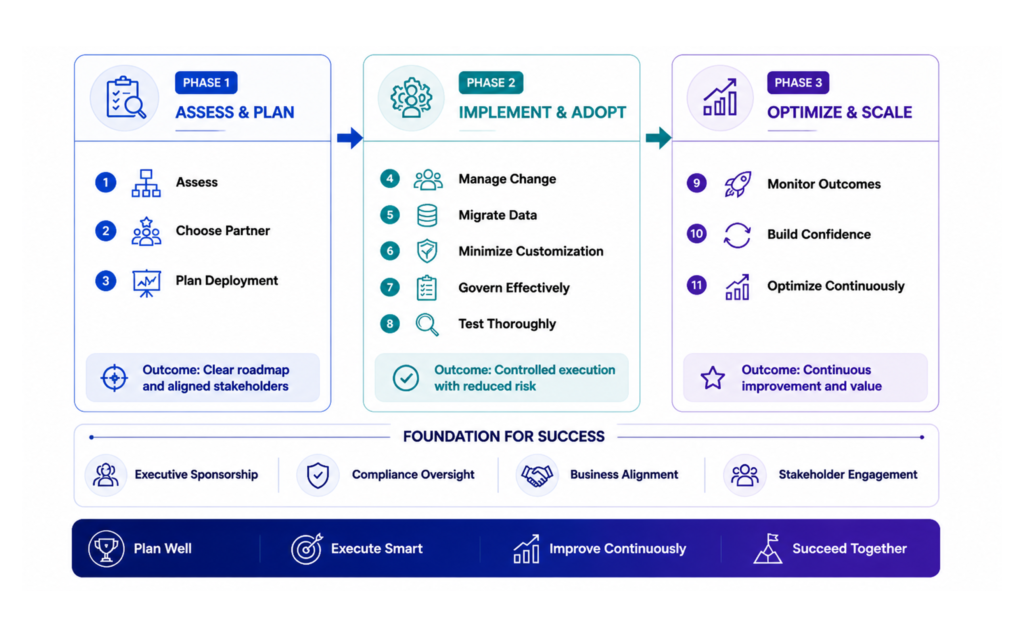
A structured implementation roadmap helps financial institutions reduce deployment risk and accelerate Digital Loan Origination System adoption.
1. Start With Process Assessment, Not Technology Selection
Many financial institutions begin evaluating vendors before fully understanding their existing loan origination workflow and operational bottlenecks.
A better approach begins with:
- Workflow mapping
- Process bottleneck analysis
- Stakeholder workshops
- Future-state design
This creates alignment between business objectives, operational requirements, and technology decisions before implementation begins.
2. Choose the Right Partner, Not Just the Right Platform
Technology capabilities matter.
Implementation expertise matters more.
When evaluating a Loan Origination System, consider:
- Experience with similar banks
- Deployment methodology
- Support structure
- Regulatory understanding
- Post-implementation capabilities
The wrong partner can turn a strong platform into a failed project.
A partner with proven lending domain expertise can also help anticipate regulatory, integration, and change management challenges before they affect project timelines.
3. Avoid Big Bang Deployments
One of the most common implementation mistakes is attempting to transform everything at once.
A phased approach significantly reduces risk.
It also allows implementation teams to validate integrations, user adoption, and operational performance before expanding to additional products or regions.
Typical rollout stages include:
- Single-product pilots
- Selected branch deployments
- Regional expansion
- Full portfolio rollout
Each phase provides lessons that improve subsequent deployments.
4. Make Change Management a Priority
Technology adoption does not happen automatically.
Successful programmes invest heavily in:
- Leadership communication
- Role-based training
- User champions
- Feedback mechanisms
Business users are more likely to embrace change when they understand the purpose, benefits, and long-term impact on their daily workflows.
5. Treat Data Migration as a Strategic Workstream
Data migration failures remain one of the leading causes of implementation disruption.
Best practices include:
- Early data profiling
- Data cleansing
- Validation testing
- Pilot migrations
- Rollback planning
High-quality data improves implementation success, reporting accuracy, automated decisioning, and long-term operational performance.
6. Minimise Unnecessary Customisation
Many banks attempt to replicate legacy processes inside new platforms.
This often increases:
- Complexity
- Cost
- Risk
- Upgrade challenges
Modern digital loan origination systems allow institutions to configure workflows and business rules without extensive custom development, making future upgrades simpler and less disruptive.
7. Establish Strong Governance Early
Effective governance prevents small issues from becoming major problems.
Key elements include:
- Executive sponsorship
- Steering committees
- Change control processes
- Transparent reporting
Effective governance enables faster decision-making, clear accountability, and better alignment between business, technology, compliance, and operations teams throughout the implementation lifecycle.
8. Test More Than You Think You Need To
Testing should extend far beyond technical validation.
Comprehensive LOS implementations require:
- User acceptance testing
- Integration testing
- Compliance testing
- Performance testing
- Operational readiness testing
Comprehensive testing builds confidence across business and technology teams, reduces implementation risk, and helps ensure a smoother transition to production with minimal operational disruption.
While every implementation is different, these principles consistently reduce project risk and improve implementation outcomes. Financial institutions that invest in planning, governance, user adoption, and continuous validation are better positioned to deliver a resilient, scalable, and future-ready loan origination process.
What Happens After Go-Live Matters More
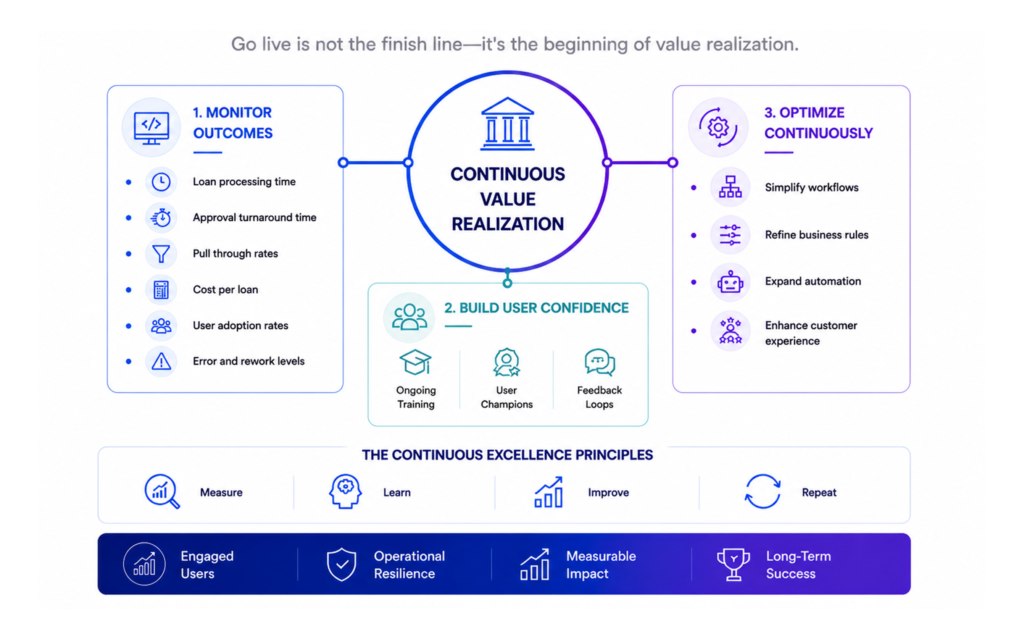
Successful loan origination processes continue to evolve through performance monitoring, user adoption, and continuous workflow optimisation.
Many organisations treat go live as the finish line.
In reality, it marks the beginning of continuous improvement, where financial institutions start realising the full value of their digital loan origination system investment.
The first few months after deployment determine whether the new Loan Origination System becomes a competitive advantage or simply another technology platform.
Financial institutions that achieve long-term success focus on three priorities immediately after launch.
Monitor Business Outcomes
Tracking system availability is not enough.
Banks should continuously measure:
- Loan processing time
- Approval turnaround time
- Pull through rates
- Cost per originated loan
- User adoption rates
- Error and rework levels
These metrics provide early visibility into operational performance, user adoption, and whether the loan origination process is delivering the expected business outcomes.
Build User Confidence
Even the most intuitive digital loan origination system requires continuous learning and user engagement.
Ongoing training, internal champions, and structured feedback loops help employees adopt new workflows faster and identify improvement opportunities before they affect productivity, customer experience, or operational efficiency.
Optimise Continuously
No implementation is perfect on day one.
Real-world usage often uncovers opportunities to simplify workflows, improve automation, refine business rules, and enhance customer journeys. Institutions that treat optimisation as an ongoing discipline continue to improve loan origination workflows, increase automation, and maximise long-term business value.
Successful implementation is not measured by a smooth deployment alone, but by the organisation’s ability to continuously refine processes, strengthen user adoption, and respond to evolving business and regulatory requirements. This commitment to continuous improvement is what transforms a technology implementation into a sustainable competitive advantage.
Building a Sustainable Loan Origination System
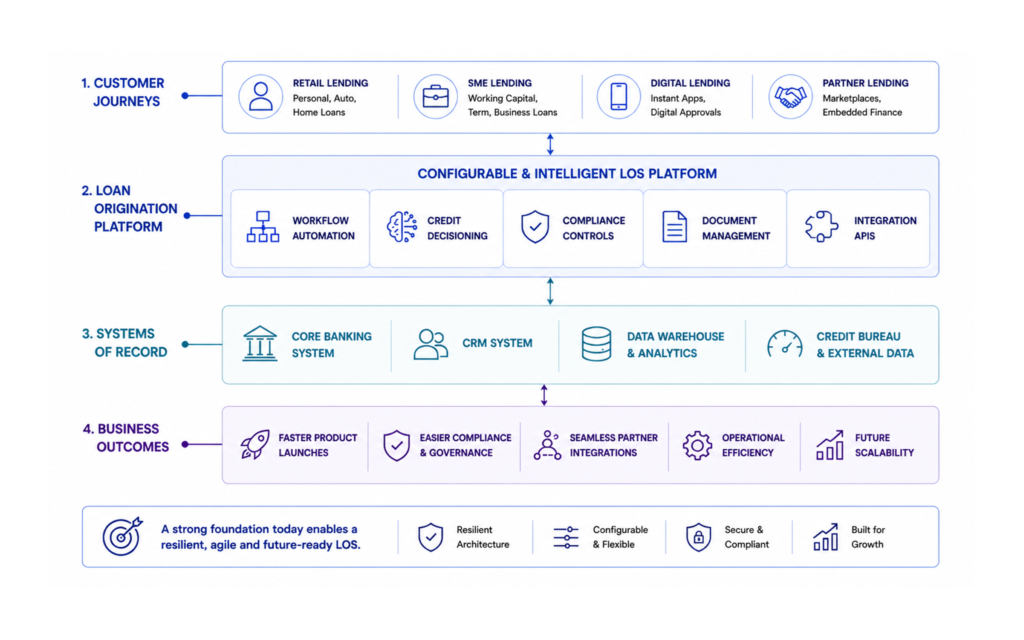
A scalable Digital Loan Origination System enables faster product launches, operational efficiency, regulatory compliance, and long-term business growth.
The strongest implementations do more than replace existing processes.
They create a foundation for future growth.
A modern Loan Origination System should provide the flexibility to support future business growth, changing regulations, evolving customer expectations, and continuous process improvement.
- Launch new lending products
- Adapt to regulatory changes
- Integrate with new partners and services
- Enhance credit decisioning capabilities
- Automate and optimise lending workflows
- Continuously improve borrower experiences
This flexibility enables financial institutions to respond more quickly to market opportunities, regulatory updates, and changing borrower expectations without undertaking large-scale transformation projects.
Banks that focus solely on current requirements often find themselves revisiting transformation initiatives much sooner than expected.
Future readiness should be built into every loan origination process implementation from the very beginning rather than treated as a post-deployment objective.
The Path to Lower Risk and Faster Value
Successful loan origination processes are built through careful planning, disciplined execution, and continuous optimisation. The institutions that consistently achieve the best outcomes recognise that implementation is a business transformation initiative, not simply a technology deployment.
Technology is only one part of the equation.
The institutions that achieve the strongest outcomes combine robust governance, effective change management, phased deployment strategies, and long-term operational improvement programmes.
This is where platforms such as ezee.ai can help simplify loan origination process implementation. Through AI-powered automation, workflow orchestration, intelligent decisioning, and configurable loan origination capabilities, financial institutions can modernise lending operations while reducing implementation complexity. Pre-built compliance controls, flexible integrations, and business-led configuration help accelerate deployment, minimise operational risk, and support long-term scalability.
The future belongs to institutions that can modernise quickly without disrupting the business they have spent years building.
For banks and financial institutions, the goal is not simply implementing a loan origination system.
It is creating loan origination processes that are faster, more efficient, easier to govern, and ready to support growth for years to come.
Frequently Asked Questions
loan origination process implementations typically fail due to poor planning, legacy system integration challenges, limited stakeholder engagement, inadequate change management, and unrealistic deployment timelines. Financial institutions that treat implementation as a business transformation initiative rather than a technology project are better positioned to reduce risk and achieve long-term success.
Implementation timelines vary depending on the institution’s size, lending products, legacy systems, regulatory requirements, and project scope. Many banks adopt a phased implementation approach, beginning with pilot deployments before expanding to additional products, branches, or business units to reduce operational risk.
A traditional Loan Origination Process relies on manual activities, paper-based documentation, and disconnected systems. A digital loan origination system automates workflows, integrates business applications, supports real-time decisioning, and provides greater operational visibility, resulting in faster processing and a more consistent borrower experience.
Technology alone does not ensure successful implementation. Effective change management helps employees understand new workflows, adopt digital processes, and minimise resistance to change. Training, leadership communication, and continuous feedback are essential for improving adoption and long-term operational success.
Legacy system integration often involves connecting core banking platforms, customer databases, document repositories, and third-party services. Hidden dependencies, inconsistent data, and outdated interfaces can increase implementation complexity, making careful planning and phased integration essential for reducing project risk.
Banks can reduce implementation risk by assessing existing workflows before selecting technology, adopting phased deployments, strengthening governance, investing in change management, validating data quality, and continuously monitoring business outcomes after go live.
A phased deployment allows financial institutions to validate workflows, integrations, and user adoption in controlled stages before expanding implementation across products or regions. This approach reduces operational disruption, improves issue resolution, and increases implementation confidence.
Beyond technical performance, banks should monitor loan processing time, approval turnaround time, user adoption, workflow efficiency, error rates, and customer experience. Measuring these outcomes helps identify optimisation opportunities and ensures the implementation continues to deliver long-term business value.
Modern digital loan origination systems are designed to support configurable workflows, business rules, regulatory updates, partner integrations, and new lending products without extensive redevelopment. This flexibility enables financial institutions to adapt more quickly to changing market and customer requirements.
Beyond product capabilities, banks should evaluate implementation experience, lending domain expertise, regulatory knowledge, integration capabilities, support services, and post-implementation guidance. An experienced implementation partner can help reduce project risk and accelerate the path to operational success.
References
- Office of the Comptroller of the Currency (OCC) – New, Modified, or Expanded Bank Products and Services: Risk Management Principles
- OCC Comptroller’s Handbook – Lending and Loan Portfolio Risk Management
- Federal Financial Institutions Examination Council (FFIEC) – Development, Acquisition, and Maintenance Guidance
- OCC Bulletin 2024-26 – FFIEC Information Technology Examination Handbook: Development, Acquisition, and Maintenance
- OCC Digitalization Resources for Community Banks