
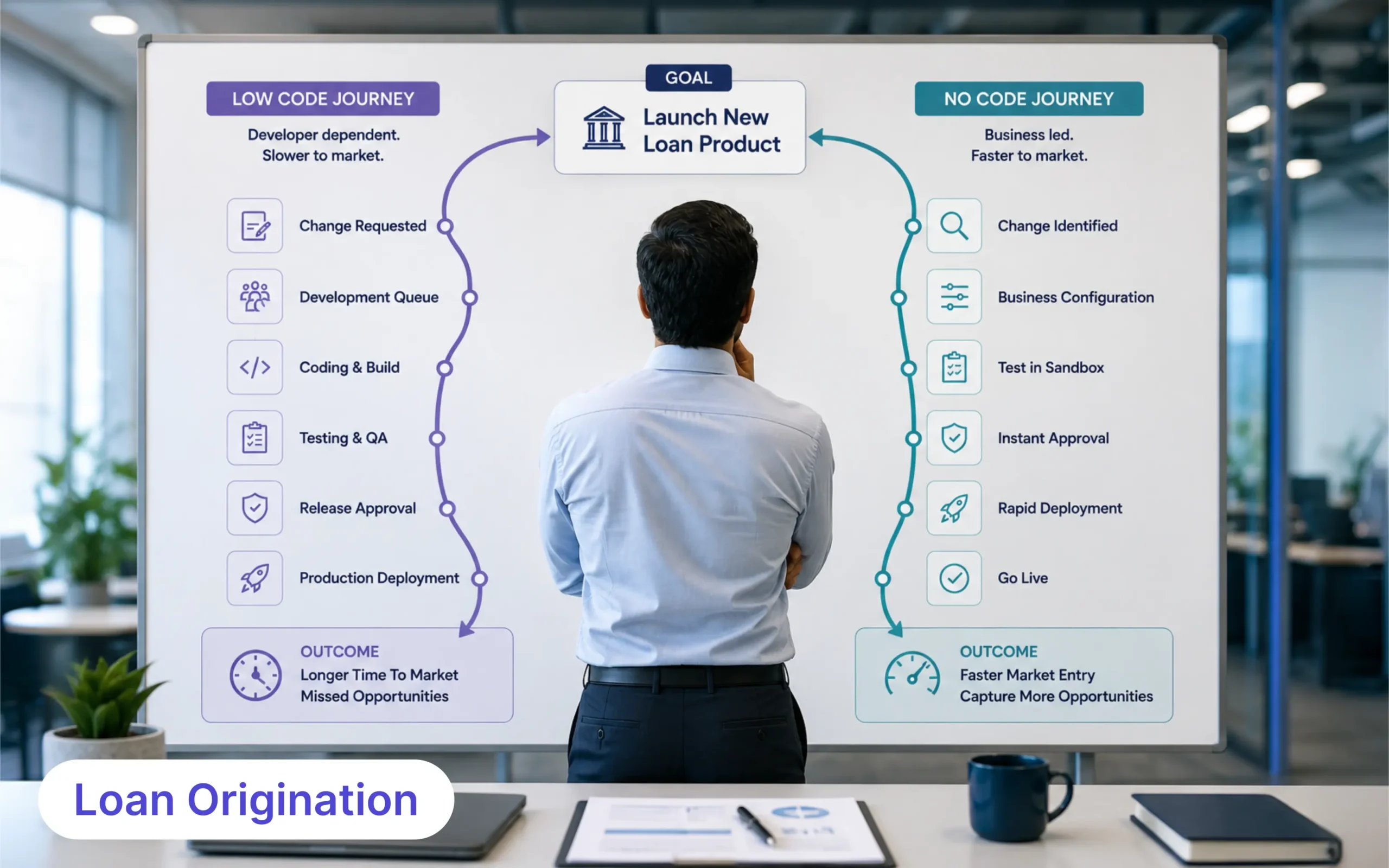
Low Code vs No Code: Understanding the Difference
The terms low code and no code are often used interchangeably because both simplify application development through visual tools and reusable components. However, they serve different users and create different operating models.
Low-code platforms help developers build applications faster by reducing the amount of code they need to write. No-code platforms enable business users to configure applications, workflows, and business rules without writing code. In lending, this difference directly impacts how quickly financial institutions can launch products, update lending policies, and improve automated loan processing across the lending lifecycle.
| Feature | Low Code | No Code |
|---|---|---|
| Primary Users | Developers & IT Teams | Business Users & Operations Teams |
| Coding Required | Some coding required | No coding required |
| Workflow Changes | Often require developer support | Business users configure directly |
| Product Launch Speed | Faster than traditional development | Faster business-led innovation |
| Best Suited For | Complex custom applications | Rapid loan automation and workflow management |
While both approaches accelerate application development, the key difference lies in who owns change. Low code reduces development effort, whereas no code enables business teams to configure, test, and deploy changes through governed interfaces. For lenders evaluating low code vs no code for loan automation, this distinction directly influences operational flexibility, product launch speed, and digital lending transformation.
Why the Low Code vs No Code Debate Matters in Lending
The conversation around low code vs no code is often framed as a technology discussion.
For lenders, it is a business discussion.
Launching a new lending product requires coordination across credit, risk, compliance, operations, product, and technology teams. Every workflow update, policy change, and integration directly influences loan automation software performance and how quickly a lender can respond to market opportunities.
As financial institutions accelerate digital transformation, the ability to adapt lending workflows quickly has become a competitive advantage. Yet many organisations still struggle to translate technology investments into faster product launches and greater operational agility.
The challenge is rarely strategy.
It is execution.
When routine business changes depend on development teams, innovation slows. Product launches take longer, workflow improvements are delayed, and operational teams lose the agility needed to respond to changing customer expectations and regulatory requirements.
This is why the low code vs no code discussion has become increasingly important for institutions investing in loan automation, automated loan processing, and loan origination system automation. The decision is no longer just about reducing development effort, it is about enabling business users to innovate faster while maintaining governance and control.
Why Traditional Loan Automation Slows Innovation
Many lenders believe they have modernised because they have digitised parts of the lending journey.
The reality is often different.
A product team wants to launch a new lending product. Risk teams need to update underwriting rules. Compliance introduces a policy change. What appears to be a routine business update quickly becomes a development request, creating delays before changes can be tested and deployed.
Individually, these delays may appear minor.
Collectively, they create significant operational friction.
The consequences appear across critical business metrics:
- Slower product launches
- Longer turnaround times
- Increased operational costs
- Reduced responsiveness to market changes
- Lower business team productivity
The issue is not technology capability.
The issue is ownership.
When business teams cannot configure lending workflows, approval rules, or product journeys without developer involvement, every change becomes part of the IT backlog. Over time, these dependencies reduce business agility and slow an institution’s ability to respond to market opportunities.
Low Code vs No Code: Key Differences for Loan Automation
Although low code and no code are often grouped together, they create fundamentally different operating models for financial institutions. Understanding these differences is essential when evaluating platforms for automated loan processing, loan automation software, and modern lending operations.
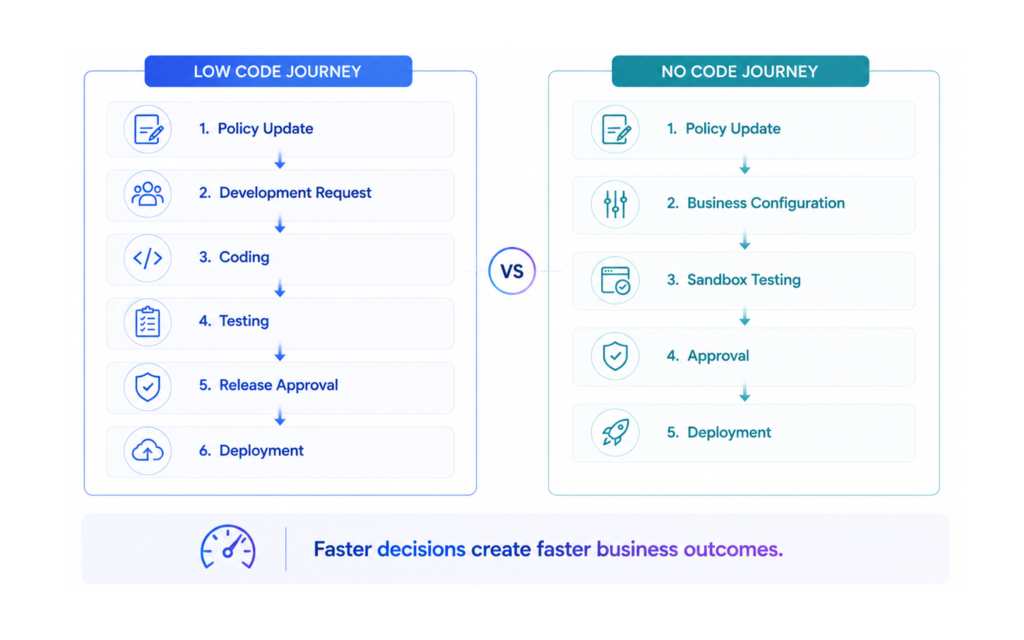
Compare Low Code vs No Code lending workflows to understand how policy changes move from configuration to deployment.
The Low-Code Model
Low code platforms simplify development through visual tools and reusable components.
However, many critical changes still require technical involvement.
Business users can often configure parts of a workflow, but deeper modifications typically move through development, testing, and release cycles.
While this accelerates software development, product and operations teams often remain dependent on developers for complex workflow changes, product configurations, and release cycles.
The No-Code Model
No code platforms shift control closer to business teams.
Risk managers, product leaders, and operations teams can configure rules, workflows, eligibility criteria, and decision logic through business friendly interfaces.
Instead of waiting for development schedules, changes can be tested, approved, and deployed significantly faster, enabling loan decisioning automation through configurable business rules and workflows.
The distinction may appear subtle, but its operational impact is significant. By giving business users greater control over lending workflows, no-code platforms reduce development dependency while enabling faster execution and continuous innovation.
A Common Lending Example
Consider a simple lending policy update.
A lender decides that borrowers showing a significant decline in GST turnover should be routed for manual review.
In many low code environments, the change triggers a familiar sequence:
- Development request
- Coding effort
- Testing cycle
- Release approval
- Production deployment
In a no code environment, business users can often configure, test, and deploy the same rule directly through a governed interface.
The outcome is not just faster deployment.
It is faster decision making and more efficient automated loan processing.
Five Business Areas Where the Difference Matters Most
The operational differences between low code and no code become most visible in day-to-day lending operations. While both approaches improve development efficiency, no-code platforms give business users greater control over change, resulting in faster execution, better collaboration, and improved business agility.
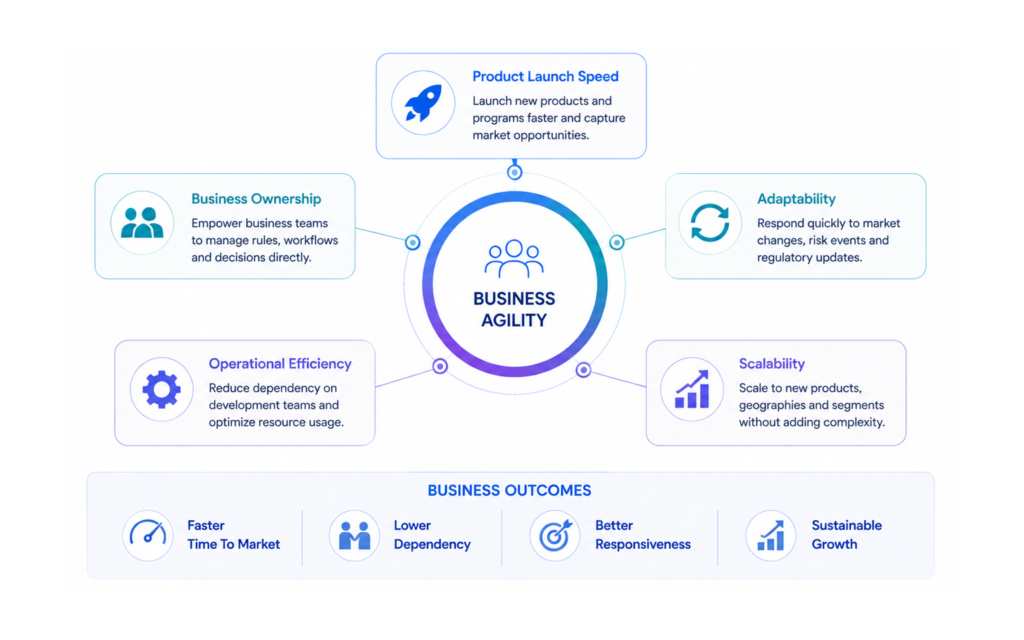
Low Code vs No Code approaches influence product launch speed, adaptability, operational efficiency, and lending scalability.
Product Launch Speed
The ability to launch new products quickly is one of the biggest advantages of modern loan automation software.
When product teams can configure journeys without technical bottlenecks, time to market decreases significantly.
This is particularly valuable for lenders introducing new credit products, partner programmes, or seasonal lending offers where speed to market directly influences business outcomes.
Business Ownership
Modern lending requires constant adjustment.
Credit policies evolve. Regulations change. Customer behaviour shifts.
A platform that allows business users to manage change directly creates far greater organisational agility than one that relies heavily on development teams.
Adaptability
Markets rarely wait for release cycles.
Lenders increasingly need the ability to respond to:
- Economic changes
- Risk events
- Competitive pressures
- Regulatory updates
The faster decision logic can be adapted, the stronger the institution’s competitive position.
Operational Efficiency
Developer-dependent workflows create hidden operational costs through repeated testing, release management, and coordination between business and technology teams. These dependencies reduce the efficiency of Automated Loan Processing while delaying business-led innovation.
Scalability
As lenders expand into new products, geographies, and customer segments, complexity increases.
The most effective loan automation software supports automated loan processing while allowing organisations to scale without creating proportional increases in technology effort.
This is where no-code platforms often provide a significant advantage by enabling organisations to scale lending operations without creating proportional increases in development effort.
Key Takeaway
Low code accelerates software development. No code accelerates business execution. For lenders, that difference can directly influence product launch speed, operational agility, and long-term competitiveness.
A Real Lending Scenario: One Loan, Two Journeys
Imagine two teams within the same financial institution launching the same MSME lending product. They have identical business objectives but rely on different technology approaches to bring the product to market.
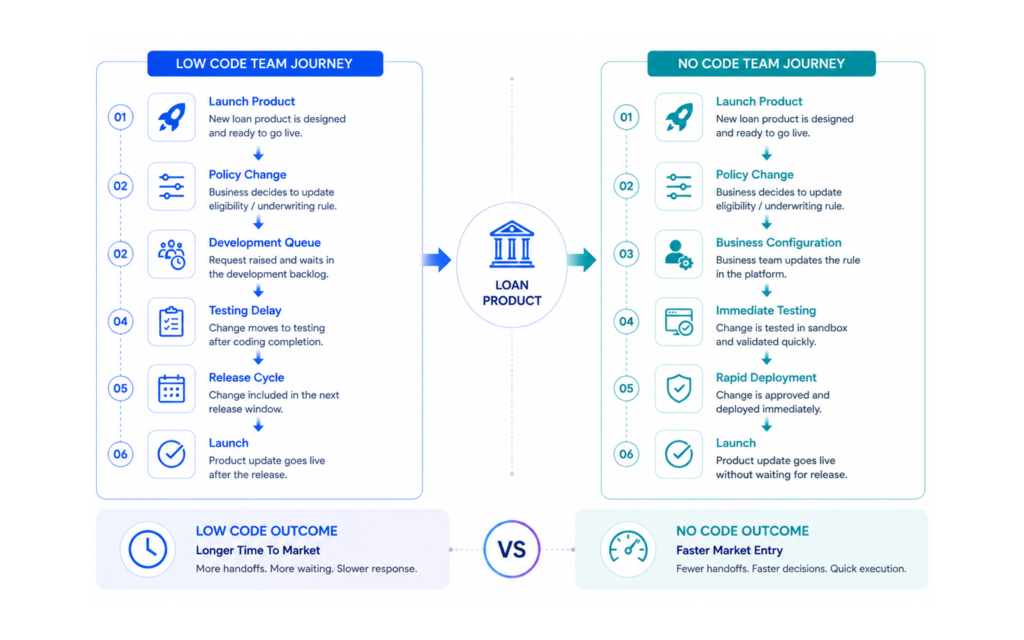
A real-world Low Code vs No Code comparison showing how technology choices affect loan origination, policy updates, testing, and deployment.
Both teams have:
- The same target market
- The same credit policies
- The same revenue goals
The only difference lies in how each team manages change.
The first team operates within a low code environment.
The second uses a no code platform built around business led configuration.
During the initial stages, both teams progress at a similar pace. The difference emerges when lending policies, workflows, or approval rules need to change.
The low code team depends on development cycles.
The no code team adjusts workflows directly, accelerating loan decisioning automation without waiting for development cycles.
The result is not simply a faster launch.
It is a fundamentally different operating model.
One prioritises controlled development.
The other prioritises controlled agility.
For lenders operating in highly competitive markets, that distinction can determine who reaches customers first.
Choosing the Right Model for Your Organisation
The answer is not always no code.
The right choice depends on your institution’s technology strategy and long-term goals for Loan Origination System Automation.
Different institutions have different requirements.
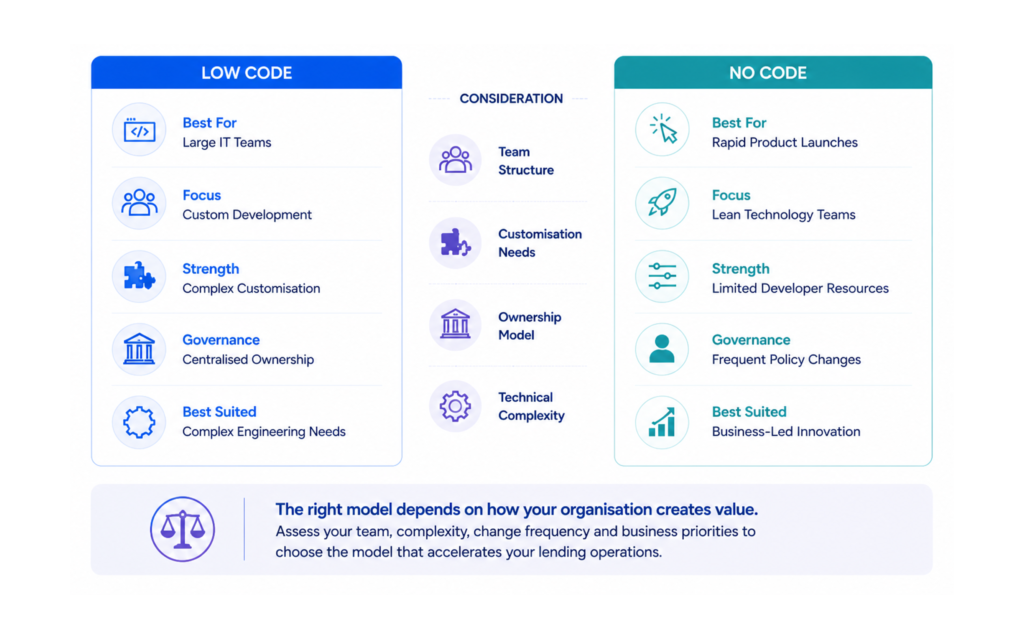
Evaluate Low Code vs No Code platforms based on team structure, governance, customisation needs, and lending objectives.
When Low Code Makes Sense
Low code remains a strong option for organisations that:
- Operate highly customised environments
- Maintain large internal technology teams
- Require extensive proprietary development
- Prefer centralised technology ownership
For these institutions, low code provides greater flexibility for highly customised development while maintaining centralised technology governance.
When No Code Creates Greater Value
No code platforms are particularly effective for organisations that:
- Need rapid product launches
- Operate lean technology teams
- Empower business users to drive innovation
- Require frequent policy and workflow changes
- Prioritise operational agility
For banks, NBFCs, fintechs, and other growth-focused lenders, the ability to configure products and workflows without developer dependency often becomes a significant competitive advantage.
The right choice depends on how your organisation creates value. If your priority is highly customised application development, low code may be the better fit. If your priority is faster product launches, business-led configuration, and continuous lending innovation, a no-code platform offers greater long-term agility.
| Organisation Type | Recommended Approach |
|---|---|
| Large banks with extensive internal development teams | Low Code |
| Banks modernising legacy lending systems | No Code |
| NBFCs | No Code |
| Digital lenders | No Code |
| Fintechs | No Code |
| Credit unions | No Code |
The Future Belongs to Business Led Lending
The future of lending will be defined by adaptability.
Institutions that can respond quickly to customer needs, market opportunities, and regulatory changes will consistently outperform those constrained by internal dependencies.
This is why the low code vs no code discussion extends beyond software architecture. It influences how quickly financial institutions can launch products, adapt lending policies, automate workflows, and respond to changing customer and regulatory requirements.
As lenders continue investing in loan origination software and loan origination system automation, the focus is shifting from simply digitising workflows to enabling business-led innovation without increasing technology complexity.
The real objective is not to reduce coding effort. It is to eliminate the delays that occur when every policy update, workflow change, or product enhancement must pass through lengthy development cycles.
This shift is driving demand for lending platforms that combine governance with business autonomy. Risk teams want to adjust decision rules without waiting for development resources. Product teams want to launch new journeys without entering a release backlog. Operations teams want the flexibility to optimise processes without disrupting existing systems.
Platforms built on a no-code architecture enable financial institutions to configure business rules, lending workflows, automate decisioning, support loan decisioning automation, and launch products without lengthy development cycles.
Solutions such as lend.ezee build on this approach by combining no-code configuration, embedded decisioning, intelligent automation, and workflow orchestration to help lenders accelerate innovation while maintaining governance and control.
Because in modern lending, the biggest advantage is no longer having the best idea.
It is having the ability to execute that idea before the opportunity disappears.
Frequently Asked Questions
Low-code platforms require some developer involvement for advanced customisation and workflow changes, while no-code platforms enable business users to configure workflows, business rules, and lending processes without writing code. The key difference is who manages change – developers or business teams.
Both approaches support configurable loan origination processes. Low-code platforms typically require developers for complex changes, whereas no-code platforms allow authorised business users to modify workflows, lending rules, and approval processes through visual configuration tools.
The right choice depends on business priorities. Low code suits organisations with large development teams and highly customised requirements, while no code is ideal for lenders that need faster product launches, business-led configuration, and greater operational agility.
No-code platforms can reduce development effort and ongoing maintenance costs by enabling business users to manage routine changes. However, the overall value depends on an institution’s complexity, technology strategy, and long-term business objectives.
Yes. Modern no-code lending platforms support consistent loan application journeys across web, mobile, branch, and partner channels while maintaining shared workflows, business rules, and borrower data throughout the lending process.
Yes. Modern no-code platforms can incorporate configurable compliance workflows, audit trails, role-based access controls, and policy rules, helping lenders adapt to regulatory changes while maintaining governance across lending operations.
Security depends on the platform rather than the development approach. Enterprise no-code lending platforms typically support role-based access, encryption, audit logging, and secure integrations to protect sensitive borrower information.
Because business users can configure workflows and business rules without waiting for development cycles, no-code platforms can significantly reduce the time required to launch new lending products and implement policy updates.
Yes. Modern no-code platforms support configurable workflows, automated decisioning, multi-stage approvals, integrations, and business rules that enable financial institutions to manage complex lending processes without extensive custom development.
Neither approach is universally better. Low code is well suited to highly customised development environments, while no code offers greater agility for institutions that want business users to manage workflows, launch products faster, and respond quickly to change.