
Why Business Rules Engines Are Becoming Strategic Assets
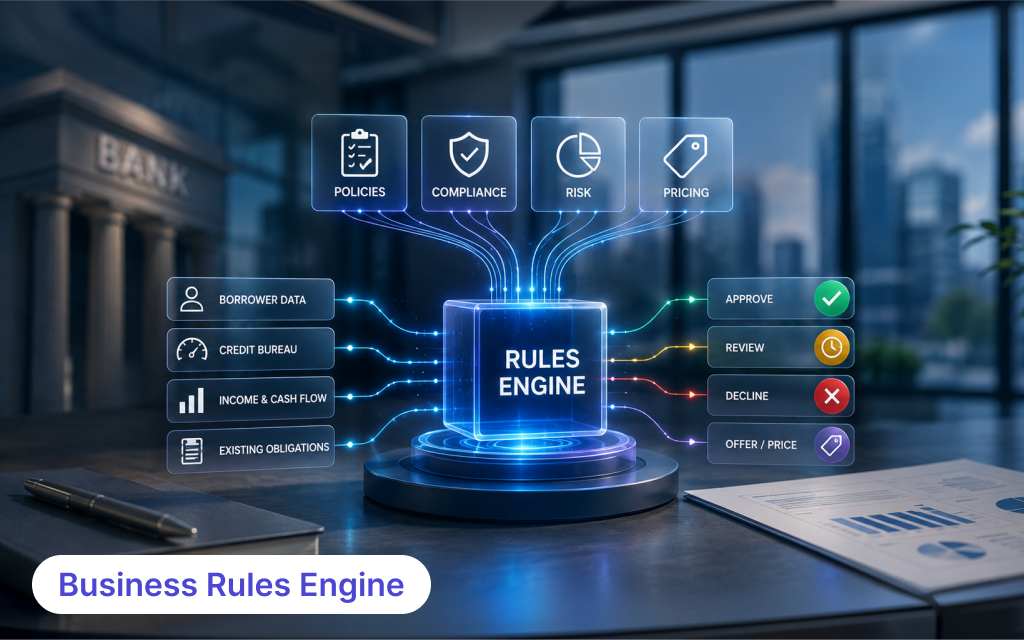
A Business Rules Engine can play a central role in lending decisions, from determining eligibility and applying credit policies to validating requirements and enforcing pricing rules. By separating decision logic from application code, it can help financial institutions adapt lending policies more quickly and apply them consistently across products and workflows.
Yet many lenders still operate rule engines designed for a different era.
A simple policy change often requires multiple teams, development cycles, testing phases, and deployment windows. What should be a business decision becomes a technology project. In a market where customer behaviour, regulations, and competitive pressures evolve constantly, that delay creates real business consequences.
Consider a common scenario. A risk team wants to launch a targeted offer for younger borrowers in metropolitan areas with strong credit profiles. The logic itself may be straightforward, but implementation can take weeks because the rules are buried inside core systems or lending applications.
By the time the change reaches production, the market opportunity may already have narrowed or disappeared.
This challenge explains why many lenders are rethinking how they manage and use business rules. The objective is no longer simply automation. It is the ability to adapt decision logic quickly while maintaining the governance and control required in financial services.
The Hidden Cost of Technology-Controlled Decisioning
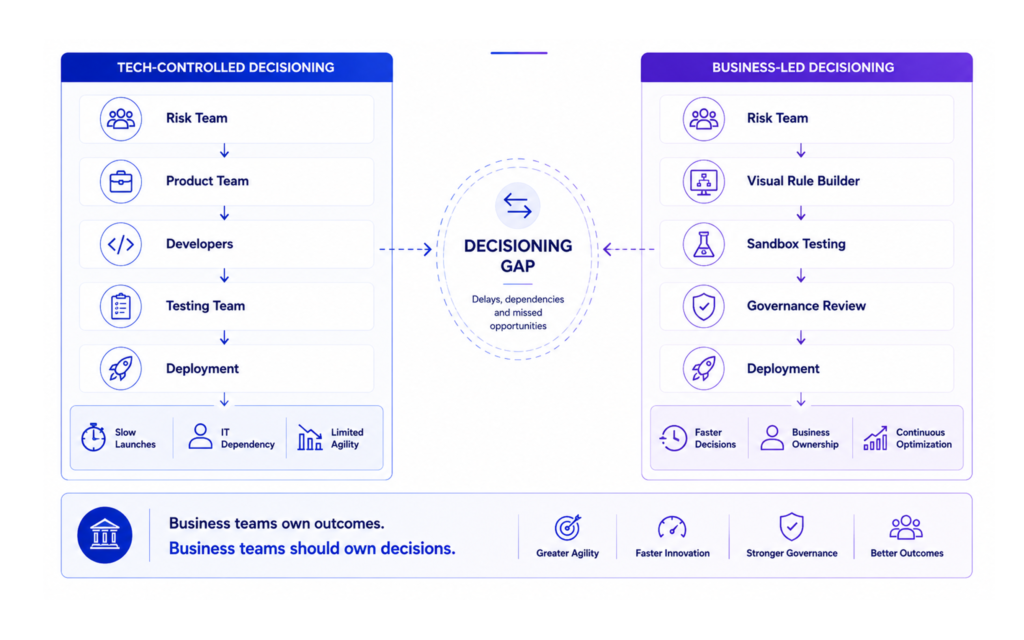
Technology-controlled decisioning can introduce dependencies between business policy changes, development, testing, and deployment.
For decades, lending institutions managed decision logic through technology teams.
Risk teams defined policies. Product teams proposed changes. Developers translated requirements into code. Testing teams validated outcomes. Only then could a rule reach production.
While this model provided control, it created significant friction.
The consequences appear across multiple functions:
- Product launches take longer than planned.
- Credit decisioning becomes difficult to optimise.
- Compliance changes move through lengthy implementation cycles.
- Innovation slows because experimentation feels expensive.
Over time, organisations may stop pursuing incremental improvements because the effort outweighs the perceived benefit.
The result is a dangerous pattern.
Instead of continuously improving lending strategies, teams settle for “good enough” policies. Opportunities remain trapped in backlogs, while competitors respond faster to changing market conditions.
At its core, the problem is one of ownership.
Business teams own the outcomes, but technology teams own the rules.
That disconnect can continue to limit agility across financial institutions.
From Business Rules Management to Decision Intelligence
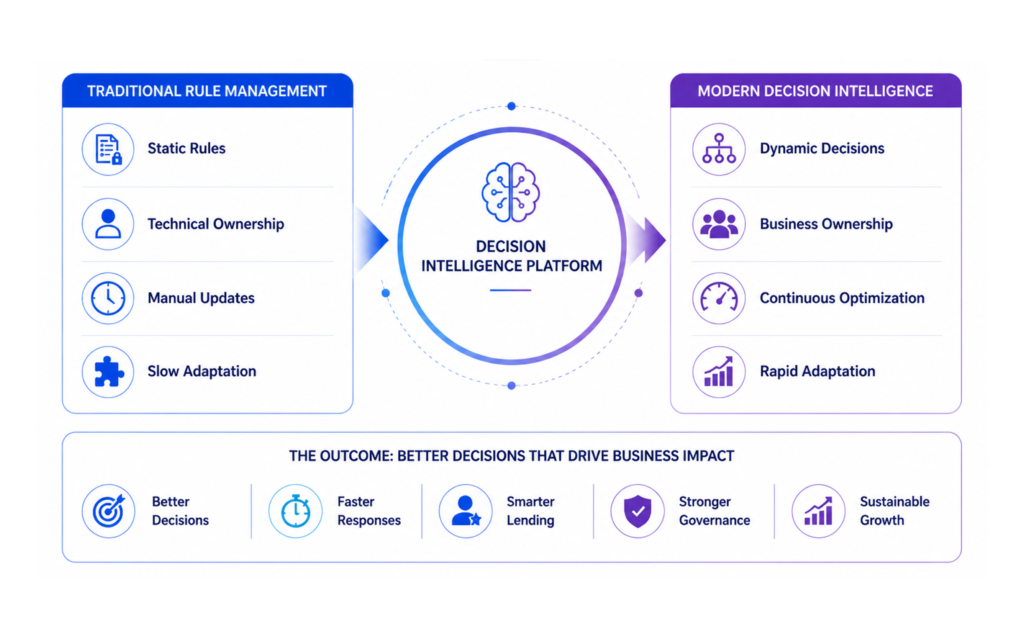
Modern decision intelligence extends rule management with greater business ownership, adaptability, testing, and continuous optimization.
The market is evolving beyond traditional approaches to Business Rules Management.
Leading lending organisations increasingly treat decision logic as a strategic capability rather than solely as a technical function.
This shift is reflected in the emergence of Decision Intelligence Platform approaches, in which a Business Rules Engine can serve as a core component for managing and executing business decision logic alongside data, workflows, models, and governance capabilities.
Instead of treating rules as static code embedded inside applications, a Decision Intelligence approach treats decision logic as a managed business asset that can be configured, tested, deployed, monitored, and refined over time.
Traditional environments focus primarily on managing rules.
Modern decisioning environments focus on improving decisions.
That means enabling teams to:
- Test new lending strategies quickly.
- Simulate policy changes safely.
- Respond rapidly to regulatory updates.
- Launch targeted offers without lengthy development cycles.
A well-governed Decision Intelligence Platform can give business teams greater control while preserving the governance, auditability, and compliance requirements expected in financial services.
This balance between flexibility and control is becoming essential as lending environments grow more dynamic.
What Makes a Modern Business Rules Engine Different
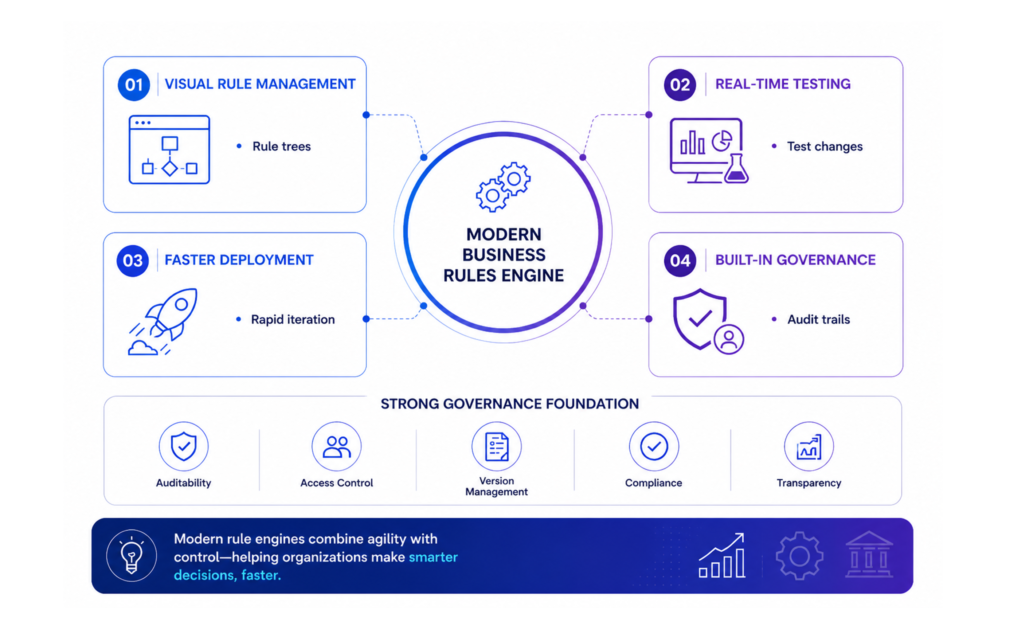
A modern Business Rules Engine combines business-friendly rule management with testing, controlled deployment, and governance.
Modern Business Rules Engines offer a range of capabilities, but several characteristics are particularly important when distinguishing them from legacy rule-management environments.
Visual Rule Management
Modern platforms allow business users to create and modify many rules through visual, configuration-based interfaces.
Instead of writing code, teams work with:
- Rule trees
- Logic flows
- Formula builders
- Decision tables
This reduces dependency on technical resources while improving transparency.
Real-Time Testing
A common limitation of traditional rule-management environments is the difficulty of testing and evaluating changes quickly.
Modern platforms can provide sandbox or simulation environments where teams can evaluate rule changes before deployment.
This allows organisations to:
- Validate new policies
- Test alternative thresholds
- Compare decision strategies
- Reduce production risk
Faster Deployment Cycles
A modern Business Rules Engine should support shorter, controlled deployment cycles, allowing validated rule changes to move from design to production without unnecessary development delays.
The ability to move validated changes into production efficiently can improve responsiveness to business and regulatory needs.
Built-In Governance
Flexibility must never come at the expense of control.
Common governance capabilities include:
- Version tracking
- Audit trails
- Role based access
- Change approvals
These controls support compliance oversight as decision velocity increases.
The Power of Modular and API-First Architecture
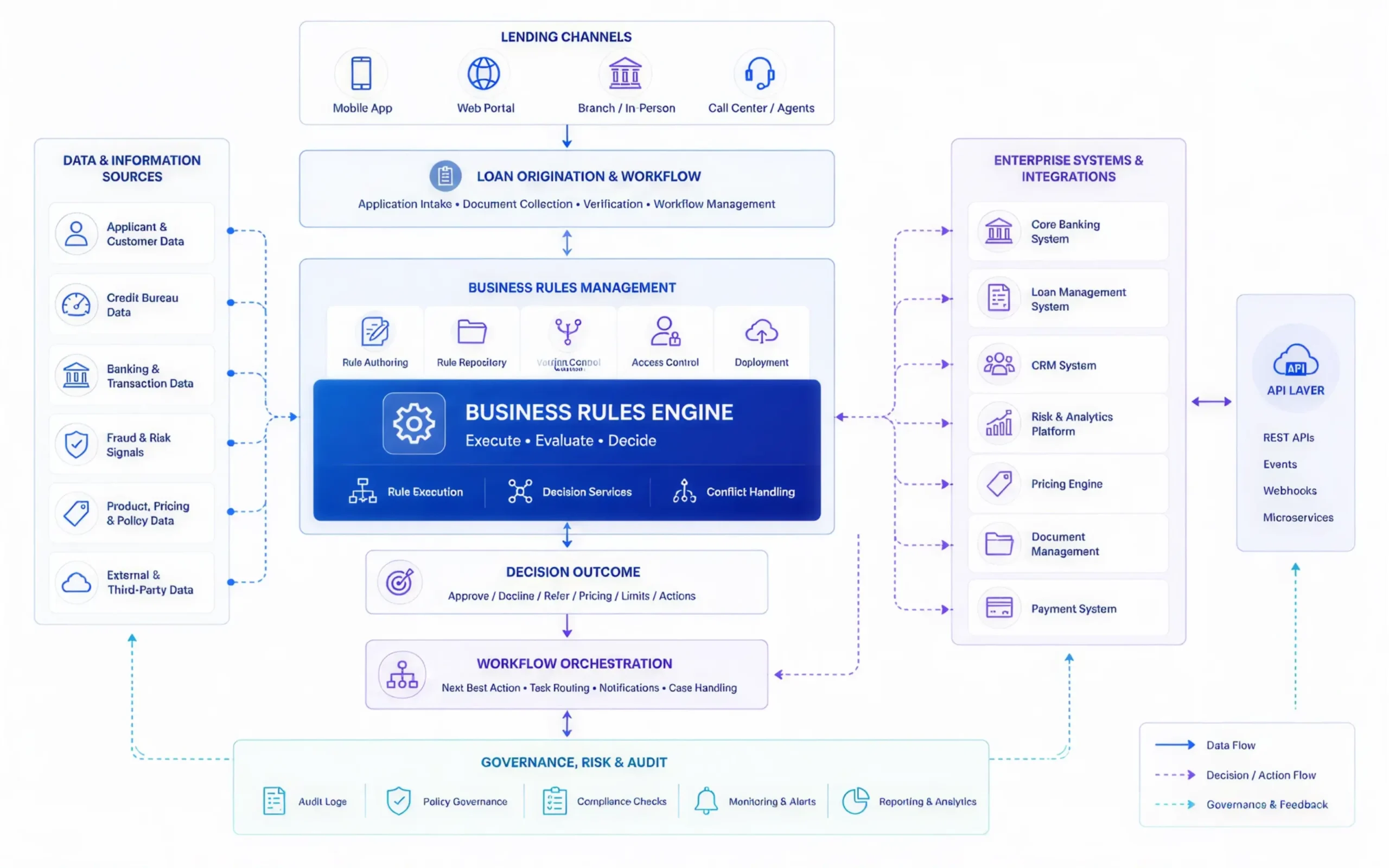
A modular Business Rules Engine can connect lending workflows with data, decisioning services, enterprise systems, and governance controls through APIs.
A significant architectural shift in decisioning is the move toward modular, API-driven design.
In many legacy implementations, rule engines were tightly coupled with:
- Loan Origination systems
- Core banking platforms
- Loan Management systems
As a result, even small changes could risk affecting broader operations.
Modern platforms can separate decision logic into modular, independently manageable components.
Examples include:
- Eligibility rules
- Pricing logic
- Underwriting workflows
- Documentation requirements
- Credit decisioning logic
Each component can be managed and evolved separately, reducing unnecessary dependencies between changes.
This modular design creates several advantages.
Faster Innovation
Teams can reuse and adapt logic across products rather than rebuilding from scratch.
A lending strategy developed for one portfolio can be quickly extended to another.
Lower Operational Risk
Because components are modular, changes can remain more isolated.
“For example, updating pricing logic can be managed separately from eligibility rules, while changes to underwriting criteria can be isolated from unrelated servicing workflows.
Better Scalability
As lenders expand across products, geographies, or partner ecosystems, modular architectures can help manage increasing complexity without unnecessarily adding operational bottlenecks.
API-first design strengthens this architectural flexibility further.
A modern Business Rules Management System should support integration with:
- Loan Origination platforms
- CRM systems
- Credit bureaus
- Fraud solutions
- Third-party partners
This flexibility is increasingly critical as ecosystems become more interconnected.
A Practical Framework for Evaluating Rule Engines
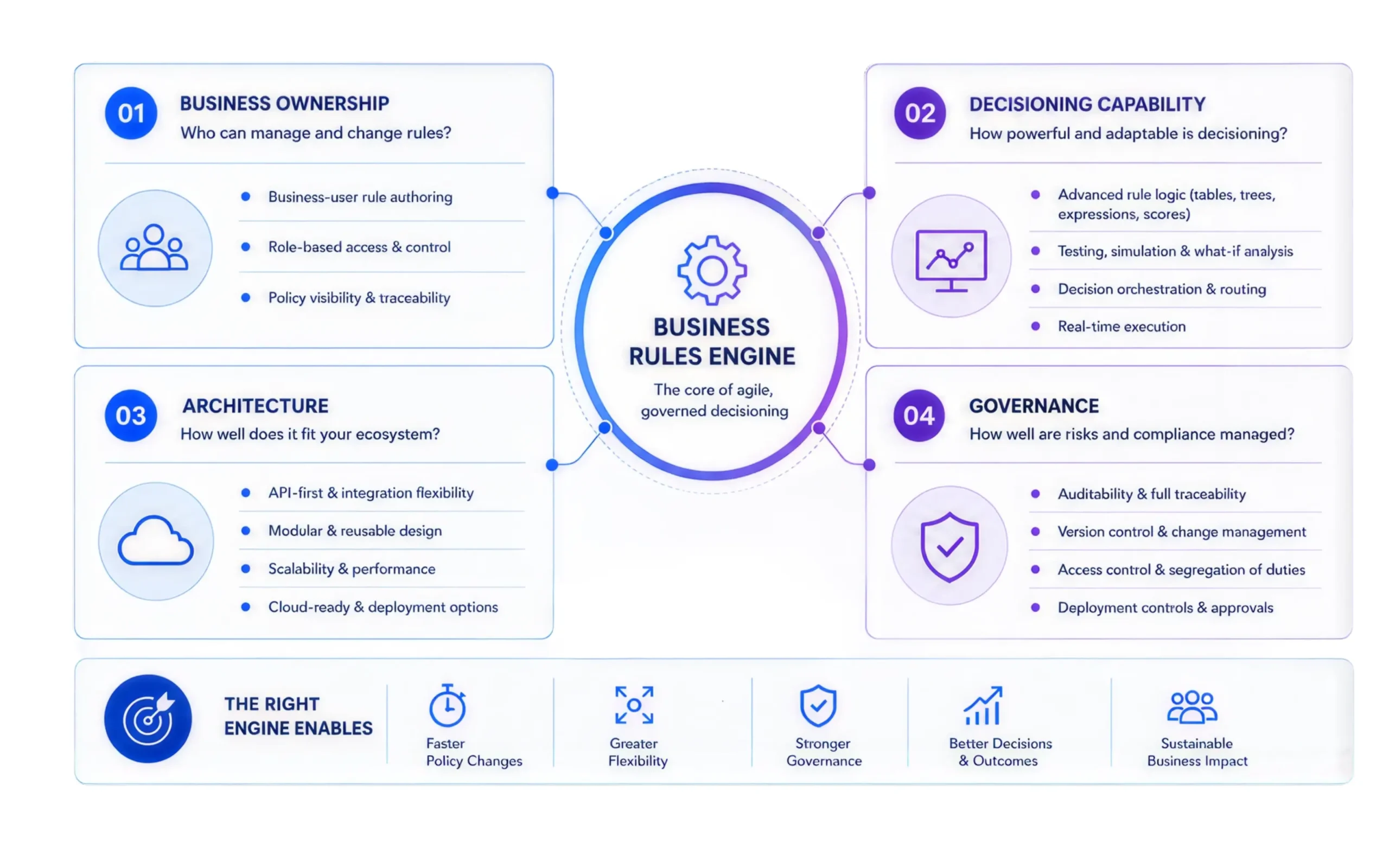
A practical BRE evaluation should consider business ownership, decisioning capability, architecture, and governance together.
Choosing a business rules engine is not about finding the longest feature list. It is about finding a platform that helps lenders manage decision logic effectively, adapt policies efficiently, and maintain the governance required for controlled decisioning.
The first question is ownership. Can risk, product, and compliance teams manage appropriate business rules without unnecessary dependency on developers? If business teams cannot manage decision logic within defined governance controls, agility will remain limited.
The second is decisioning capability. A modern Business Rules Management System should support adaptable credit decisioning across products, segments, geographies, and partner ecosystems. Static rules remain useful for defined policies, but lenders also need the ability to adapt decision logic as products, risk conditions, and market requirements change.
Architecture matters just as much. A modern platform should combine modular design, API-first connectivity, and scalable underwriting capabilities. This can help lenders introduce new products, integrate partners, and refine policies while reducing unnecessary disruption to existing operations.
Finally, evaluate governance. Every rule change should be traceable, testable, and auditable. A well-governed decisioning platform can enable teams to experiment within defined controls while providing the visibility needed for compliance oversight.
A practical test is to examine how a routine lending-rule change moves from design to production. If a simple rule change still requires a full development sprint, the platform may be creating unnecessary friction rather than enabling faster policy iteration.
Warning Signs to Watch For
Be cautious of platforms that:
- Require unnecessary developer involvement for routine rule changes
- Embed decision logic deep inside core systems
- Offer limited testing or simulation capabilities
- Struggle to support multiple products, segments, or partner models
- Lack visibility into active rules and decision flows
The right Business Rules Engine should not become another system to manage. It should provide a foundation that helps lenders adapt policies, scale decisioning, and improve decision quality over time.
The Future of Credit Decisioning Is Business-Led
The lending industry is entering a period where adaptability matters as much as scale.
Markets shift quickly. Regulatory requirements evolve. Customer expectations continue to rise.
Organisations that rely on lengthy development cycles may struggle to keep pace.
Leading lenders are increasingly treating decision logic as a strategic asset. They can empower business teams to design, test, and optimise decision strategies while maintaining strong governance and oversight.
ezee.ai applies this business-led approach through intelligent decisioning, workflow orchestration, AI-powered automation, and credit decisioning capabilities. Its Decision Intelligence Platform approach is designed to help financial institutions manage decision logic as a business function, support faster policy updates, and modernise Business Rules Management System operations while maintaining governance and control.
The future of lending will not belong to institutions with the most rules.
It will favour institutions that can adapt those rules quickly, test them effectively, and deploy them with confidence.
Because in modern lending, decisions are no longer just automated.
They are designed.
Frequently Asked Questions
Yes. Business rules engines can support real-time credit decisioning by evaluating borrower, product, risk, and policy data against predefined decision logic. When integrated with lending systems and data providers through APIs, a BRE can evaluate eligibility and route applications automatically while maintaining consistent application of credit policies.
A modular rule engine separates decision logic from tightly coupled application code, allowing authorised business teams to update applicable policies through configuration-based interfaces. This can reduce development dependency, shorten policy-change cycles, and make it easier to adapt thresholds, eligibility criteria, and other decision rules without unnecessarily disrupting existing workflows.
Business rules engines can standardise parts of the underwriting process by applying consistent eligibility, policy, and risk rules to borrower and application data. They can automate straightforward decisions, route exceptions for review, and ensure that approved policies are applied consistently across applications. This can reduce manual intervention and improve process consistency while allowing lenders to retain appropriate human review for complex cases.
Business rules engines can support controlled testing of new eligibility criteria, thresholds, and decision strategies before production deployment. Teams can compare alternative rule configurations, evaluate expected outcomes using historical or test data, and refine decision logic before rollout. Where supported by the platform architecture, this can also include controlled experiments such as champion-challenger or staged deployment approaches.
Business rules engines can help lenders operationalise applicable regulatory and compliance requirements by encoding relevant policies and validation rules into decision workflows. When regulations or internal policies change, authorised teams can update the corresponding rules, subject to governance and approval controls. Versioning and audit capabilities can also help organisations track what changed, when it changed, and which version of the decision logic was used.
Lenders should evaluate a modern business rules engine across several dimensions: business-user rule management, decisioning flexibility, testing and simulation, deployment controls, governance and auditability, scalability, and API-based integration with existing lending systems. The platform should also support the lender’s product mix, borrower segments, operating model, and regulatory requirements.
Lenders should evaluate performance under realistic transaction volumes, peak loads, rule complexity, and integration conditions. Testing should measure response latency, throughput, error rates, and resource utilisation under expected and peak workloads. Where applicable, lenders should also assess how the platform scales as products, rules, and decision volumes increase.
Lenders can integrate a business rules engine with existing lending software through APIs, events, or other supported integration patterns. The BRE can receive relevant application and policy data from systems such as loan origination platforms, CRM systems, core banking systems, and external data providers, evaluate the configured decision logic, and return the resulting decision or workflow instruction. This allows lenders to introduce decisioning capabilities without necessarily replacing their existing core systems.
Lenders can organise decision logic into modular rule sets aligned to loan products, borrower segments, risk tiers, and channels. Eligibility thresholds, policy conditions, and decision strategies can then be configured for different lending scenarios, subject to the platform’s capabilities and governance controls. This approach can make it easier to adapt policies without unnecessarily changing underlying application code.
- Extract embedded decision logic from legacy code, spreadsheets, and policy documents.
- Translate the rules into structured, executable formats within the target business rules engine.
- Validate rule outcomes using historical or representative test data.
- Run the new rules alongside the legacy process where appropriate to compare outcomes and identify gaps.
- Analyse exceptions and refine thresholds, dependencies, or rule logic.
- Obtain required business, risk, audit, and compliance approvals.
- Enable versioning, rollback, and change-control mechanisms before full production rollout.
References
- IBM — What is Business Rules Management?
Overview of business rules management systems, rule repositories, rule authoring, and business rules engines. Read the IBM overview - Oracle — Rules Engine Documentation
Technical documentation covering rule execution, criteria, priorities, and runtime business-rule management. Read the Oracle documentation - Reserve Bank of India — Guidelines on Digital Lending
Regulatory guidance relevant to digital lending, regulated entities, lending service providers, and data governance. Read the RBI guidelines - Consumer Financial Protection Bureau — Adverse Action Notification Requirements
Guidance on providing specific reasons for adverse credit decisions when complex algorithms are used. Read the CFPB circular