

Credit union consolidation is reshaping the market
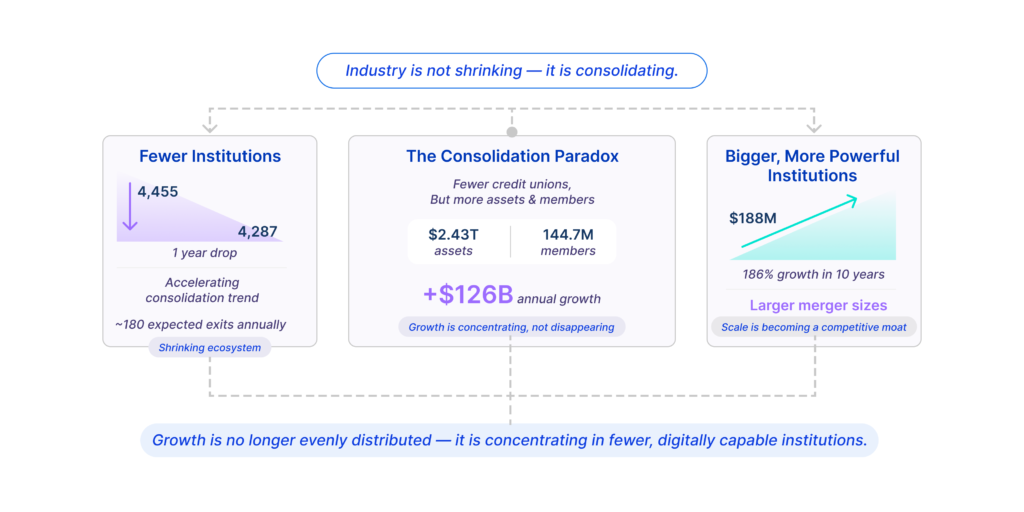
The US credit union landscape is entering a new phase. While membership and assets continue to grow, the number of institutions continues to decline, creating a market dominated by fewer and larger players.
According to the National Credit Union Administration, federally insured credit unions fell to 4,287 in Q4 2025, down from 4,455 a year earlier. During the same period, system assets reached approximately $2.43 trillion, while membership climbed to 144.7 million. The NCUA approved 157 mergers in 2025 alone, continuing a trend that has reshaped the industry for more than a decade.
These figures reveal an important reality. credit union consolidation is no longer a temporary response to economic conditions. It has become a structural shift driven by rising technology costs, evolving member expectations, increasing compliance obligations, and the need for operational scale.
Bigger institutions are gaining more ground
Industry data shows the average credit union asset size has grown by approximately 186 percent over the last decade. Growth is becoming increasingly concentrated among institutions capable of investing in modern technology, streamlined operations, and improved member experiences.
This does not mean smaller institutions are destined to disappear. It does mean that independence can no longer rely solely on legacy relationships or local presence.
Why governance matters more than ever
The ncua succession planning rule highlights this changing environment. By requiring federally insured credit unions to establish written succession plans for key leadership positions, regulators are signalling that long term sustainability requires proactive planning rather than reactive decision making.
For boards and executives, the challenge is no longer understanding whether consolidation is occurring. The challenge is determining how to remain competitive while preserving independence.
The real threat is competitive irrelevance
Mergers often dominate industry discussions, but they are not the greatest threat facing credit unions today.
The greater risk is becoming less relevant to members.
Fintechs have changed expectations
Consumers now compare every financial interaction against the best digital experience they receive anywhere. This shift mirrors priorities discussed across the global credit union sector, where digital transformation and member experience modernization continue to rank among the most important strategic initiatives for long term competitiveness.
Fintech firms and digital banks have set new benchmarks for service delivery. Instant approvals, seamless applications, and mobile first experiences have become standard expectations rather than premium features.
Digital channels are becoming the primary branch
Member behaviour reflects this shift. Mobile and online banking adoption continues to grow while branch traffic remains relatively flat. Increasingly, a credit union’s first impression is formed through a smartphone screen rather than a branch visit.
This shift makes credit union digital transformation a strategic priority rather than a technology initiative.
Institutions that deliver consistent digital experiences strengthen engagement, deepen relationships, and improve retention. Those that fail to modernise risk losing relevance even when they maintain strong community roots.
Scale now means something different
Historically, scale was measured by assets and membership.
Today, scale is also measured by operational agility.
Can policies be updated quickly?
Can products be launched rapidly?
Can lending decisions be delivered efficiently?
Can members move seamlessly between digital and physical channels?
The institutions answering yes to these questions are often outperforming competitors regardless of size.
This is why successful credit union growth strategies increasingly focus on operational efficiency and member experience rather than balance sheet expansion alone.
Grow, merge, or modernize?
Credit union leaders face three primary strategic options.
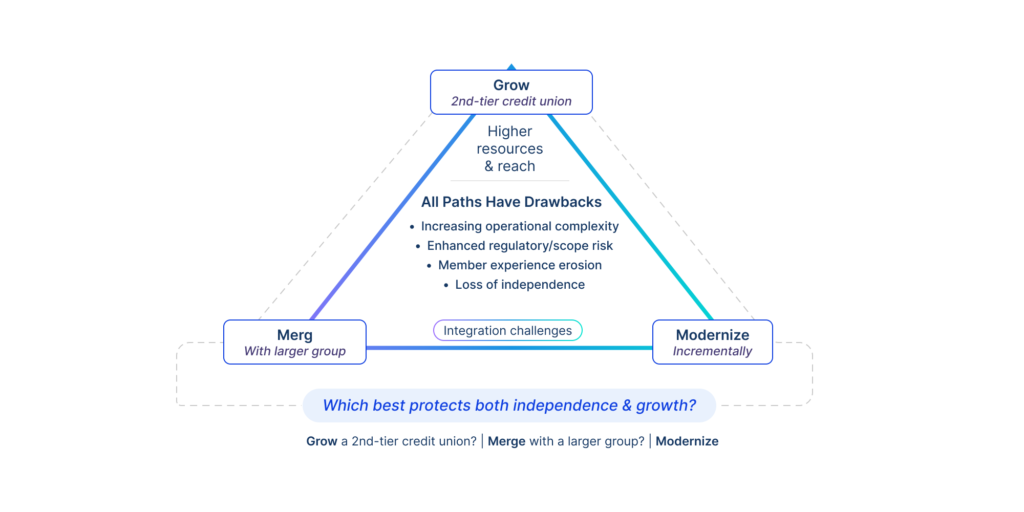
Option one: Grow independently
Independent growth offers control and flexibility but requires disciplined execution, investment, and operational maturity.
Institutions pursuing this path must continuously improve efficiency while expanding services and maintaining member satisfaction.
Option two: Merge
Mergers can provide immediate scale, broader capabilities, and access to additional resources.
However, they also introduce cultural integration challenges, operational complexity, and technology consolidation risks.
The larger the merged institution becomes, the more difficult it can be to maintain agility.
Option three: Modernize
For many institutions, modernization offers a middle path.
Rather than sacrificing independence to achieve scale, leaders can use technology to improve productivity, streamline operations, and strengthen competitiveness.
The most successful credit union growth strategies often combine modernization with selective partnerships, allowing institutions to preserve their identity while gaining access to new capabilities.
The question is no longer whether modernization is necessary.
The question is how quickly it can be executed.
Why lending has become the strategic control point
Among all modernization priorities, lending delivers some of the highest returns.
Lending shapes member perception
For many members, applying for a loan represents one of the most important interactions they have with their financial institution.
A slow application process creates frustration.
A fast, transparent experience builds confidence.
This is why loan origination system modernization has become a strategic focus for forward looking institutions.
Borrowers expect faster decisions
Modern borrowers expect:
- Digital applications
- Faster approvals
- Real time status updates
- Minimal paperwork
- Consistent experiences across channels
Fintech lenders have normalised these expectations.
Credit unions relying on manual workflows often struggle to match the speed and convenience competitors provide.
Modern lending platforms create measurable advantages
Today’s lending platforms do far more than process applications.
They help institutions:
- Automate document collection
- Streamline underwriting workflows
- Improve compliance consistency
- Reduce manual intervention
- Increase processing capacity
- Enhance member experiences
These capabilities directly support loan origination system modernization while creating measurable business value.
Better lending supports long term growth
Modern lending technology enables institutions to scale without proportionally increasing staffing requirements.
Faster processing improves member satisfaction.
Automation reduces operating costs.
Improved data visibility strengthens decision making.
Together, these outcomes create a stronger foundation for sustainable growth.
This explains why industry forecasts project significant expansion in lending technology investments over the coming years.
For many institutions, loan origination system modernization is becoming the most practical starting point for broader modernization efforts.
Modernizing without disruption
One of the biggest misconceptions about modernization is that it requires replacing everything at once.
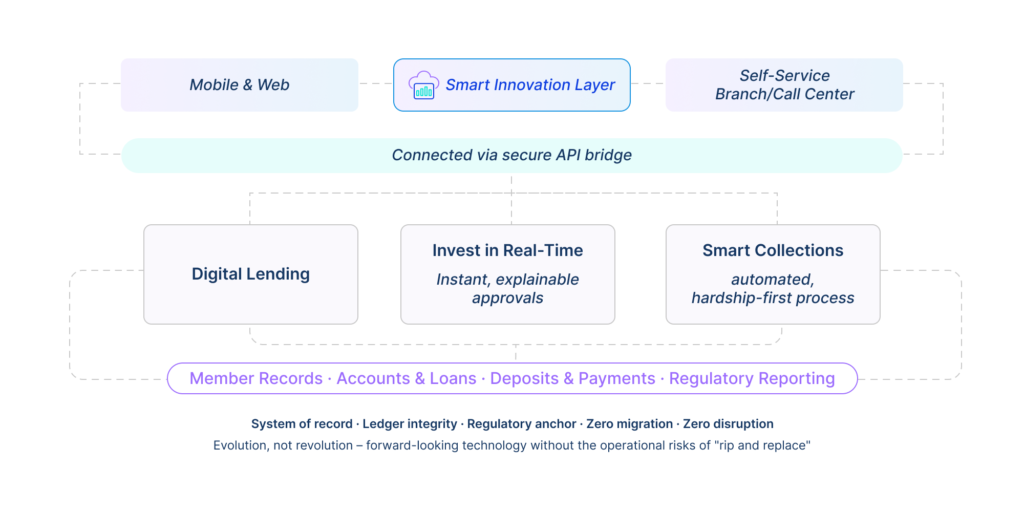
Avoid the big bang approach
Large scale transformation projects often introduce unnecessary risk.
Many successful institutions instead pursue phased modernization strategies that deliver incremental value while reducing disruption.
Focus on high impact areas first
Leaders increasingly prioritise:
- Lending
- Member onboarding
- Workflow automation
- Data integration
- Digital engagement
These areas typically deliver measurable returns while creating momentum for broader initiatives.
Build flexibility into the operating model
Modern architectures allow institutions to add capabilities gradually rather than committing to massive replacement projects.
This approach supports credit union digital transformation while protecting operational stability and member trust.
Most importantly, it gives institutions the flexibility to adapt as market conditions continue to evolve.
Independence through modernization
The future presents a significant opportunity for credit unions willing to embrace change with confidence.
Advances in automation, data intelligence, and AI are helping institutions operate with a level of speed, agility, and efficiency that was once reserved for the largest financial organizations. Success is no longer defined solely by size. It is increasingly determined by an institution’s ability to deliver exceptional member experiences, make smarter decisions, and adapt quickly to changing market conditions.
The credit unions that thrive in the years ahead will be those that build connected operating models where lending, decisioning, servicing, risk management, and recovery work together seamlessly. This not only improves operational efficiency but also creates stronger member relationships and a more resilient foundation for growth.
As modernization efforts mature, many institutions are moving away from isolated systems and toward unified platforms that support the entire credit lifecycle. This approach reduces complexity, accelerates innovation, and enables organizations to evolve without disruptive transformation programmes.
Supporting this shift, ezee.ai brings together AI powered loan origination through lend.ezee, governed credit decisioning through decision.ezee, and intelligent collections through collect.ezee within a connected ecosystem designed for modern financial institutions. By enabling faster execution, greater operational control, and more intelligent lending journeys, it helps institutions modernize strategically while preserving the values and member focus that define the credit union model.
The future will not belong simply to the largest institutions.
It will belong to those that can combine trust, innovation, and adaptability to create lasting value for their members.
For credit unions, modernization is no longer just a response to industry change. It is a pathway to sustainable growth, stronger competitiveness, and enduring independence.
Frequently Asked Questions
Credit union consolidation is the reduction of independent credit unions through mergers, driven by scale demands, technology investment pressure, and competitive positioning. The NCUA approved 157 mergers in 2025, with 2026 projected to exceed 200 the highest in a decade as rising tech costs and succession gaps accelerate strategic combinations.
Merging feels faster and cheaper than overhauling a decades-old core especially when leadership succession is thin. Yet 71% of recent mergers cited expanded services, not financial distress, as the primary driver, suggesting technology capability gaps not failure are increasingly pushing boards toward consolidation as the default resolution.
Consolidation combines two credit unions into one institution to gain scale; modernization upgrades a single credit union’s systems, processes, and digital lending capabilities without changing ownership. One achieves efficiency through structure; the other achieves it through technology while preserving member ownership, community identity, and local governance.
Credit unions preserve independence by automating manual workflows—loan origination, KYC verification, credit bureau pulls, and underwriting replacing headcount-driven operations with scalable technology. McKinsey identifies AI and data analytics as the primary levers, enabling lean teams to process higher loan volumes and respond to member needs at fintech-level speed.
Delayed modernization drives member attrition, inflates operational costs, and weakens the independence case. IDC reports legacy technology cost financial institutions $36 billion in 2022, projected to hit $57 billion by 2028, while McKinsey finds operational costs for legacy-core institutions run 10x higher than modern-platform peers.
A loan origination system (LOS) automates application intake, KYC, credit bureau pulls, underwriting decisions, and disbursal so a lean team manages volumes that previously required a larger institution’s headcount. This directly removes the staffing-pressure argument for merging, letting a credit union grow lending capacity without growing overhead.
Credit unions should look for a platform like ezee.ai that gives them control over underwriting, workflows, and integrations without forcing a core replacement. Key features include configurable rule-engine decisioning, bureau and identity API connectivity, automated KYC, and no-code changes so teams can adapt faster as products and policies continuously evolve
The NCUA succession planning rule (effective January 1, 2026) requires federally insured credit unions to maintain a board-approved written plan covering key positions, reviewed at least every 24 months. Boards should document CEO, CFO, and lending leadership roles, identify internal successors, and align succession timelines with technology modernization roadmaps.