
Credit unions understand the need for modernization. Members expect faster service, digital convenience, and seamless experiences. Leadership teams want greater visibility, stronger efficiency, and the ability to launch new products quickly. The challenge is not recognising the need for change. The challenge is determining how to achieve it without taking on excessive risk.
For years, modernization has been framed as a choice between maintaining outdated systems or replacing the core altogether. That assumption has created a transformation trap. Many institutions know they need to evolve, yet a full replacement programme often appears too expensive, disruptive, and difficult to justify.
The reality is that credit union innovation does not have to begin with a core replacement. A more practical approach is emerging: preserve the core where it delivers value while moving innovation to the edge through a banking orchestration layer and a composable banking architecture.
The Credit Union Modernization Paradox
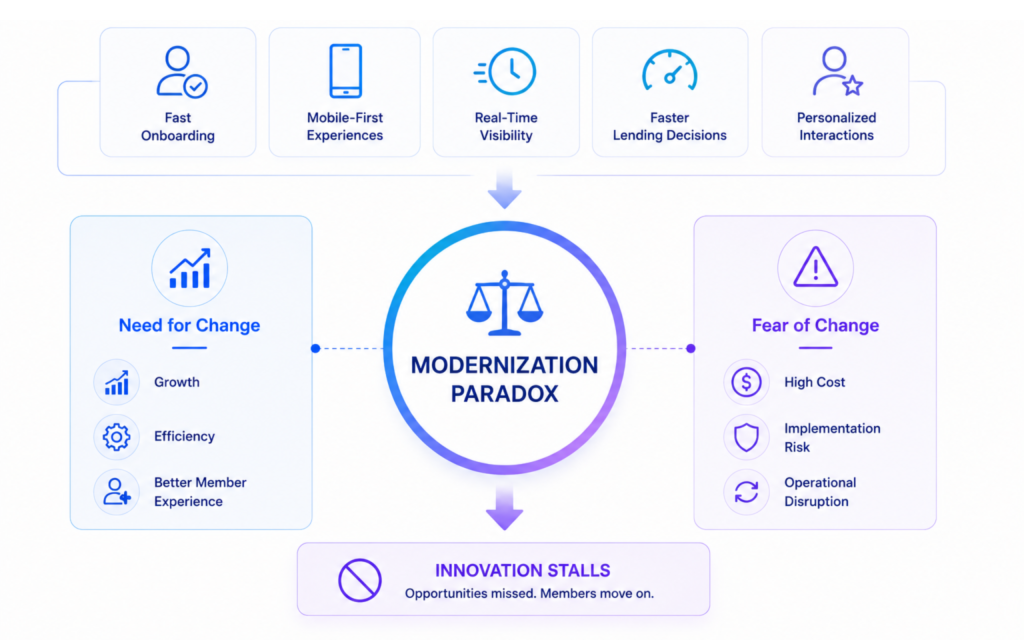
Member expectations have changed dramatically. Deloitte’s digital banking research notes that consumers increasingly benchmark financial experiences against the best digital interactions they encounter across all industries, raising expectations for speed, convenience, and personalization.
Consumers now compare every financial interaction against the best digital experiences available anywhere. They expect:
- Fast onboarding
- Real time visibility
- Mobile first experiences
- Faster lending decisions
- Personalised interactions
Yet many institutions still rely on platforms built decades ago.
Research consistently shows that legacy systems remain one of the biggest obstacles to digital transformation across financial services. While institutions recognise the need for change, large scale modernization projects often remain stuck in planning cycles because the perceived cost and risk outweigh the perceived benefits.
This creates a paradox.
Everyone agrees modernization is necessary, but the traditional path to modernization feels too difficult to pursue.
Why Legacy Core Banking Limitations Hold Innovation Back
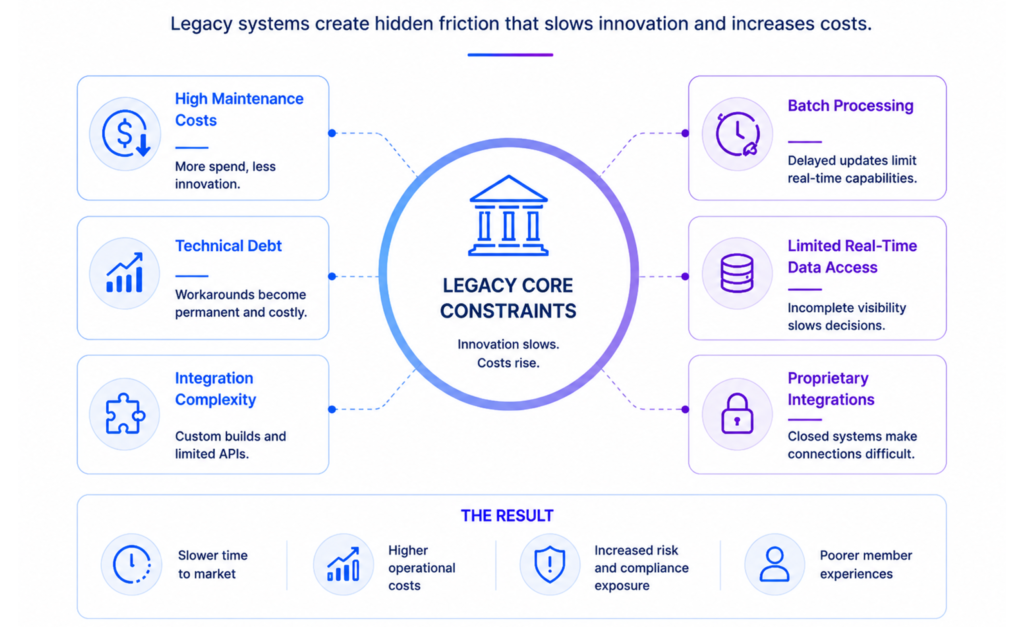
The biggest challenge is not always the technology itself. It is the operating model that develops around aging systems.
Maintenance Consumes Innovation Budgets
A significant portion of technology spending is often directed toward maintaining existing infrastructure.
As a result:
- Less funding remains for innovation
- Product improvements are delayed
- Digital initiatives compete with maintenance priorities
Over time, technology debt becomes a hidden tax on growth. McKinsey estimates that technology debt can represent 20% to 40% of the value of an organisation’s technology estate, making it one of the largest barriers to modernization and innovation.
Technical Debt Becomes Business Debt
Many institutions compensate for system limitations through manual processes, spreadsheets, and workarounds.
What begins as a temporary solution gradually becomes permanent infrastructure.
Common legacy core banking limitations include:
- Batch processing
- Limited real time data access
- Proprietary integrations
- Rigid workflows
These constraints reduce operational agility and make innovation more difficult.
Integration Complexity Slows Progress
Modern financial ecosystems depend on APIs and interconnected platforms.
However, integrating fintech solutions into legacy environments often requires:
- Custom development
- Extensive testing
- Ongoing maintenance
Instead of enabling innovation, technology teams become trapped managing integrations.
The Real Cost of Vendor Lock In and Delay
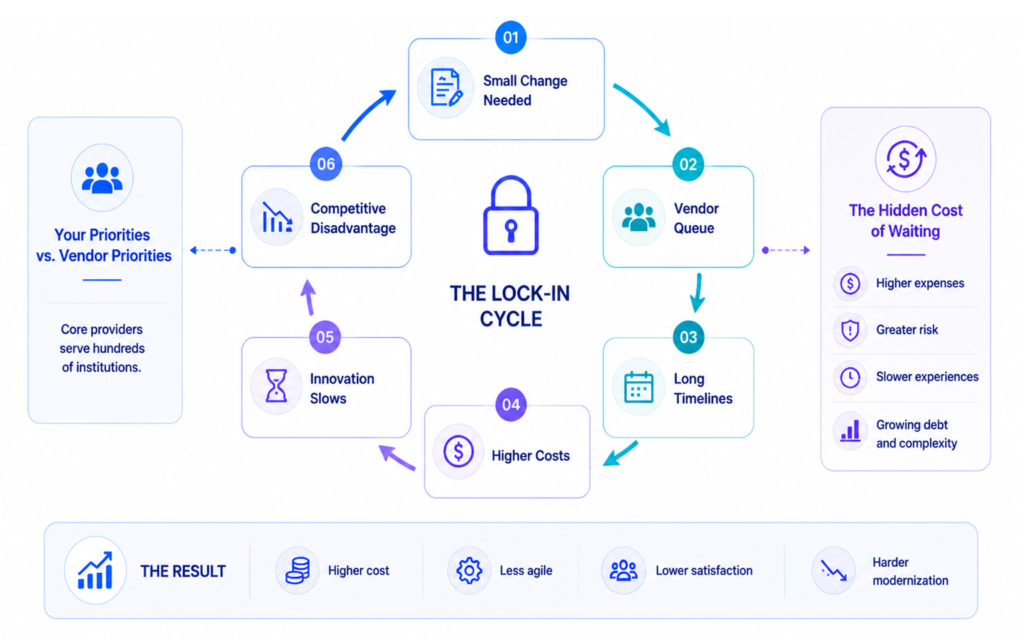
Technology constraints are often reinforced by vendor lock in.
Many institutions discover that even small changes require:
- Formal change requests
- Professional service engagements
- Long implementation timelines
- Additional costs
This creates what many leaders describe as a “change request economy.”
When every improvement becomes a project, innovation slows naturally.
Your Priorities Are Not Always Vendor Priorities
Core providers serve hundreds of institutions simultaneously.
As a result, their roadmaps are designed around broad market demand rather than individual credit union strategies.
This creates friction between institutional goals and vendor timelines.
Waiting Is More Expensive Than It Appears
Delaying modernization often feels like the safer option.
In reality, waiting creates costs of its own:
- Higher operational expenses
- Greater complexity
- Increased compliance risk
- Slower member experiences
Every year of delay allows technical debt to grow.
The eventual modernization effort becomes larger, more expensive, and more difficult to execute.
Keep the Core, Move Innovation to the Edge
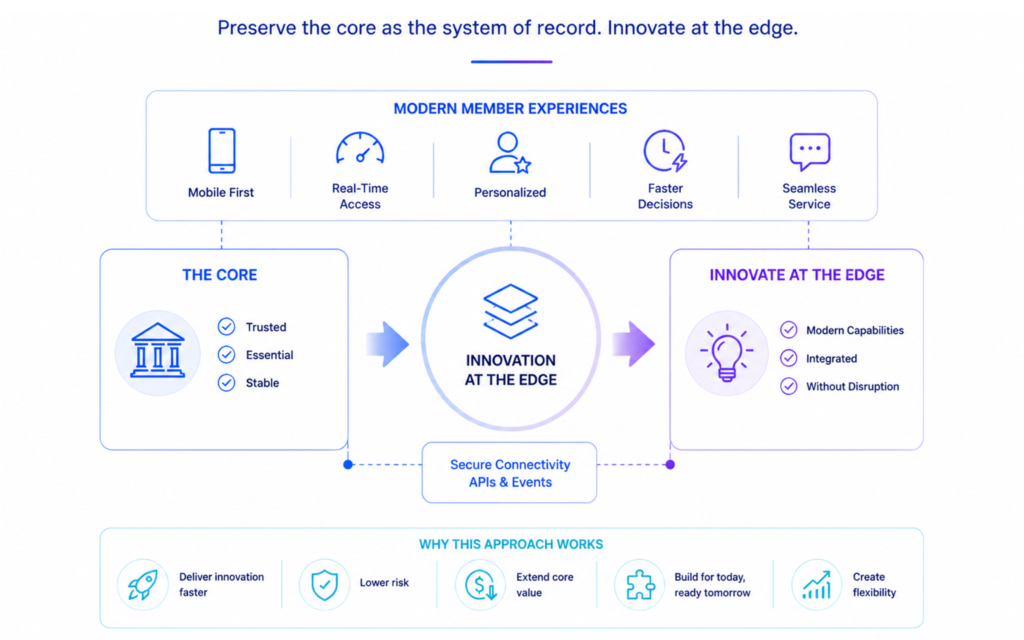
Modernization does not have to start with replacement.
A growing number of financial institutions are embracing a different model: keep the existing core as the system of record while introducing a digital layer above it.
This approach allows institutions to modernize experiences without disrupting critical systems.
The core continues to manage:
- Accounts
- Ledger functions
- Compliance reporting
- Transaction processing
Meanwhile, innovation occurs through an overlay architecture that sits above existing systems.
This is where a composable banking architecture becomes valuable.
Instead of relying on a single monolithic platform, institutions can assemble capabilities around the core while maintaining stability.
Why This Approach Works
Modernizing at the edge allows credit unions to:
- Improve member experiences quickly
- Reduce implementation risk
- Extend the life of existing investments
- Build future flexibility
Most importantly, it creates progress within months rather than years.
How a Banking Orchestration Layer Changes the Game
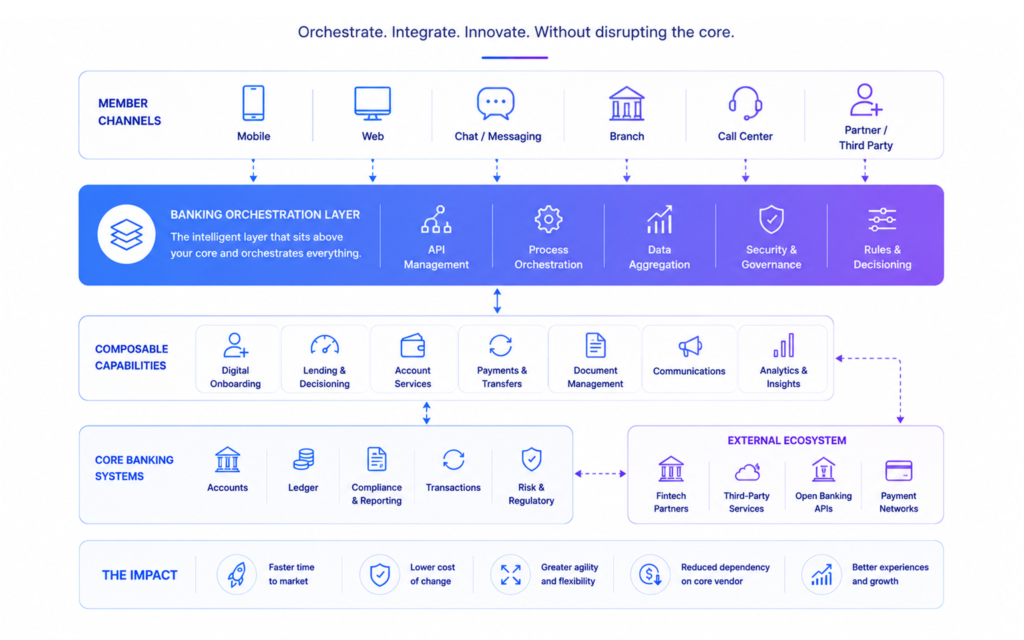
A banking orchestration layer acts as the connective tissue between systems, workflows, channels, and data.
Rather than replacing technology, it coordinates technology.
This creates a more flexible operating environment that supports ongoing credit union innovation.
Faster Journey Design
With an orchestration layer, institutions can redesign critical journeys such as:
- Digital account opening
- Consumer lending
- Loan servicing
- Collections
Changes can be configured without extensive development cycles.
Better Workflow Automation
Manual handoffs remain a major source of inefficiency.
Workflow orchestration helps automate:
- Document collection
- Verification processes
- Decision routing
- Case management
This improves speed while reducing operational effort.
Stronger Data Visibility
One of the biggest advantages of a banking orchestration layer is visibility.
Institutions can track:
- Journey completion rates
- Process bottlenecks
- Approval times
- Member engagement metrics
This turns modernization into a measurable business initiative rather than a technology project.
Easier Fintech Integration
A composable banking architecture also makes it easier to connect with external partners.
Instead of creating multiple point to point integrations, institutions can plug fintech capabilities into a common orchestration framework.
This reduces complexity and improves scalability.
Governance, Agility, and Phased Core Modernization
One concern often raised about modernization is governance.
Financial institutions cannot sacrifice control for speed.
The strongest modernization strategies balance both.
Technology teams continue managing:
- Security
- Architecture
- Integration standards
- Compliance controls
Business teams gain the ability to improve journeys and workflows within approved guardrails.
This creates governed agility rather than uncontrolled change.
Why Phased Core Modernization Makes Sense
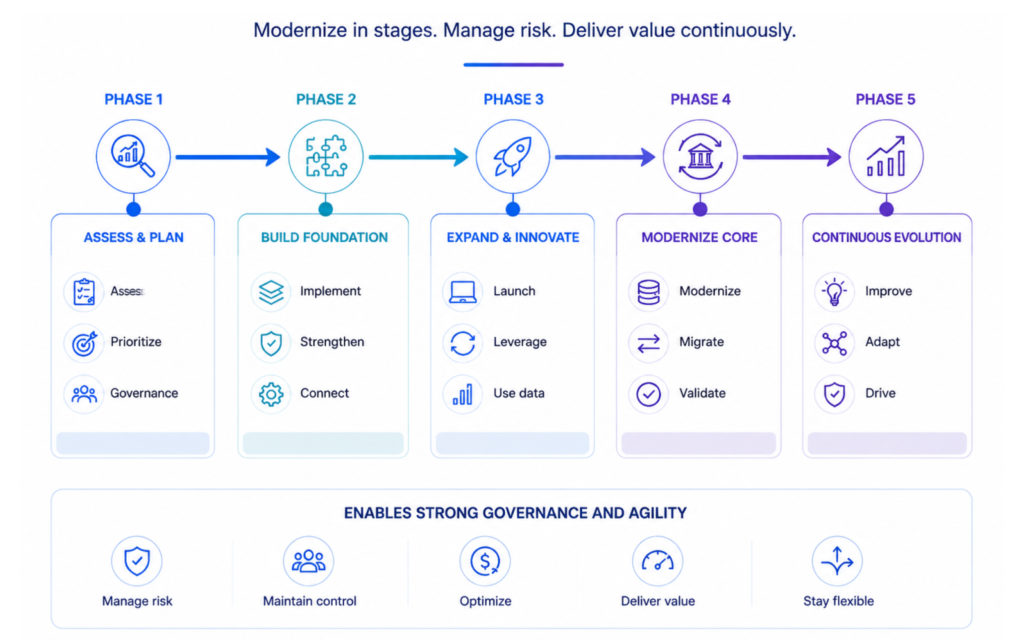
Rather than pursuing a large scale transformation programme, institutions can modernize in stages.
A phased core modernization strategy typically begins with high friction areas such as:
- Lending
- Onboarding
- Credit decisioning
- Servicing operations
Each phase delivers measurable results before the next investment is made.
This reduces risk while building confidence across leadership teams.
Modernization Without Losing Independence
The pressure to achieve scale continues to increase across the credit union sector.
Many institutions pursue mergers to gain access to technology resources and operational efficiencies.
While consolidation may be appropriate in some situations, it is not the only path forward.
Smart modernization offers another option.
By adopting a composable banking architecture and modern orchestration capabilities, institutions can:
- Improve digital experiences
- Increase operational agility
- Reduce dependence on legacy vendors
- Strengthen competitiveness
Technology strategy increasingly influences institutional independence.
The institutions that modernize effectively gain greater flexibility in determining their future.
A Practical Path Forward
The most successful modernization initiatives do not begin with a core replacement.
They begin with solving specific business problems.
Start with one or two journeys that create the greatest friction for members and employees. Focus on measurable outcomes such as faster approvals, better onboarding experiences, improved efficiency, or stronger visibility.
From there, build momentum through phased core modernization rather than a single high risk transformation programme.
This is where ezee.ai naturally fits into the conversation. As a digital orchestration layer, it enables institutions to modernize lending, credit decisioning, loan management, and debt collection journeys without forcing an immediate core replacement. Through AI powered automation, workflow orchestration, and intelligent decisioning, financial institutions can improve execution speed while preserving existing investments.
The future of credit union innovation is not defined by how quickly an institution replaces its core. It is defined by how effectively it removes friction, improves experiences, and builds the flexibility needed to adapt to changing member expectations.
For most credit unions, the smartest modernization strategy is not replacing everything at once. It is modernizing what matters most today while creating the foundation for tomorrow.
Frequently Asked Questions
Many credit union transformation programs miss measurable results because they fund technology before they define journey KPIs, governance, and adoption metrics. In banking, only about 30% of digital transformations fully succeed; fragmented architecture, weak business-IT alignment, and poor impact tracking are recurring causes.
A phased, journey-led approach reduces risk by isolating one member journey at a time, like onboarding, auto loans, or collections, instead of changing everything at once. Banking programs using staged modernization have cut time to market by about 20%, while regulators also endorse controlled pilots before full-scale rollout.
Credit unions can innovate faster by layering modular digital workflows and APIs on top of the core rather than replacing the ledger first. That lets teams launch onboarding, underwriting, or servicing journeys in weeks, and one banking case linked modernization to 20% faster product time-to-market.
The biggest hidden costs are slower product launches, higher servicing expense, and rising member attrition when digital journeys stay clunky. One banking transformation cut branch and contact-center costs by 25%; delaying similar changes usually means carrying manual work, duplicate systems, and avoidable abandonment longer.
Early indicators are faster release cycles, higher digital adoption, lower manual exceptions, and clearer KPI ownership by journey. In one banking case, digital customer share doubled to 60% as transformation took hold; for lending teams, the equivalent signals are quicker application decisions and fewer handoffs.
Governance enables innovation by setting decision gates, owners, and risk controls before pilots sprawl into unmanaged exceptions. Regulators support pilot programs because early input and controlled testing improve controls before full rollout; in practice, launch, mid-pilot, and scale-or-stop gates usually keep work disciplined.
Credit unions scale innovation by reusing the same orchestration, data, and decision components across journeys instead of rebuilding each use case. Shared APIs for KYC, bureau pulls, and rule-engine decisions make onboarding, underwriting, servicing, and collections repeatable, and one banking case tied this model to 20% faster time-to-market.
Credit unions should look for platforms like ezee.ai when the core is stable but member journeys, integrations, or policy changes still take too long to launch. The right fit should offer APIs, configurable workflows, and rule engines that accelerate delivery; banking modernization has been associated with roughly 20% faster launches.
Credit unions reduce vendor lock-in by decoupling channels, workflows, and decisioning from the core while keeping the core as system of record. API-first layers let teams replace services incrementally, not in a big-bang rewrite; that matters because only about 30% of banking digital transformations fully succeed.
No-code orchestration platforms such as ezee.ai help credit unions launch digital journeys faster by letting business teams configure workflows, rules, and integrations without waiting on custom development. That makes onboarding, origination, bureau checks, document collection, and collections easier to roll out, and banking modernization has been linked to about 20% faster time-to-market.